
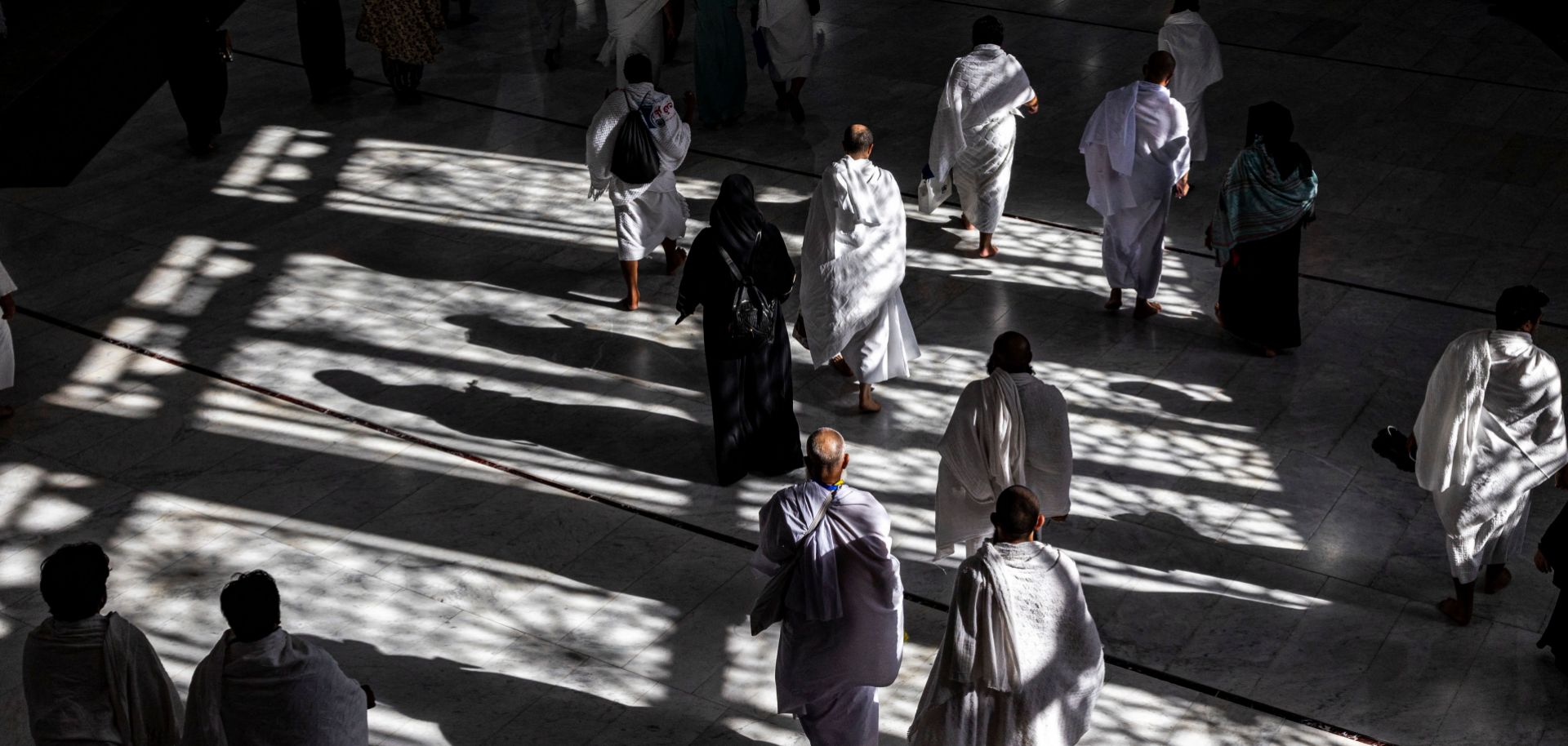
Muslim pilgrims walk at the Grand Mosque in Saudi Arabia's holy city of Mecca on July 6, 2022 during the annual hajj pilgrimage.
New COVID-19 variants and global economic uncertainty could force Saudi Arabia to recalibrate its tourism development strategy, potentially leaving ongoing projects and plans either abandoned or delayed. Saudi Arabia’s post-pandemic hajj season is underway, with a reported 1 million foreign and domestic pilgrims visiting Mecca for the pilgrimage ahead of Eid al-Adha, which begins July 8. These numbers are an improvement from 2020 and 2021, when only 1,000 and 60,000 pilgrims were allowed to visit Mecca for the annual pilgrimage, respectively. But 1 million is still a far cry from the 2.5 million hajj pilgrims that Saudi Arabia welcomed in 2019 — due in part to continued COVID-19 restrictions, which include testing and vaccine requirements, capacity limits and age limits.
- Hajj is a major driver of tourism for Saudi Arabia and supports thousands of jobs around the country. The $12 billion generated by the 2019 hajj pilgrimage, for example, made up roughly 3.5% of Saudi Arabia’s non-oil revenue that year.
- Boosting religious tourism is also a major goal of Vision 2030, with Riyadh aiming to attract some 30 million pilgrims for hajj by the end of that year. Saudi Arabia wants to convert these pilgrims into regular tourists for the country as well as part kingdom’s long-term strategy to diversify its economy away from oil.
- Saudi Arabia was initially very concerned about the health impacts of COVID-19, given that many of its citizens have comorbidities like hypertension that increases the risk of severe infection. This saw Riyadh take a strict approach to containment in 2020 and 2021 (including restricting foreign arrivals for the annual hajj pilgrimage), as the monarchy saw the spread of a deadly virus as a more immediate challenge to their legitimacy than the prospect of derailing Vision 2030 goals. But with the majority of Saudis now vaccinated and/or able to access new COVID-19 treatments, Riyadh is less concerned about the impact of a hajj-induced spike in infections and is, in turn, taking a more relaxed approach to this year’s pilgrimage by dropping mask mandates and loosening travel restrictions.
Despite the modest number of visitors in 2022, there is likely pent-up travel demand for the annual hajj pilgrimage, which could enable Saudi Arabia to capitalize on a larger hajj season next year. Pilgrims often save up for years before traveling to Mecca for the hajj, which for many is a once-in-a-lifetime experience. This means that pilgrims who planned on going in 2020-22 probably still have both the savings and intent to visit Mecca once Saudi Arabia opens up enough visas. With increased access to both vaccines and COVID-19 therapies that reduce the risk of severe infection, Riyadh could relax its restrictions further next year by easing testing, vaccine, or age requirements. The kingdom could also increase the number of visas up to and potentially even beyond the 2.5 million visitors who traveled to Saudi Arabia for the hajj pilgrimage in 2019.
- Saudi Arabia is also boosting its conventional tourist sector, aiming for 70 million visitors this year from 19.8 million in 2019, some of whom are regional and domestic tourists. This sector is rapidly growing, as Saudi Arabia only began offering non-hajj tourist visas in 2019.
- Because of this growth, Saudi Arabia’s ability to host more pilgrims has also increased, with the construction of more hotels and amenities. The kingdom has also eased social restrictions to attract more tourists from different cultures and areas of the world.
However, the emergence of more deadly variants of COVID-19 or a longer-than-expected global economic slowdown could still derail Saudi Arabia’s tourism strategy, exposing investors to losses and causing the government to again reframe its goals for Vision 2030. Riyadh’s perception of the threat of COVID-19 to its legitimacy as a steward of public health has changed because treatments have improved. But the potential emergence of a new variant that reduces the effectiveness of vaccines and treatments could still force Saudi Arabia to impose tough restrictions again. The loss of tourism and business activity would slow the kingdom’s progress toward building a post-hydrocarbon economy. However, the revenue Riyadh is racking up from the current surge in global oil prices would help soften the economic and political blow of another COVID-19 shutdown. But even if Saudi Arabia is able to keep its doors open, the state of the global economy could still dampen tourism rates, with fuel prices making flights unaffordable, and commodity and price shocks causing some visitors to use up their hajj savings at home rather than travel abroad. Lower-than-expected tourism revenue could cause Saudi Arabia to reduce its Vision 20230 goals, potentially leading to abandoned projects, failed ventures and unfinished construction.
- Many countries around the world are currently seeing another surge in COVID-19 cases, fueled by a fast-spreading new subvariant of Omicron known as BA.5. The new strain is highly contagious and is able to bypass immunity created by vaccines and previous infections, including infections from earlier Omnicron subvariants. In the wake of this new surge, neighboring Abu Dhabi in the United Arab Emirates has recently started reimposing COVID-19 restrictions; Abu Dhabi’s risk aversion during the pandemic mirrored that of Saudi Arabia’s, though Riyadh has not yet imposed new restrictions in response to the new BA.5 threat.
- In the United States, Florida and other states with popular tourism destinations have already begun seeing a drop-off in visitors amid growing concerns of a looming economic recession and inflation-induced increases in travel costs. Some major sources of hajj pilgrims like Egypt, Indonesia and Turkey are also grappling with economic challenges that are making citizens hesitant to use their savings on a trip abroad to Saudi Arabia.
- Saudi Arabia has changed some of its development goals in the past. It aimed for a fiscal surplus by 2020. But only now in 2022, led by high oil prices, does the kingdom appear ready to achieve that goal. Jeddah Tower, touted to be the world’s tallest building when completed, has already missed its 2020 completion target as the kingdom’s infrastructure goals appeared to shift to other projects, like the megacity NEOM.
