
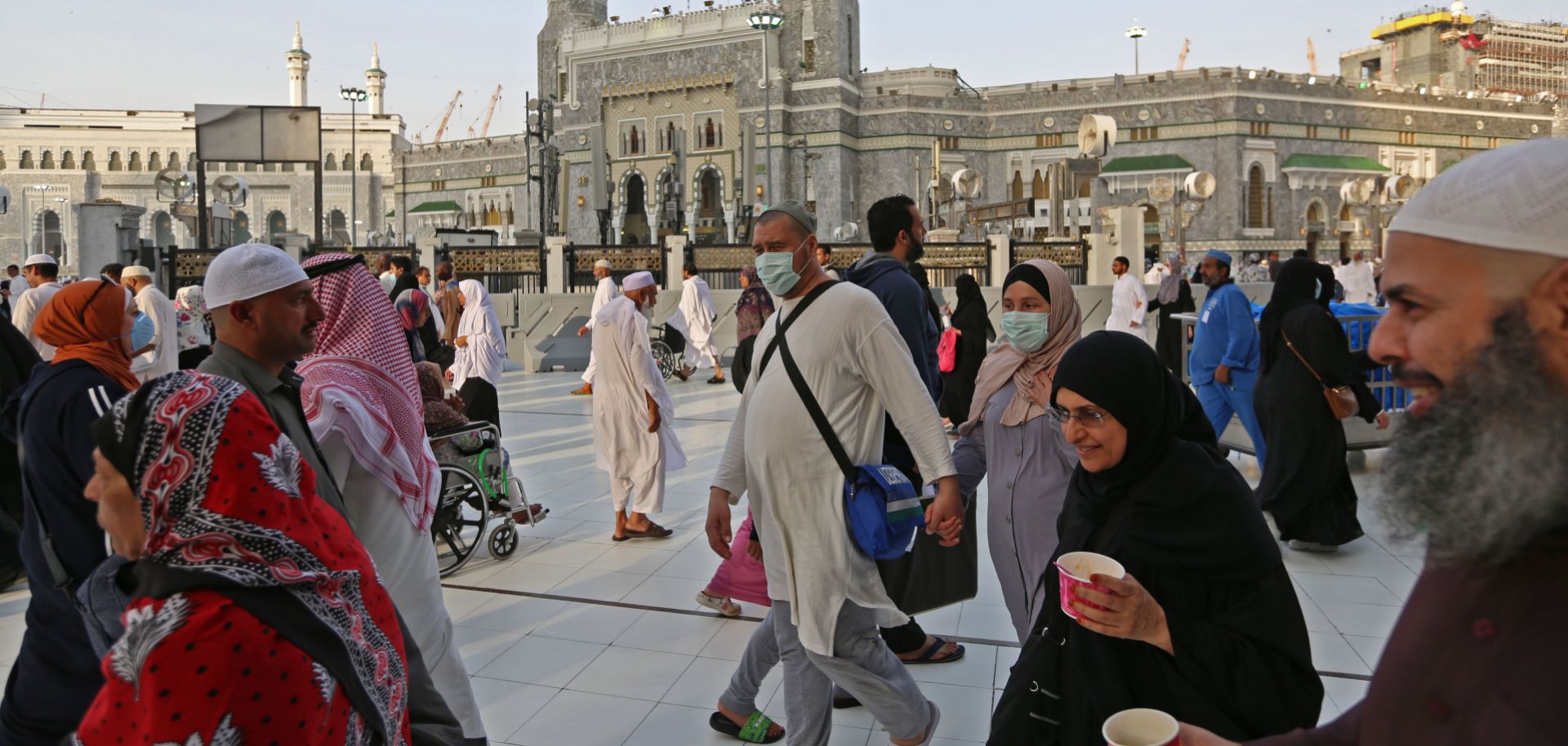
Muslim pilgrims wear masks at the Grand Mosque in Saudi Arabia's holy city of Mecca on Feb. 28, 2020.
The key takeaway: Saudi Arabia will try to simulate key aspects of its tourism industry to offset the damage from this year's canceled hajj and limited umrah pilgrimages due to the COVID-19 pandemic. But even with this added support, Riyadh will still miss Vision 2030 goals in the sector, leaving the kingdom reliant on oil income well into the global energy transition.
The Price of Pilgrimage Cancellations
Saudi Arabia will very likely suspend foreign arrivals for the annual hajj pilgrimage to prevent future COVID-19 outbreaks among the country's health-compromised population. Saudi Arabia is concerned about the health impacts of COVID-19, given that many of its citizens have comorbidities: 40 percent of Saudis are obese, 17.9 percent have diabetes and 15 percent have hypertension.
- Riyadh has already prepared its public for the possibility of canceling hajj already through its state-run media platforms.
- The kingdom has also severely limited public access to the Kaaba, the holiest site in Islam, since February.
Canceling the hajj pilgrimage, however, will set back the kingdom's Vision 2030 goal to boost its tourism revenue, which is a central objective for the kingdom's greater non-oil diversification goals. Private investors will likely freeze their commitments to these sectors until it becomes clear when the COVID-19 restrictions might be lifted.
- Pilgrimages accounted for roughly 7 percent, or $12 billion, of Saudi Arabia's non-oil GDP in 2019. Under its Vision 2030 plan, Riyadh aimed to increase this revenue by having the umrah pilgrimage bring in 15 million tourists per year by 2022 and 30 million by 2030.
- The closures also come just as Saudi Arabia had begun welcoming non-religious tourists to the kingdom, another major Vision 2030 goal. Prior to the COVID-19 outbreak, 25.8 million tourists and pilgrims were initially expected to visit Saudi Arabia this year, according to the Saudi Information Center for Research on Tourism. But instead, the kingdom has seen virtually no foreign visitors.
Stop-Gap Measures
In order to capitalize on the expected post-pandemic tourism surge, Saudi Arabia will continue to use its Public Investment Fund (PIF) to bankroll tourism infrastructure developments that are slated to launch within the next two years.
- The Red Sea Project, a vast series of tourist attractions being built up along the Saudi coast, is not scheduled to begin opening until 2022 (past the point of a theoretical COVID-19 vaccine), and is thus likely to see continued funding.
- NEOM — the $500 billion "mega-city" project on the northwest Saudi border near Jordan, Israel and Egypt — is also slated to open post-pandemic. This, combined with the fact that the project is one of Crown Prince Mohammed bin Salman's top political priorities, means it will likely continue to enjoy PIF backing as well. But the proposed city's remote location and unknown attractiveness as a place to live, as well as the slow pace of economic restructuring inside Saudi Arabia, will likely still hinder the project's overall success.
- The PIF will likely delay investments in newer projects designed to build up the tourist sector to preserve capital until the global economic situation begins to improve. This lack of new funding will further impede Saudi Arabia's overall strategy to build a vibrant hajj and secular tourist industry by 2030.
Saudi Arabia will also likely provide loans to or bailouts for tourism-related industries and businesses directly affected by the COVID-19 crisis and pilgrimage cancellations.
- Saudi Arabia's national airline carrier Saudia is likely to enjoy some state support to help keep it afloat for the post-pandemic recovery. But the government aid won't be enough to fully offset the airline's loss of revenue, meaning layoffs and budget cuts remain likely.
- To curb the immediate blow of the economic fallout, individual hotels, restaurants and local businesses, particularly in the holy cities of Mecca and Medina, will likely also see waivers on fees and licensing requirements, as well as potentially more generous state-backed loans and potential direct stimulus. These efforts, however, are unlikely to be enough to ensure all businesses and jobs survive the crisis. As a result, Saudi Arabia's tourism sector will shrink as a percentage of GDP this year.
Municipal and provincial budgets in regions dependent on revenue generated by the hajj pilgrimage may also see direct boosts from the national treasury to help absorb potential new waves of unemployment and bolster local businesses. Specifically, Saudi Arabia may supplant the tourist-reliant economies of Mecca and Medina with further direct payments to their local budgets.
- Pilgrimages account for roughly 25-30 percent of Mecca and Medina's economies.
- Payments to these cities could be used for a variety of localized stimulus, including loans, hiring new workers on city and provincial payrolls, and direct payments to citizens.
- Such stimulus efforts, however, could impede state strategies designed to reform the kingdom's current public welfare system by creating new expectations for Saudis to see continued government support. Some residents in these cities may try to remain on these benefits for as long as possible, thus setting back Riyadh's efforts to nationalize some business sectors by hiring more Saudi workers.
No Tourists, No Money
But these efforts will only address the supply side of hajj and umrah tourism, and not the demand, as COVID-19 travel restrictions around the world keep Muslims home. Even if the pandemic eases in the latter part of the year to allow the umrah pilgrimage to begin, Saudi Arabia will still struggle to convince Muslim countries to allow their citizens to participate in hajj and umrah this year until a vaccine emerges and is widely distributed.
- Some national governments, including Indonesia and Malaysia, have already banned travel to Saudi Arabia for the hajj pilgrimage this summer.
- Other countries with large Muslim populations, such as Pakistan, India and Egypt, may also decide to limit or suspend religious travel to the kingdom this year, and potentially even longer, for fear of having their citizens infected with COVID-19 in the densely packed mosques and holy sites of Mecca and Medina.
Pandemic-induced economic downturns will make it harder for pilgrims worldwide to save and afford a trip to Saudi Arabia for hajj or umrah. Riyadh will remain sensitive to these challenges, adjusting policy and fiscal stimulus to keep its tourism sector — as well as its larger economic diversification plans — alive. But a sustained recovery is unlikely without a COVID-19 vaccine, limiting Saudi revenue from tourism well into 2021.
