
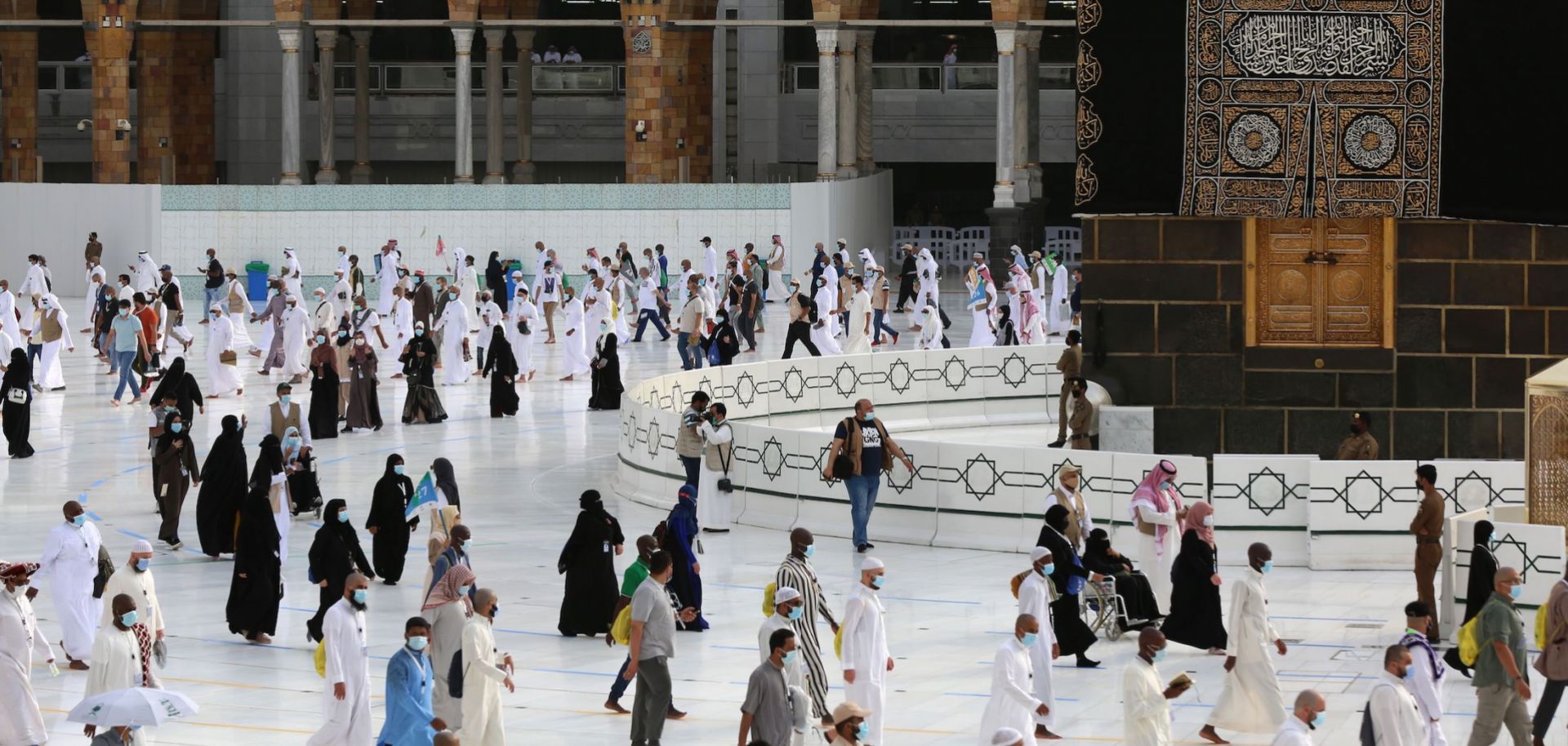
Hajj pilgrims gather around the Kaaba in the holy city of Mecca, Saudi Arabia, on Aug. 2, 2020.
Saudi Arabia is trying to set up its tourist industry for success ahead of this year’s hajj pilgrimage, but hitting pre-pandemic numbers isn’t likely until vaccine distribution increases in the Muslim world, slowing the kingdom’s economic recovery while stalling its Vision 2030 development trajectory. On March 9, Saudi King Salman approved a series of measures designed to help restart the kingdom’s dormant hajj economy ahead of the annual pilgrimage, which this year will take place in July. The measures include easing fees for companies, residents and transport that rely on the annual hajj pilgrimage for income. This indicates that Saudi Arabia is preparing to restart its religious tourism industry after a quiet 2020, in which annual numbers of hajj pilgrims tumbled from 2.5 million in 2019 to only a few thousand.
COVID-19’s impact on tourism, and particularly hajj tourism, is sapping a major source of revenue key to Saudi Arabia’s strategy to diversify away from oil. Saudi Arabia aims to attract 100 million tourists a year by 2030 and employ around 1.2 million Saudis in the industry, up from 900,000 today. This strategy includes increasing tourism for the seasonal hajj pilgrimage, as well as the year-round umrah pilgrimages. It also includes developing luxury accommodations near Saudi Arabia’s historical sites and coasts to attract more secular tourists. Management of the yearly hajj pilgrimage is a major source of the Saudi monarchy’s religious and political legitimacy and a point of national pride for Saudis as well.
- The $70.9 billion generated by the 2019 hajj pilgrimage made up 8% of Saudi Arabia’s total GDP that year, and roughly 20% of the kingdom’s total non-oil revenue.
- A high but yet-to-be-determined number of expatriates also left the kingdom during the COVID-19 pandemic, removing some of the experienced workers in Saudi Arabia’s tourist industry. It is not yet clear how many will return.
Saudi Arabia is likely to deepen its incentives for pilgrims to return to the kingdom, as well as for investors and workers to restart its tourist industry, to prevent its Vision 2030 tourism strategy from stagnating further. Currently, Saudi Arabia is maintaining strict border controls to control further COVID-19 transmissions, but Riyadh may weaken these controls to allow in vaccinated pilgrims. The kingdom may also bolster its ongoing COVID-19 economic stimulus program to stabilize the tourism industry during the ongoing recovery period.
- Since COVID-19 began, the Saudi government has announced $61 billion in stimulus for the private sector, including a wage subsidy of 60% for Saudi employees, in an attempt to keep key industries like tourism ready for the post-COVID-19 recovery.
But such efforts are unlikely to have a major impact on this year’s hajj pilgrimage, as vaccine shortages and dysfunctional healthcare systems continue to hamper inoculation campaigns across the Muslim world. Of the 2.5 million tourists who visited Saudi Arabia in 2019, the vast majority (approximately 83%) came from Asian, African and non-Gulf Cooperation Council countries. This includes Malaysia, Indonesia, Pakistan and India, where vaccine rollouts are currently lagging.
- As of March 8, Bangladesh, home to 152 million Muslims, was only 2% vaccinated. Indonesia, meanwhile — the largest source of hajj pilgrims in 2019 — was only 1.1% vaccinated.
To lure back tourists, there’s a chance Saudi Arabia could offer vaccines to new pilgrims. Riyadh may even adjust its own risk tolerance for unvaccinated tourists as the Saudi population itself becomes inoculated to avoid the greatest damage to its Vision 2030 tourism strategy. Saudi Arabia’s vast wealth allows it to purchase large quantities of vaccines. The kingdom’s COVID-19 vaccine strategy includes inoculating its estimated 10 million foreign residents, creating precedence for sharing vaccines with non-Saudis to improve the kingdom’s economic performance. Even beyond offering vaccines to foreigners both at home and abroad, Saudi Arabia’s restrictive approach to lockdowns and border controls is likely to ease as more of its population receiving the vaccine, where state-controlled media has helped build up public confidence to quickly inoculate.
- The United Arab Emirates is already experimenting with “vaccine tourism,” allowing a handful of wealthy tourists to visit and get a vaccine.
- For Riyadh to take advantage of the largest wave of pilgrims for hajj, the kingdom will need to implement policy by the summer, as religious holiday often begins by the middle of the July.
