
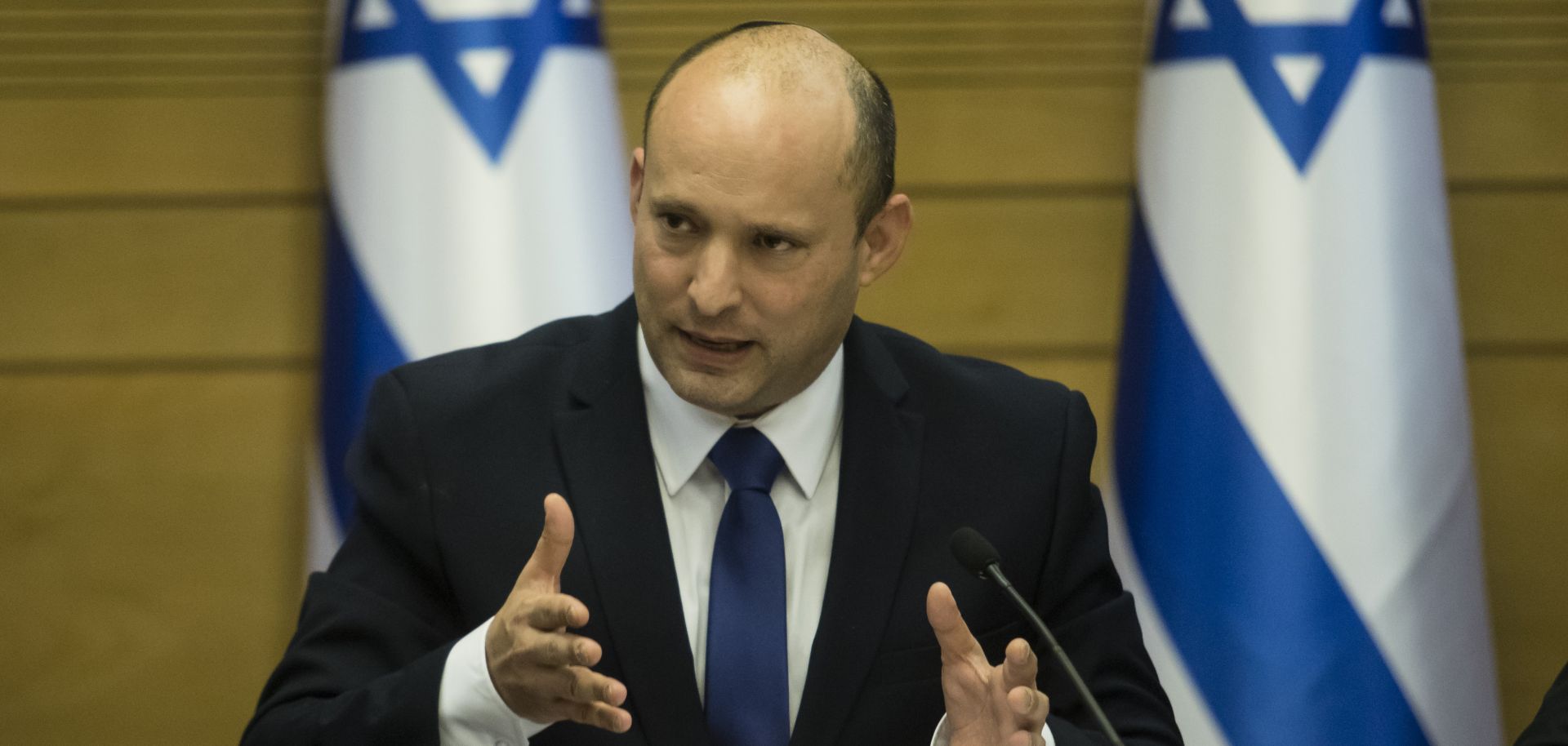
Naftali Bennett attends the first meeting of his new government on June 13, 2021, in Jerusalem.
Israel is coming under international pressure to engage in a fresh peace process with the Palestinians that could contribute to normalization with Gulf Arab states like Qatar, Saudi Arabia and Oman. The United States, Egypt, Jordan and the Palestinian Authority have all publicly stated they want a resumption of peace talks, and the Biden administration has reemphasized the White House's traditional commitment to the two-state solution after the mixed signals from former President Donald Trump about a future Palestinian state. Although Israeli Prime Minister Naftali Bennett himself has ruled out a Palestinian state, he has not conclusively ruled out peace talks. And he is under internal pressure from his coalition partners, like Defense Minister Benny Gantz and Foreign Minister Yair Lapid, to entertain the prospect of talks.
- Egypt, Jordan and the Palestinian Authority held talks Sept. 1 in Egypt to discuss ways to revive the peace process. On Sept. 11, Bennett became the first senior Israeli leader to visit Egypt in more than a decade, where he discussed the prospect of returning to peace talks with the Palestinians.
- On Aug. 29, Gantz held a rare direct talk with Palestinian President Mahmoud Abbas, the first such high-level Israeli contact with the authority in years. Gantz offered the Palestinian Authority a $155 million soft loan to help boost the authority's budget; the loan will be repaid in taxes Israel collects on the authority's behalf, thereby preventing debt from piling up.
Since the May 2021 war in Gaza, Israel has been shifting back to old tactics to prevent another major regional war in both the West Bank and Gaza Strip. In the West Bank, Israel is providing economic support to the Palestinian Authority, releasing taxes to the authority so it can pay civil servant salaries and trying to boost the region's economy and the Palestinian Authority's budget to reduce unemployment. In Gaza, Israel is providing steady Qatari financial aid and reconstruction materials to discourage militants from launching large-scale attacks, and while Israel's military has been quicker to use airstrikes in response to provocations than in the past, the strikes have been carefully calculated to avoid triggering a bigger escalation. Gantz has linked the Palestinian Authority's strength to Israel's strategy of isolating Hamas, saying that "the stronger the Palestinian Authority is, the weaker Hamas will be."
- The presence in the Israeli government of two parties that oppose settlement expansion (Ra'am, an Islamist party, and Meretz, an Israeli left-wing party) poses a political risk to rapid settlement construction, as either party leaving the coalition will cause the government's collapse.
- In August, Israel's Supreme Court delayed the evictions of Palestinians in restive neighborhoods in East Jerusalem. These evictions helped spark the protests that led to the May conflict in Gaza.
- The West Bank has seen a surge in anti-Israeli and anti-Palestinian Authority sentiment driven by the death of authority critic Nizar Banat in police custody, the collapse of the economy because of COVID-19 restrictions, the cancellation of scheduled elections and the Gaza war. This has influenced Israel's willingness to provide economic aid to the Palestinian Authority.
If Israel engages in peace talks with the Palestinians, it will boost support for normalizing relations in countries like Saudi Arabia, Oman and Qatar. But if peace talks do not happen, tensions with the Palestinians could spark another major conflict and push these Gulf Arab states away. Gulf Arab citizens pressure their governments against normalization with Israel in large part because of Israel's poor relations with the Palestinians. Many Gulf Arab citizens support a process that looks like the Arab Peace Initiative of 2002 that offered full recognition for Israel across the Arab world in exchange for a Palestinian state. While a Palestinian state remains improbable, Gulf Arab citizens would react favorably to peace talks that increase Palestinian rights. But given that anti-Palestinian state parties belong to the Israeli government, including the prime minister's Yamiona party, Israel might for domestic political reasons scuttle peace talks. If the Palestinians are left in diplomatic and political limbo, tensions will inevitably boil over, sparking another war that Gulf Arabs will react to negatively and hence freezing moves toward normalization.
- Covert ties between Saudi Arabia, Oman and Qatar on one side and Israel on the other continue to build, but public opinion in these Arab countries remains squarely against further normalization with Israel.
- While Emirati and Bahraini opinion was generally opposed to normalization as well, both governments pushed ahead with the policy anyway in part because of incentives offered by the Trump administration, such as approving the sale of the advanced F-35 to the United Arab Emirates. U.S. President Joe Biden is unlikely to offer new incentives for normalization given his political base is more critical of Israel's Palestinian policies than was Trump's base.
