
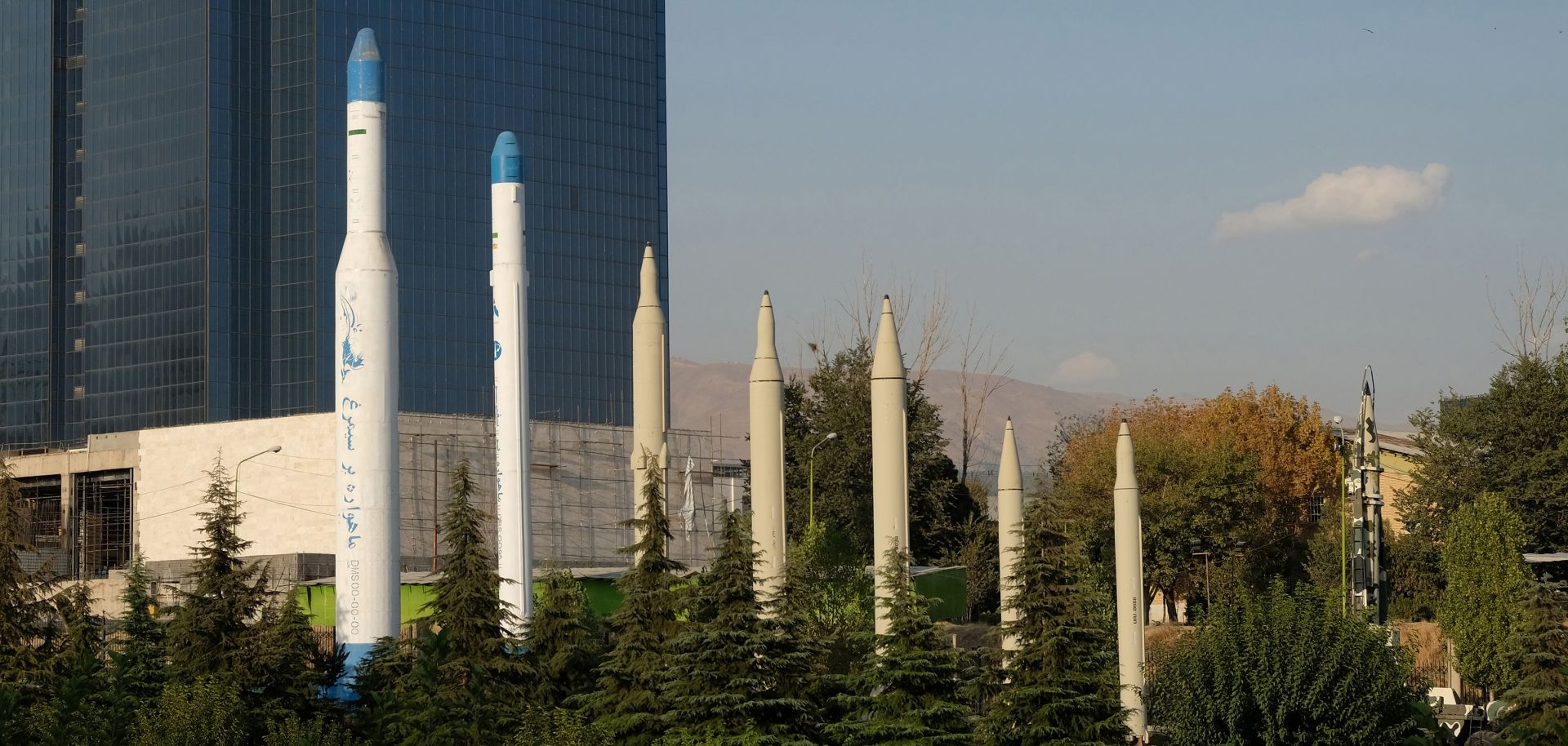
Iranian-made satellite carriers (left) and missiles (right) are displayed in front of the Holy Defense Museum in Tehran, Iran, on Sept. 20, 2020.
A U.S. plan for integrated air and missile defenses across the Middle East could eventually help countries in the region deter and intercept attacks by Iran and its proxies — a prospect that might entice Saudi Arabia to deepen ties with Israel. On June 9, a bipartisan group of U.S. lawmakers introduced the Deterring Enemy Forces and Enabling National Defenses (DEFEND) Act. The DEFEND Act aims to create an integrated air and missile defense (IAMD) system across U.S. allies and partners in the Middle East, covering Israel, Egypt, Jordan, Iraq and the Gulf Cooperation Council (GCC). The legislation would require the U.S. Department of Defense to lead the effort to establish an IAMD system to defend against Iranian and Iranian-backed militia missile, rocket and drone attacks.
- Many of the countries the legislation aims to integrate already have U.S. defense systems deployed. The United Arab Emirates owns an advanced THAAD system. Saudi Arabia, Qatar, the United Arab Emirates, Bahrain, Egypt, Jordan, Iraq and Kuwait also all either own or host U.S.-run Patriot missile batteries, with other countries in the region still using the older U.S.-built HAWK surface-to-air missile system.
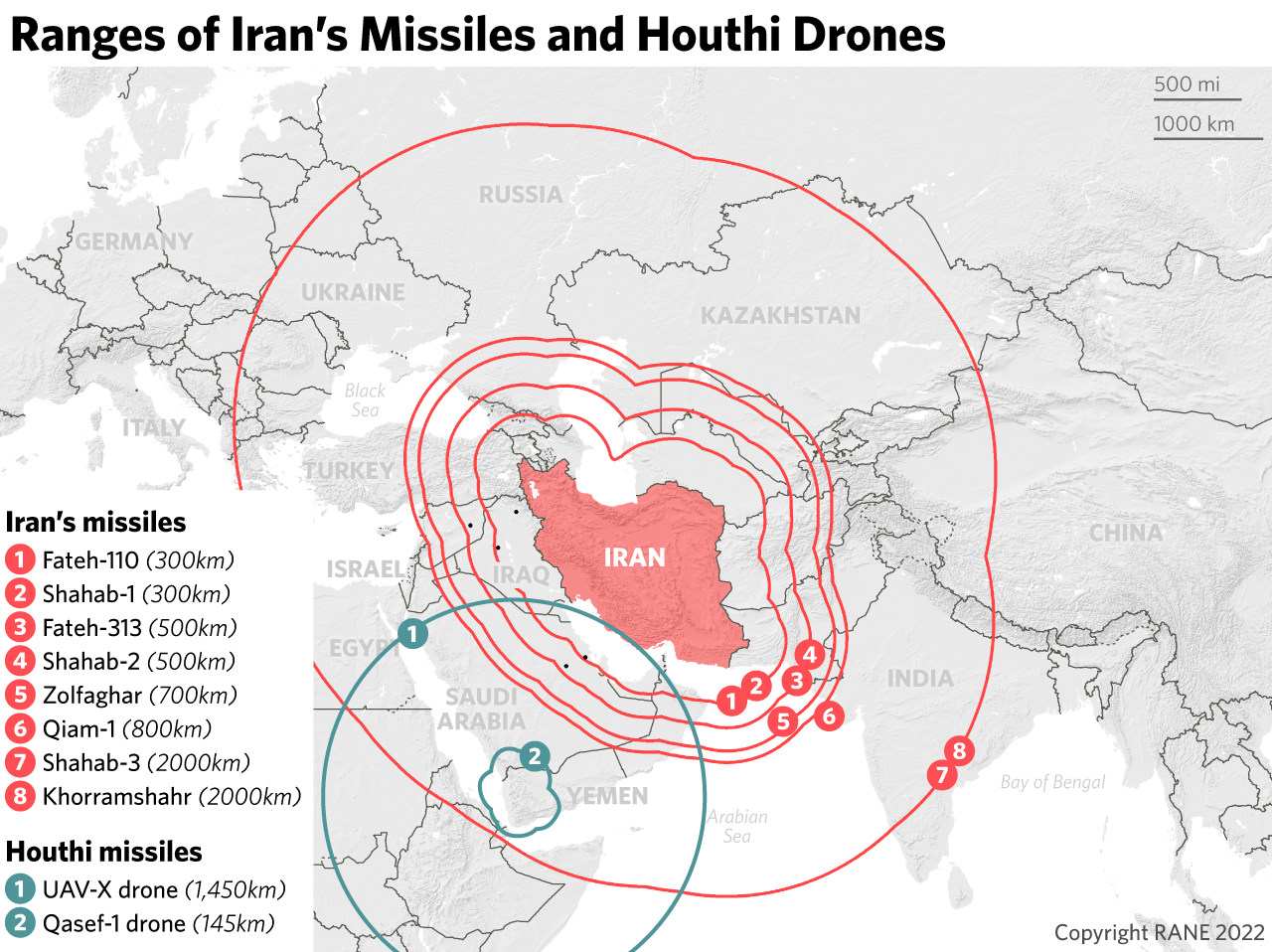
- The legislation comes as the prospects of a U.S.-Iran nuclear deal dim, possibly portending more Iranian missile, rocket and drone attacks across the region. Iran’s ballistic missile, rocket and drone strike capabilities extend out of Iran to Lebanon through Syria, Iraq and Yemen, giving Tehran the ability to target U.S., Israeli, and Arab Gulf forces from several sources.
- The United States already takes part in NATO’s Integrated Air Defense System (NATINADS), which was established in the 1950s. NATINADS aims to create another integrated air defense system in Asia-Pacific by 2028 among U.S. allies and partners there.
Though existing systems are already in place in most countries, local politics will prevent the full implementation of a regional air and missile defense system — especially in Saudi Arabia, Qatar, Oman, Kuwait, and Iraq — because Israel would be part of the network. Saudi Arabia, Qatar and Oman have covert security, economic, or diplomatic relations with Israel, but are not yet willing to embrace full normalization with the country for varying domestic and ideological reasons. Iraq and Kuwait, which have elected legislatures and populations that are overwhelmingly opposed to relations with Israel, are even further from normalization. In part because of Iranian influence in Iraq, Baghdad is also far from owning an advanced U.S. air or missile defense system; the Patriot batteries in the country are under U.S. control at the Ain al-Asad airbase in Iraq’s Anbar province. Despite these challenges, covert integration is possible for countries like Saudi Arabia and Qatar, which have more advanced ties with Israel as well as deep defense ties with the United States. Saudi Arabia and Qatar’s centralized political systems also grant both kingdoms more room to implement the systems compared with countries like Iraq and Kuwait, where elected parliaments are more able to check executive power.
- Officially, Saudi Arabia remains opposed to formally normalizing with Israel until there is a Palestinian state. But Riyadh’s normalization path is nonetheless relatively advanced. Last month, reports emerged that the United States had helped mediate the transfer of the Tiran and Sanafir islands from Egypt to Saudi Arabia by convincing Israel to drop its objections (the strategic islands sit along the Strait of Aqaba, which Israel needs to access the Red Sea; Israel previously was able to block Tiran and Sanafir’s transfer to Saudi Arabia by pointing to stipulations in the 1979 Israeli-Egyptian peace treaty that the islands remain demilitarized). The recent breakthrough on the Tiran and Sanafir dispute also comes amid reports of Israeli businesses cutting deals in Saudi Arabia, as well as rumored meetings between Saudi and Israeli officials designed to boost trade ties.
- Both Oman and Qatar officially oppose normalizing relations with Israel before the establishment of a Palestinian state. But they are also both eager to maintain their regional neutrality between the United States, Israel and Iran.
- Anti-Israel sentiment remains high in Iraq, where an Israeli airstrike on Iranian-linked targets killed up to 47 people in 2019. Just last month, Iraq’s parliament strengthened the country’s anti-normalization laws.
- Kuwait has also had its own anti-normalization law since 1964, which the country’s parliament expanded in 2018 to also include barring ties between Kuwaitis and Israelis online.
Even a partially implemented IAMD system would boost Israel and (to a lesser extent) other nearby countries’ ability to deter and intercept some Iranian and proxy attacks. But geographic distance and the point of origin of attacks will at least partially determine the effectiveness of such a system. Early warning systems that inform even a partial regional IAMD system would increase the likelihood that Iranian or proxy attacks are detected sooner and that air and missile defense systems are activated faster to block such strikes. Even if the DEFEND Act only covered Israel, Bahrain, the United Arab Emirates, Egypt and Jordan, it would still give Israel more advanced warning of some incoming Iranian strikes from Iraq and Iran. However, without Saudi Arabia as an IAMD system participant, Iran-backed Houthis in Yemen would exploit the intelligence gap over the kingdom. An IAMD system would also do little to reduce the effectiveness of shorter-range missile attacks, as well as rocket and drone attacks, against regional targets. This is especially true when it comes to protecting Israel and Saudi Arabia from attacks launched from neighboring countries like Lebanon and Syria (in Israel’s case) and Yemen (in Saudi Arabia's case), as assailants may rely more often on short-range swarm attacks and shorter flight times to strike targets before air defenses could intercept them.
- Israel has various anti-missile radar systems that are land, air and sea deployed. But until recently, the range of these systems has been limited to Israel’s own borders and bases. Israel’s EL/M-2080 Green Pine, the country’s primary anti-missile radar system, has a range of around 360-500 miles, making parts of Iraq, and all of Iran and Yemen, outside of its ability to detect. It’s not clear if the DEFEND Act would encourage Israel to send its systems to participant countries.
With the DEFEND Act, the United States could also use the benefit of closer integration with U.S.-led air defenses and possible access to Israeli military technologies to further incentivize Saudi Arabia — a frequent target of Houthi and Iranian attacks — to deepen normalization with Israel. U.S. legislators openly stated that the DEFEND Act was aimed at progressing the Arab-Israeli normalization push laid out in the 2020 Abraham Accords — a goal that would explain Israel’s inclusion. Saudi Arabia is rumored to be interested in Israel’s Iron Dome to help protect the kingdom’s southern border and oil infrastructure from attacks launched by Iran and Iran-backed Yemeni Houthis. The increasing pace of these Houthi and Iranian attacks could make Riyadh more interested in a U.S.-led IAMD program if it includes Israeli technologies, like the Iron Dome and Israel’s future Iron Beam laser defense system. In order to prevent domestic public opposition, Saudi Arabia could have the option to covertly participate in the program, similar to how the United Arab Emirates and Bahrain quietly held military drills alongside Israeli forces at U.S.-and NATO-led exercises shortly before both countries normalized ties with Israel in 2020.
- Saudi Arabia has already developed other covert ties with Israel, including business connections and a rumored meeting between Crown Prince Mohammed bin Salman and former Prime Minister Benjamin Netanyahu in 2019. These ties are reflective of the Saudi crown prince’s desire to build connections with Israel even without progress on the Palestinian issue, though it’s widely assumed the Saudi public would oppose normalization.
