
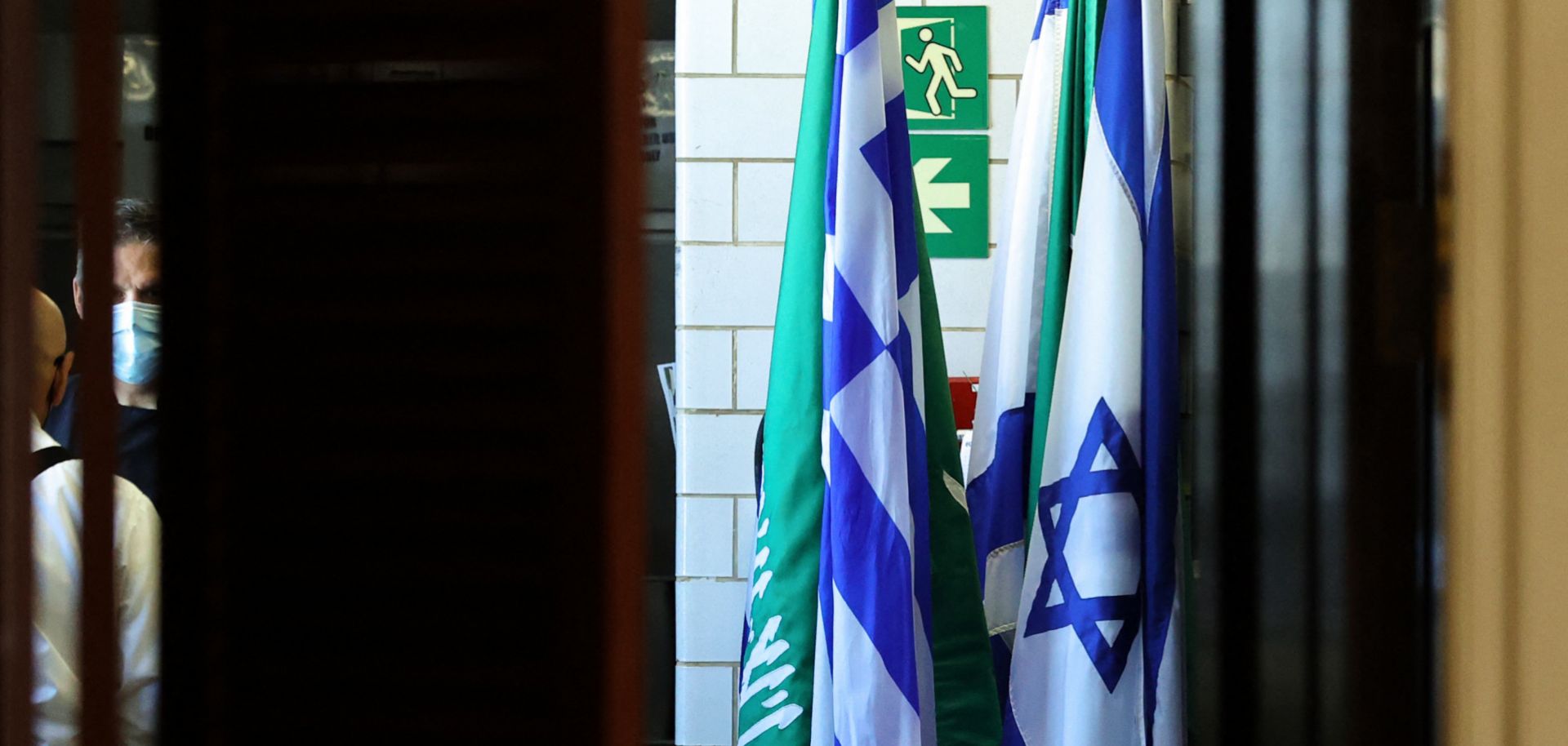
The flags of Saudi Arabia and Israel are seen outside a meeting at the U.S. State Department in Washington D.C. on Oct. 14, 2021.
Saudi Arabia will continue building diplomatic ties with Israel, using the covert path toward normalization charted by the United Arab Emirates as a guide — unlocking business opportunities in key economic sectors like entertainment, sports and culture. Israel normalized ties with the United Arab Emirates, Bahrain, Sudan and Morocco last year. Since then, many observers have been monitoring Saudi Arabia’s covert relationship with Israel to gauge when, if ever, Riyadh, may follow suit. On Nov. 4, a delegation of U.S. Jewish leaders visited Saudi Arabia, where they met high-ranking royal family members and ministers, according to the Israeli newspaper Yedioth Ahronoth. Though the meetings reportedly went well, few signs emerged of imminent normalization between the kingdom and Israel, which would still require the final approval of the former’s 85-year-old King Salman. The slow process is not surprising: the United Arab Emirates’ own normalization process took years, with small signs of engagement gradually building toward more open ties over the past decade.
Saudi Arabia has a long-term strategic interest in opening ties with Israel, but it still must approach the normalization process slowly due to uncertainty regarding the public and royal family’s reaction. Riyadh and Israel are both aligned against Iran and radical political Islam. Saudi Arabia’s wealth and domestic needs also make it a prime potential customer of Israel’s advanced agricultural, medical, surveillance and defense technologies, including anti-projectile systems like Israel’s Iron Dome. However, Saudi Arabia has been a major proponent of a Palestinian state since Israel was founded. And much of the kingdom’s regional reputation and diplomatic legitimacy are still associated with its support of the Palestinian cause. Younger Saudis are likely to be less vested in the Palestinian issue than their elders, but what limited information is available on Saudi sentiment suggests most still oppose the idea of normalization without a resolution to the Israel-Palestine conflict. The Saudi royal family’s opinions on the matter are also split. Saudi Crown Prince Mohammed bin Salman, who allegedly met with former Israeli Prime Minister Benjamin Netanyahu in 2019, has been spearheading normalization efforts. But his father, King Salman, is reportedly still wedded to the idea of a Palestinian state before the kingdom officially recognizes Israel.
To reshape public and royal opinion, Saudi Arabia will likely engage in low-level contacts with Israelis through sports, culture, entertainment, international conferences and military drills — creating opportunities for the businesses and sectors that host these events. The more public these events become, the more proof they’ll provide of Riyadh’s growing comfort with the idea of opening ties with Israel — especially if events are held in Saudi Arabia. Israeli and Saudi officials, meanwhile, can also continue to meet surreptitiously to discuss normalization. They can also build ties through meetings overseen by mutual allies, like the United States and the United Arab Emirates.
- Sports: The United Arab Emirates used sports tournaments as a way to bring Israeli athletes to the country to both test popular sentiment toward visits by non-political Israelis and to normalize Israeli visits. By hosting these non-political Israelis, the UAE government was able to both test popular sentiment and begin getting Emiratis used to the idea of having Israelis visit their country. As part of its push to diversify its oil-dependent economy, Saudi Arabia is also seeking to enhance its sports sector and, like the United Arab Emirates, will be able to use the cover of such events to have Israeli athletes publicly visit the kingdom. In launching this sports outreach, Riyadh may also take Abu Dhabi’s lead by officially denying that the athletes are visiting on behalf of Israel at first and avoiding the use of the Israeli flag.
- Culture/entertainment: Saudi Arabia is also in the process of building up its entertainment and cultural sectors, including cinemas, new restaurants, concert venues and theme parks. Riyadh could invite Israeli directors, actors, restaurateurs, performers and others in the entertainment sector to perform for Saudis, normalizing Israelis in the public eye. Saudi Arabia could also lean on some Israeli Arabs to pave the way for this strategy, especially since Israeli Arabs have long been allowed to visit Saudi Arabia for the annual hajj pilgrimage.
- International institutions: Saudi Arabia and Israel share membership in numerous international institutions, including the United Nations, World Trade Organization and the World Health Organization. This offers opportunities for Saudi and Israeli officials to build ties and meet on the sidelines of normal meetings held by these organizations. Saudi Arabia could also take another page out of the Emiratis’ book by inviting Israeli officials to visit the kingdom under the guise of such meetings (Israel’s foreign minister visited the United Arab Emirates for a U.N. conference in 2019, which was later seen as a significant step toward normalization).
- Military drills: Joint military drills could also enable Saudi and Israeli armed forces to take part in activities alongside one another. The United Arab Emirates deployed its own forces to Western military drills that also had Israeli forces as early as 2017.
