
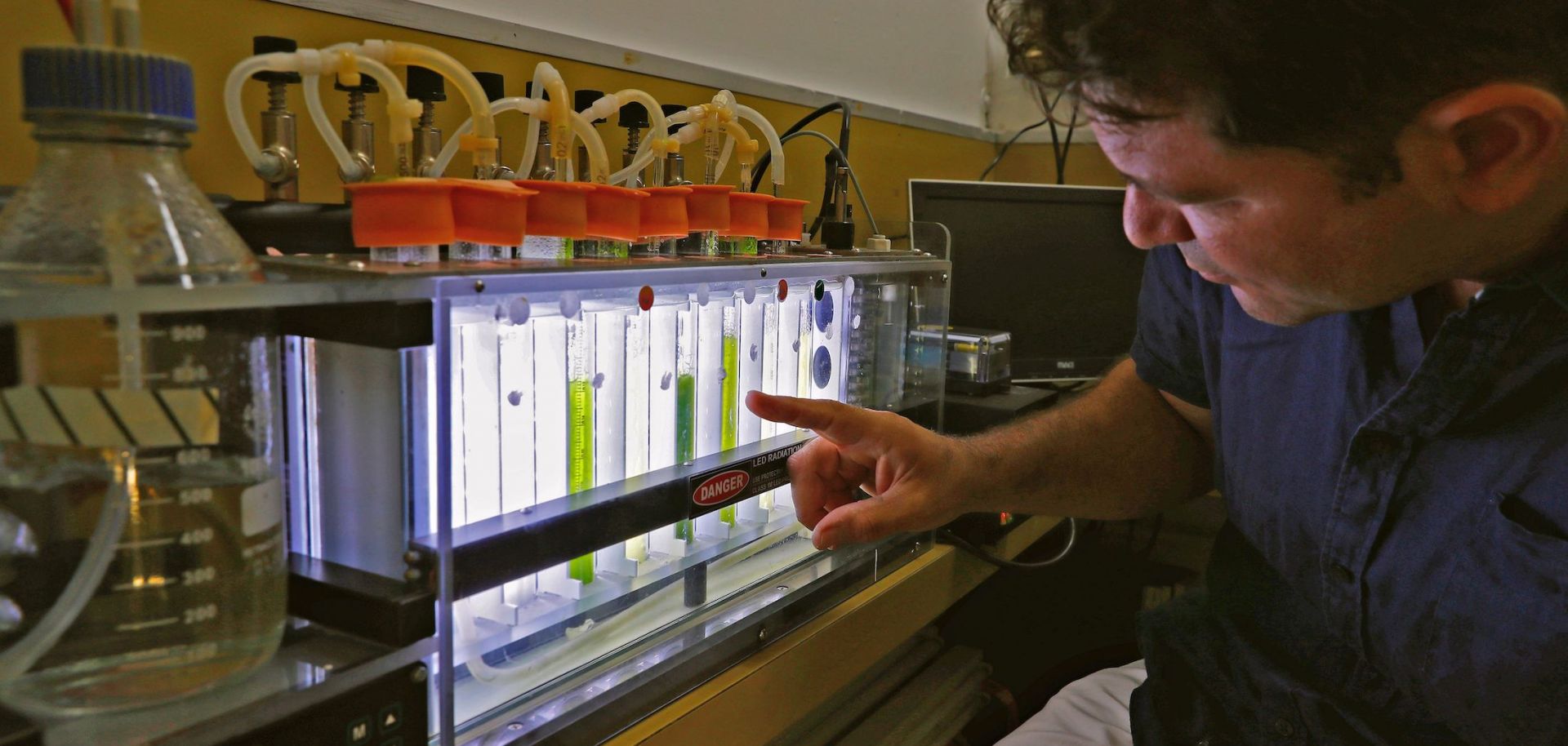
The head of the renewable energy laboratory at Israel’s Tel Aviv University researches how to harness hydrogen from plants to potentially use as a new form of electricity on June 11, 2020.
Israel’s new climate-focused diplomatic push will unlock new business and political opportunities in arid Arab Gulf states, and could also pave the way for normalization in major holdout countries like Oman, Saudi Arabia and Kuwait. Prime Minister Naftali Bennett’s new government is pursuing a new “climate diplomacy” strategy designed to increase compliance with international climate accords while sharing Israel’s renowned expertise in green technology with friendly states in exchange for new business and improved diplomatic relations. Israel’s foreign ministry announced the eco-focused push in July following the release of a major U.N. climate report warning that the world would soon face catastrophic climatic changes. The new diplomatic strategy also comes at a time when Israel’s most eco-focused party, Meretz, is not only in government but in control of the country’s environment ministry — adding to the renewed sense of political urgency on combatting global warming.
- Israel has long been a technological pioneer in green technologies, developing dry climate agricultural practices and water reclamation technologies over decades. The country sells up to $2.2 billion per year in water-related technologies alone.
- Under former Prime Minister Benjamin Netanyahu’s government, Israel did not emphasize the environmental angle in its technology deals, in part because his ruling coalition excluded the environmentalist Meretz party.
The most economically and diplomatically lucrative new deals under Israel’s new green diplomatic push will likely emerge from the Arab Gulf states, with the countries that have signed onto the Abraham Accords leading the way. The United Arab Emirates and Bahrain have both pledged to deepen their environmental cooperation with Israel, as they face mutual water and climate problems and, in the case of the United Arab Emirates, have large amounts of capital to invest in green technologies. The other, less wealthy members of the Abraham Accords — Sudan and Morocco — are likely to seek deals with Israel as well, as both also face climate-related disruption and problems with securing energy and water. Compared with the business-focused UAE and Bahrain agreements, deals with Sudan and Morocco would provide more of a humanitarian and diplomatic opportunity for Israel.
- In June, the United Arab Emirates, another water-scarce country, announced it would cooperate with Tel Aviv University to build a new water technology institute. The Water Project, a U.S.-based nonprofit, estimates the United Arab Emirates will deplete its groundwater by 2070.
- The United Arab Emirates and Bahrain are already heavily dependent on desalination, which accounts for the vast majority of their water supply. Despite the high cost of producing water from ocean sources, both countries subsidize water prices to maintain their economic attractiveness. Israel, meanwhile, has managed to cut its costs for desalination by around a third since the 1990s.
- Sudan’s major city of Khartoum, as well as Morocco’s major cities of Marrakech and Rabat, are also already facing water shortages amid longer droughts and hotter weather. Morocco, in particular, is increasingly turning to desalination as a solution to its water problems.
As their desert climates become increasingly unlivable, Saudi Arabia, Oman, Qatar and Kuwait will become more interested in Israeli green technologies, creating opportunities for Israel to build up public goodwill in these states as well. Currently, these Arab Gulf states have notable domestic and/or political constraints keeping them from overtly normalizing their ties with Israel. But their governments will find Israel’s cheaper water- and energy-saving technologies increasingly attractive in order to reduce the cost of living amid rising temperatures and dwindling water reserves. Indeed, environmental cooperation was one of several avenues in which the United Arab Emirates warmed to Israel. Should Israeli green technologies prove to help alleviate the United Arab Emirates’ climate-related woes, people in other Arab Gulf countries could also start warming up to the idea of doing business with Israel — especially as the impact of climate change starts becoming all the more apparent in their everyday lives. In addition, Israel and other countries could start building trust with Saudi Arabia, Oman, Qatar and Kuwait on the sidelines of environmentally-focused conferences hosted by either the United Arab Emirates or Bahrain.
- In July 2019, Israel’s minister of foreign affairs visited the United Arab Emirates publicly to discuss, among other things, water management with the country. That following month, Israel and the United Arab Emirates announced their intention to normalize relations.
Even if Bennet’s coalition collapses, the next Israeli government would be likely to continue this green diplomacy push. The current Israeli government is politically frail, with Bennett’s coalition relying on razor-thin margins to maintain power in the Knesset. However, with the climate crisis only set to worsen, environmentalism is sure to remain a major plank of Israeli politics for decades regardless of what happens with its current government.
