
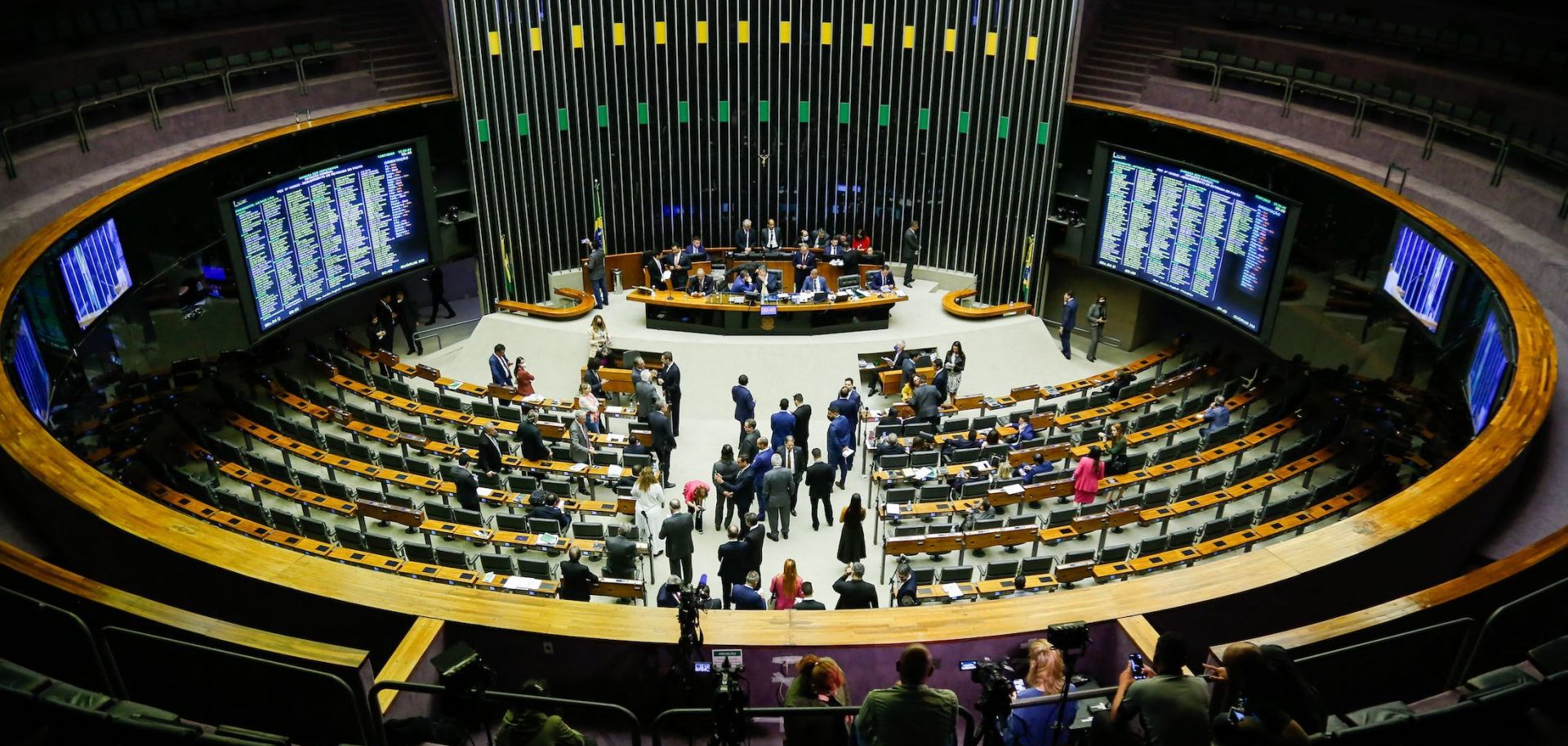
Members of Brazil’s Congress hold a plenary session in Brasilia on July 13, 2022.
A plan to increase cash handouts for poorer Brazilians could boost President Jair Bolsonaro’s re-election chances, but it will also risk casting doubt on the country’s long-term commitment to fiscal consolidation. On July 13, lawmakers in the lower house of Brazil’s Congress approved a proposed amendment to the constitution that places the country under a state of emergency until the end of 2022 to allow the government to spend $7.6 billion in economic aid measures. The legislation includes cash handouts for truckers and teachers, two sectors that have protested in recent weeks. It also expands the country’s cash-transfer program, Auxilio Brasil, in terms of both the government funding allocated to the program and the number of recipients who qualify. The move to raise subsidies for the poor will be popular among Brazilians at a time of rising inflation and slowed economic growth. Congress is thus expected to approve the amendment, as voting against such a measure would risk hurting legislators’ chances in the upcoming general election.
- The proposed amendment would allow the Brazilian government to temporarily waive the country’s constitutionally-mandated spending cap until the state of emergency is lifted on Dec. 31. It would also override regulations that ban Brazil’s government from increasing direct cash transfers within six months of an election.
- On Oct. 2, Brazil will hold a general election to elect the president and members of the country’s National Congress. If no presidential candidate secures more than 50% of the vote in the Oct. 2 election, a runoff ballot will be held on Oct. 30.
- Two-thirds of the members in each chamber of Congress must vote to approve the amendment in a joint session in order to ratify it. In addition to Bolsonaro’s Centrao coalition, which already has a simple majority in both chambers, members of other parties will likely vote in favor of the amendment to help carry it over that threshold.
The proposed spending push is a last-ditch effort by Bolsonaro to woo lower- and middle-class voters away from his main rival, former left-wing president Luiz Inacio Lula da Silva, ahead of the Oct. 2 election. The economy will be top of mind for Brazilians when they cast their ballots in October, with 44% saying it was their number one concern in a recent poll. Brazil is currently facing an economic slowdown, as well as high levels of inflation driven largely by skyrocketing food and fuel prices. This has led to stagnating wages and an increased cost of living for most citizens. If approved, the newly proposed constitutional amendment will provide immediate financial assistance for low- and middle-class Brazilians struggling to purchase basic necessities amid inflationary pressures. As the far-right incumbent candidate, Bolsonaro stands more to lose from the voters’ frustration with the country’s poor economic conditions, as evidenced by da Silva’s 15-19 point lead in recent polls. With the election only a few months away, Bolsonaro’s team is likely hoping the expanded cash handouts will help tighten the race by replenishing Brazilians’ wallets and, in turn, their faith in his leadership — especially among poorer voters who typically support left-wing candidates like da Silva.
- In a Datafolha poll published in late June, da Silva was projected to secure 47% of the vote in the Oct. 2 presidential election, with Bolsonaro securing 28%.
- According to the Organization for Economic Cooperation and Development, Brazil’s GDP is expected to grow just 0.6% in 2022, down from 5% in 2021.
- Brazil’s consumer price index reached 12.13% year-on-year in May 2022.
But while it may provide a brief boost to Brazil’s economy (and Bosonaro’s polling numbers), the hike in public spending could come at the cost of stoking inflation and investor concerns about the future trajectory of the country's fiscal deficit and sovereign debt. If the amendment is approved, the influx of cash transfers to low-income families under the expanded Auxilio Brazil program will likely boost economic growth in the short term by promoting domestic spending — the number one driver of economic activity. However, in the medium-to-long term, the increased spending will likely exacerbate inflationary pressures, especially if a re-elected Bolsonaro prolongs the spending measures beyond the end of 2022. This could, in turn, prompt Brazil’s central bank to continue aggressively hiking interest rates, further slowing economic growth in the second half of 2022 and into 2023. The economic stimulus also risks decreasing investor confidence in Brazil by breaking the constitutionally-mandated spending cap, a key marker of fiscal prudence. On the campaign trail, both Bolsonaro and da Silva have expressed support for permanently scrapping the spending cap, casting even more doubt on Brazil’s commitment to reducing its debt burden in the medium-to-long term.
- The spending cap was written into Brazil’s constitution in 2016 to usher in a period of fiscal responsibility following several years of high spending. The cap ensures that the fiscal spending is the same as the previous year, adjusted for inflation.
- Brazil’s fiscal deficit is projected to be $12.43 billion; the country’s debt-to-GDP ratio is expected to reach 79.6% by the end of 2022.
