
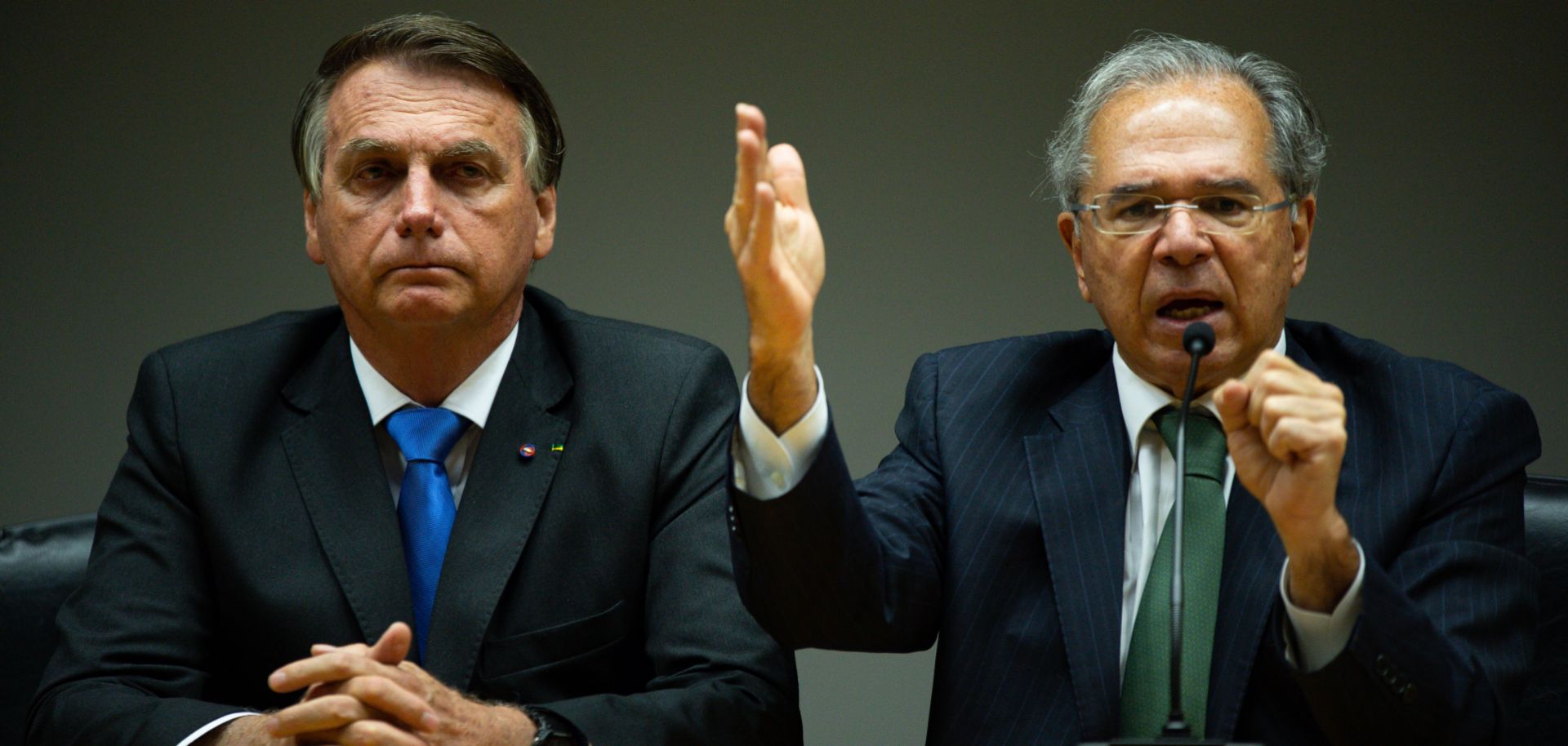
Brazilian Economy Minister Paulo Guedes (right) speaks next to President Jair Bolsonaro during a press conference on Oct. 22, 2021, in Brasilia.
Rising public spending and interest rate increases will likely exacerbate Brazil’s long-standing economic problems, leading to stagflation, growing inequality and greater vulnerability to shocks. On Oct. 21, Brazilian President Jair Bolsonaro announced that his government would move forward with a new cash-transfer program, called Auxilio Brasil, which will likely put Brasilia over the constitutionally-mandated spending cap. Bolsonaro’s allies in Congress are likely to push for a temporary rise of the constitutional spending limit and spacing out a series of recently court-ordered outlays, which currently total $15 million. Bolsonaro and his allies hope the Auxilio Brasil program will bolster domestic support ahead of the October 2022 general election.
- The spending cap was written into Brazil’s constitution in 2016 to usher in a period of fiscal responsibility following several years of high spending. The cap ensures that the fiscal spending is the same as the previous year, adjusted for inflation.
- Any attempt to alter or abolish the spending ceiling requires a constitutional amendment, which in turn requires a three-fifths majority in both the upper and lower houses of Brazil’s legislature. While this is a potentially lengthy process, Bolsonaro has the support needed to change the constitution. Alternatively, the government may choose to partake in creative accounting in an effort to disguise the true level of public spending in the budget, though this scenario would require collusion from Brazil’s federal audit court. One federal auditor, Augusto Nardes, has publicly signaled support for the government’s initiative, though it remains unclear whether the federal audit court in its entirety will allow the budget to go through.
- Four key members of Brazil’s economic team, including the treasury secretary, stepped down on Oct. 21 to protest the government’s push to supersede its constitutionally mandated spending cap.
- Both the lower- and upper-house speakers are members of the center-right voting bloc dubbed the Big Center (Centrao). The bloc is known for engaging in pork-barrel spending, in which legislators vote to approve larger federal policies in exchange for government funding for infrastructure or other development projects in their constituencies. The government’s congressional coalition is preparing a bill that would free up $14 billion, just under 1% of the country’s GDP, to be spent by lawmakers on regionally-focused public procurement initiatives in 2022. If approved, the bill would fall under an emergency spending clause, and thus not be considered in the spending cap.
- Auxilio Brasil would replace Bolsa Familia and increase monthly payments to Brazil’s poorest citizens from $54 to $72. A fourth of the program’s funding would come from extraordinary credit approved by Congress. Additionally, the new initiative does not specify the parameters for the domestic poverty line, potentially leading to an increase in the number of households who receive it, should the government raise the poverty line in tandem with high inflation.
Brazil’s central bank is likely to continue raising interest rates in response to high inflation, putting Brazil’s monetary and fiscal policy in conflict with one another and likely slowing the country’s economic rebound in 2022. While the Brazilian government’s stimulus measures are likely to generate inflation, Brazil’s central bank, which is independent of the government, has suggested it will increase interest rates in light of high inflation. The combination of high inflation and high interest rates is likely to slow down economic growth and lead to a rise in unemployment.
- In February, Bolsonaro signed a law setting fixed four-year terms for central bank directors that don’t coincide with the country's presidential election cycle, thus shielding the bank from political pressure regarding the use of monetary policy to manipulate the economy.
- Though Brazil is expected to see a significant rebound in GDP growth in 2021, the International Monetary Fund forecasts that growth will return to 2% growth from 2022 onwards.
- On Oct. 27, Brazil’s central bank raised its policy interest rate by 175 basis points to 7.75% and promised a similar increase at its next meeting in December. This represents the largest interest rate increase since 2020 and the sixth consecutive monthly rise, and followed an acceleration in consumer price inflation to more than 10%. The policy statement cautiously called out the government's uncertain fiscal policy.
In the immediate term, Brazil’s economy is likely to see a temporary boost due to an upswing in global commodity prices and domestic consumption. Rising global prices for oil and gas products, iron ore and agricultural products — all of which Brazil exports — will likely draw a temporary investment bump as companies look to cash in on the potential for increased profits. Additionally, as Brazil has lifted regional social distancing restrictions, the pent-up demand for services will likely contribute to a temporary boom in domestic consumption.
- Brazil’s real GDP is projected to grow by 5.3% in 2021, leading to a temporary strong recovery from COVID-19 that is supported by the improving labor market and high household savings.
- Rising global prices for Brazil’s top commodities will also provide a short-term economic boost. Prices for soybeans and Brent crude — Brazil’s top two exports — have risen 14% and 55% year to date, respectively.
In the medium-to-long term, however, the loss of the spending cap will likely result in higher public-sector debt, rising inflation and slower GDP growth. A deterioration of Brazil’s fiscal position could inflate its already-high external debt leading to inflation, higher interest rates and a subsequent slowdown in economic activity. It would also create unpredictability around sovereign debt payments, as Brazil’s debt trajectory would vary from year to year.
- Brazilian markets are likely to fall quickly in response to the news that the country is either engaging in creative accounting or blatantly disregarding the constitutionally-mandated spending cap.
- Brazil’s debt-to-GDP ratio hovers around 90% after a significant 10 point increase in 2020 as the government covered expenses for the COVID-19 pandemic under an emergency-spending clause, outside of the spending cap.
- Brazil’s inflation is projected to reach 7.7% by the end of 2021. The country’s consumer price index rose 10.2% year-on-year in September and is expected to further grow.
- In 2020, just 5.8% of Brazil’s debt was held in foreign currency, making it easier for the government to pay it back when accounting for the country’s high inflation rate.
Bolsonaro may return to fiscal discipline if he is re-elected in 2022. But if he loses to his likely competitor, former president Luis Ignacio Lula da Silva, Brazil will probably maintain high levels of fiscal spending. Bolsonaro has traditionally adhered to fiscal discipline and would thus be more likely to return to his pro-market platform upon securing a second term. Conversely, da Silva would be more prone to stray from fiscal discipline as his ties with the country’s powerful labor unions would likely pressure him to give increased welfare stimulus. In this scenario, a government under da Silva may consider implementing price controls or increasing taxes on commodity-centric exports. Should fiscal spending outpace growth under either scenario, it would likely increase capital flight as the rich will likely seek to store their currency in dollars. Additionally, it would decrease the country’s capacity to manage exogenous shocks, such as a drop in demand for Brazilian goods, global commodity prices or probable climate-related events.
- If the Auxilio Brasil program is pushed through, whatever government enters office in 2023 will have to either face political backlash by cutting the popular cash transfer program or, more likely, continue to disregard the spending cap. This leaves investors with no clear idea as to how much will be spent in 2022 and beyond.
- Bolsonaro’s approval ratings have recently averaged below 30%, with polls showing he’d lose the presidential election if ran against da Silva.
