
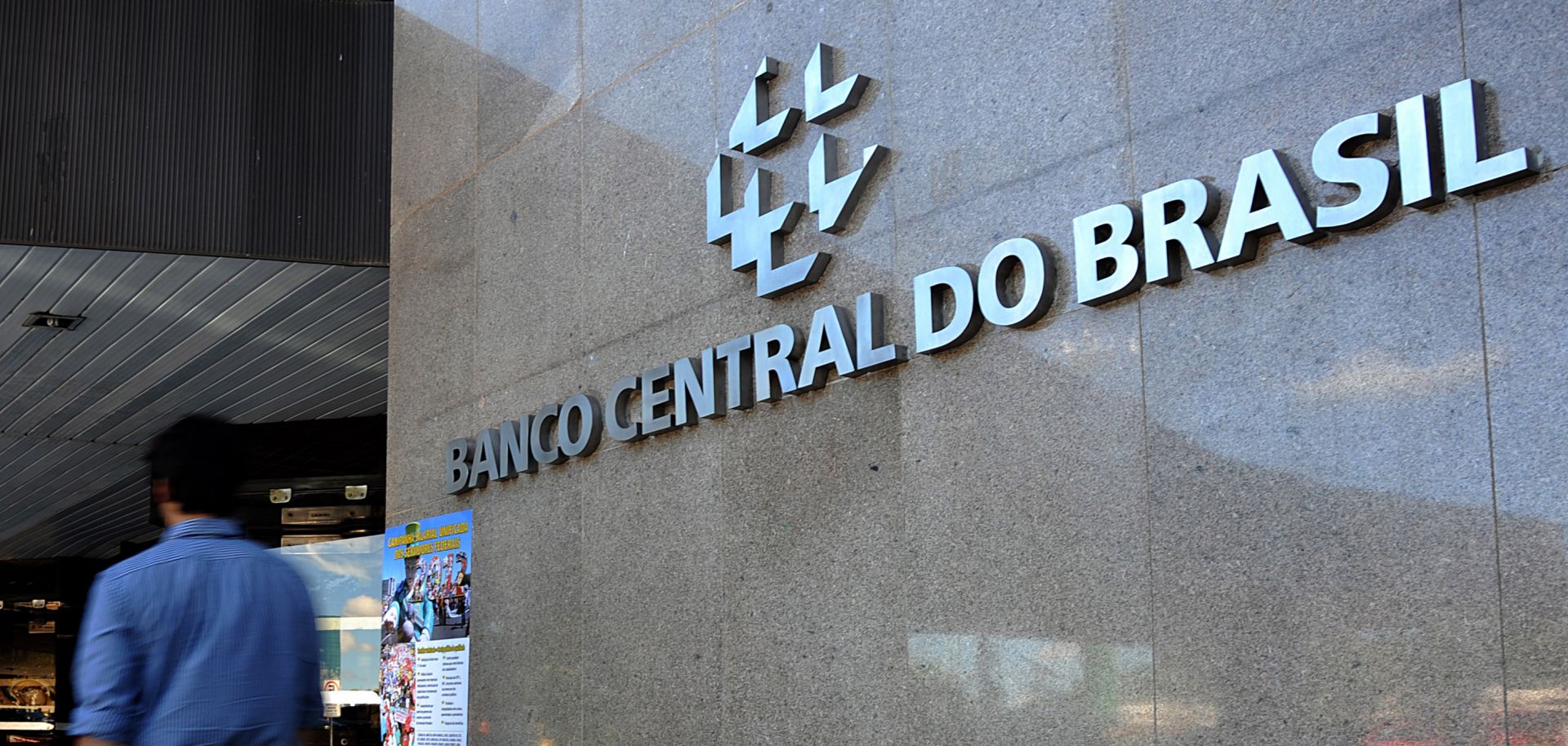
A man walks past the building of Brazil’s central bank in the capital of Brasilia on May 29, 2012.
Central bank policy alone will not be enough to generate sustainable economic growth in Brazil, as the government struggles to introduce fiscal discipline and structural reforms amid the country’s ongoing COVID-19 crisis. On May 5, the Banco Central do Brasil (BCB) raised its main policy interest rate, the Selic, by 75 basis points to 3.5% following a similar increase in April. The BCB signaled that another similar increase is likely in June, as it tries to get inflation and exchange rate depreciation under control.
- In the second half of 2020, a combination of an expansive monetary policy and fiscal stimulus boosted domestic demand in Brazil, with credit and liquidity measures worth 17.5% of GDP.
- Excess liquidity in a low interest rate environment is depreciating Brazil’s local currency, the real, and generating inflation. Although the real reached a four-month high following the interest rate announcement, it is still down 1.6% year-to-date, while annualized inflation reached 6.1% in March.
- Brazil’s depreciating currency has made imports more expensive at a time when international food and commodity prices are already on the rise. Both phenomena are negatively affecting the cost of basic consumption items and production, and further derailing domestic demand and Brazil’s competitiveness.
Brazil will probably delay the implementation of austerity measures, which will ultimately make it harder for the government to finance its debt and deficit needs by exacerbating inflation and further harming investor confidence. Brazil’s fiscal policy was highly expansionary in 2020, with emergency payments to informal workers (who account for one-third of the labor force) boosting expenditure by 7 percentage points of GDP and taking the primary deficit to 11.6% of GDP from only 1% in 2019. Emergency payments kept approval ratings for President Jair Bolsonaro and his government high throughout last year. While Brasilia has recently scaled back some of the emergency aid programs, the government is unlikely to significantly lift the relief measures. Ahead of the presidential election in October 2022, Bolsonaro will seek to preserve social programs for the poor, but he’ll also likely remain unwilling to cut existing benefits for other workers, including public pensions, to finance the project. These fiscal risks contribute to currency volatility, while rising inflation limits the effectiveness of monetary policy and the BCB’s room for action.
- Brazil’s Congress suspended the country’s constitutional spending cap in 2020. While investors and independent economic bodies are pressuring the government to adhere to the spending cap, the government is considering another suspension in 2021.
- In mid-April, Citibank warned that Brazil will likely breach its spending cap again in 2021 by 2% of GDP, citing the country’s current and projected spending patterns.
Regardless of BCB action, the Brazilian government will struggle to eliminate the structural impediments to competitiveness and investment, which will make it difficult for the country to generate sustainable growth, create jobs and reduce poverty. While the BCB has a reputation for credibility, monetary policy alone cannot stabilize the economy and generate economic development. Economic growth should accelerate in the second half of this year, especially as the country’s vaccination campaign makes progress. But Brazil will not return to pre-pandemic GDP levels at least until 2022. In December, the International Monetary Fund (IMF) declared Brazil “one of the most closed economies in the world.” According to the institution, Brazil’s structural problems include a distorted tax system that imposes one of the highest tax burdens in Latin America (33% of GDP compared with the region’s average of 22%), a high level of trade protectionism and barriers to business that deter investment, a reduced role for state banks in allocating credit, and labor market regulations that keep 38 million workers (nearly 20% of Brazil’s population) in the informal sector, along with rampant corruption and money laundering.
- Brazil has been dealing with low economic growth rates for at least 20 years. Economic growth averaged less than 2.3% annually from 1997-2019, compared with 5.3% for all emerging markets and developing countries in the world, and the Latin American median of 2.5%.
- The IMF’s long-term estimates of growth for Brazil average only 2-3% per year, but depend critically on a pick-up in labor productivity, which averaged less than 1% annually from 1993-2019.
- Uncontrolled inflation could further impede economic growth.
- Brazil ranks 124 of 190 countries in the World Bank’s Ease of Doing Business Index.
