
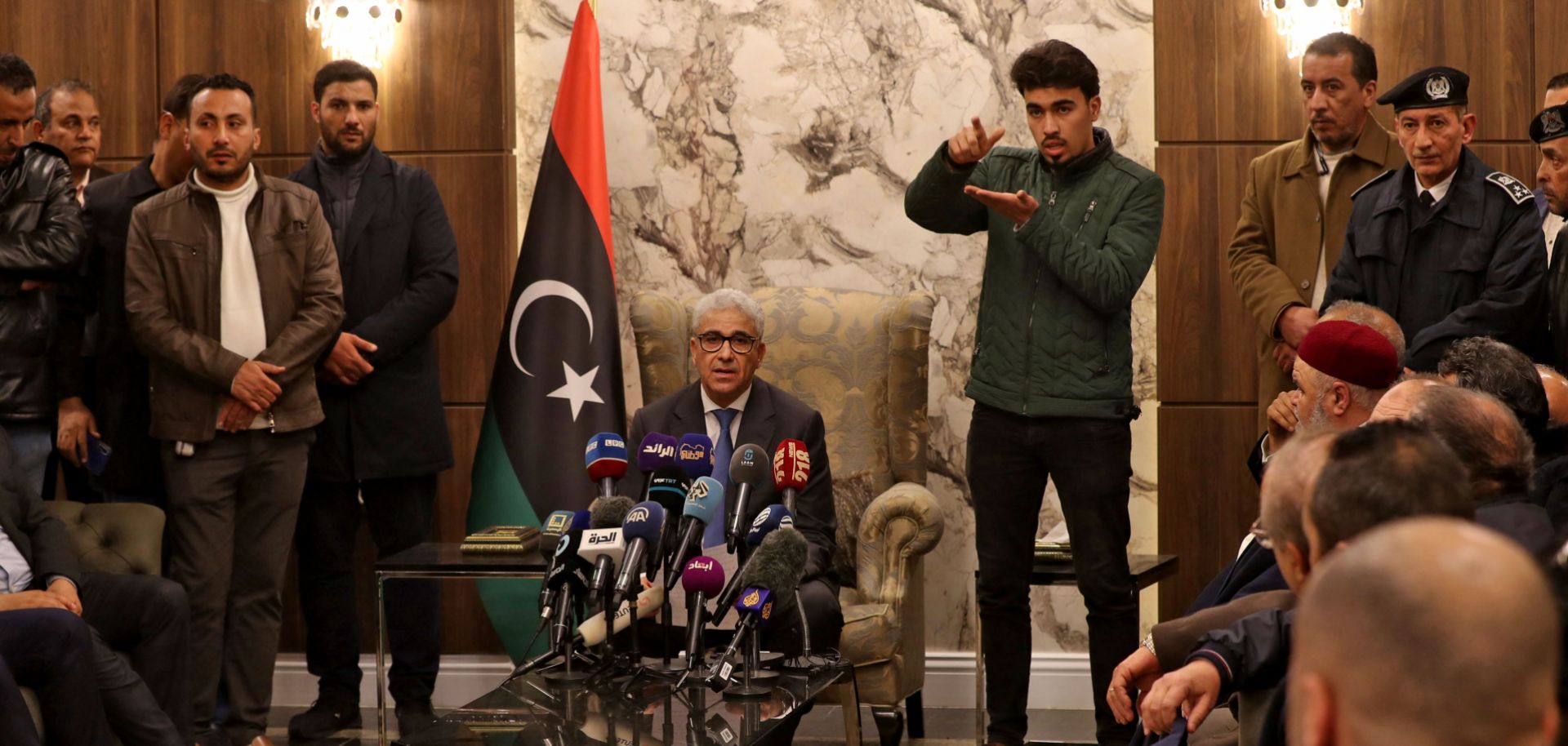
Fathi Bashagha delivers a speech in Tripoli, Libya, after east-based lawmakers named him as the head of a new interim government on Feb. 10, 2022.
The presence of two governments in Libya risks renewing violence in Tripoli and disrupting the energy-rich nation’s crucial oil and gas exports as the leader of each regime vies for domestic and international legitimacy. Libya’s House of Representatives, which is based in the eastern town of Tobruk, approved a new government on March 1 with former Libyan interior minister Fathi Bashagha as its prime minister. Incumbent Prime Minister Abdulhamid Dbeibeh — who heads the U.N.-recognized Government of National Unity (GNU) based in the western city of Tripoli — rejected the parliament’s decision, vowing to remain in power and rule from Tripoli. On March 1, Bashagha said his new government plans to assume power peacefully in Tripoli, setting up a potential clash with Dbeibeh in the country’s capital.
- For most of the last eight years, Libya has had two rival governments, with one operating in the country’s east and the other in the west. Dbeibeh’s government was formed in March 2021 to unify the two governments and shepherd the country toward a planned December 2021 presidential election, but the election was scrapped at the last minute over infighting about how it should be held and who was eligible to run.
- Bashagha’s new government, known as the Government of National Stability (GNS), was sworn in on March 3 and includes 35 different cabinet positions. Allies of the powerful east-based commander Khalifa Hifter and his Libyan Arab Armed Forces were appointed to several cabinet positions as Bashagha tries to build a broad coalition of support.
While Dbeibeh and Bashagha’s governments will each push their own competing visions on how to get Libya’s elections back on track, their priority will be to solidify their power and garner domestic and international recognition. The failed December election left the U.N.-led Libya Peace Process without a clear path forward to hold the country’s first nationwide elections since 2014. But the United Nations and many Libyans still want an election to be held relatively soon. Both the GNU and GNS are trying to exploit those demands by presenting different paths to elections, even though their respective leaders are well aware that holding elections and a referendum over a new constitution is unlikely as long as there are competing governments.
- GNU Prime Minister Dbeibeh has laid out a plan to hold parliamentary elections by June 2022. The short timeline is an important part of Dbeibeh’s push to ensure his government retains U.N. recognition as it coincides with a timetable floated by U.N. Libya adviser Stephanie Williams in January.
- GNS Prime Minister Bashagha will be tasked with implementing the House of Representatives’ own election road map, which the east-based legislature approved in early February. Under the House of Representatives’ plan, Libya's political institutions would amend the country’s draft constitution and put it for a referendum as a basis for elections and then hold elections 14 months after the referendum — putting elections in mid-2023 at the earliest.
The two sides will likely fight for control of Libya’s critical government offices, including the central bank and the state-owned National Oil Corporation, which could disrupt the country’s oil exports. Libya’s political crisis is now more complex than an east vs. west conflict because, like Dbeibeh, Bashagha hails from the western city of Misrata. Bashagha also has some level of support in western Libya, which if he’s able to grow, could increase his chances of unseating Dbeibeh in Tripoli. Winning over the international community, however, may prove even more important because U.N. recognition conveys more legitimacy to the country’s oil and natural gas exports, which are critical to funding the Libyan budget. In the past, the United States has stopped tankers that were exporting Libyan oil not under the auspices of the National Oil Corporation. In addition, most of the 1.2 million barrels of oil that Libya exports each day are shipped out of five oil terminals located in the eastern half of the country — territory that is firmly controlled by Hifter, the House of Representatives and supporters of the new Bashagha-led government. Over the past decade, Hifter and other eastern Libyan political actors have repeatedly blockaded exports from some of those terminals to cut off oil revenue to government leaders in Tripoli. And they could do so again to disrupt Dbeibeh’s GNU, particularly if Bashagha is unable to assume power in Tripoli. Any cut-off of Libyan oil exports over the next few months would exacerbate the ongoing energy market crunch due to Western sanctions on Russia, one of the world’s largest exporters of oil and natural gas.
- As part of an offensive on Tripoli launched in 2019, Hifter and his rebel army blockaded oil exports from eastern ports and some fields in southern Libya between January-September 2020. The country’s oil production declined from 1.2 million bpd to less than 200,000 bpd during those nine months.
- The loss of Russian oil exports due to Western sanctions related to Moscow's recent Ukraine invasion has caused a global supply shock. On March 3, European oil benchmark Brent reached $119 a barrel for the first time since 2008 before slipping back to $110 later in the day. As of 11 a.m. Eastern Standard Time on March 4, it was trading at about $115 per barrel.
In the short term, Bashagha’s attempt to govern from Tripoli will probably lead to some violence in the capital, but a broader return to civil war across the country is unlikely. In the 11 years since the Arab Spring, powerful militias have emerged in Tripoli. They appear split over whether to support the GNS or GNU, and different militias have, at times, fought one another. Bashagha has the support of some militias in Tripoli and Misrata, but also made enemies of others during his time as interior minister in the Tripoli-based government from 2018-21. Given their history of fighting Hifter’s rebel forces, some of Tripoli’s most powerful militias will also oppose the GNS due to its alliance with the commander. If Bashagha ever arrives in the city, the different militias supporting different governments means that there will probably be fighting between them over controlling government offices and buildings in Tripoli. This competition for power could cascade beyond just government offices if the violence leads to significant casualties. Nevertheless, a broader conflict is unlikely as Hifter appears content with letting Libya’s political crisis continue. If Bashagha is able to wrestle control from Dbeibeh, it would grant Hifter key allies in the Libyan government. But even if that doesn’t happen, increased infighting among leading western Libyan figures like Bashagha and Dbeibeh would still benefit Hifter by enabling him to continue reconsolidating his power in the south and the east.
