
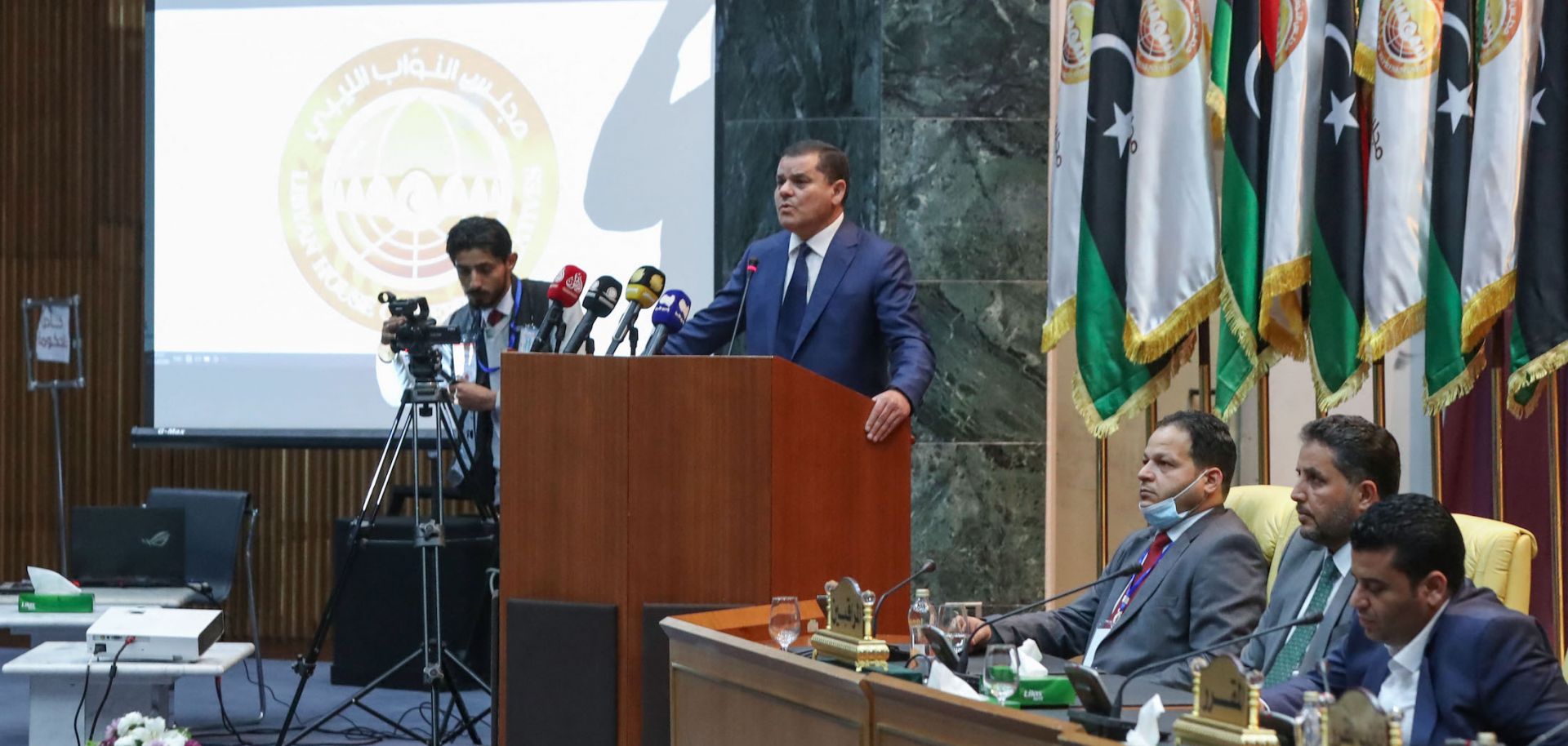
Libyan Prime Minister-designate Abdul Hamid Dbeibah addresses lawmakers during the first reunited parliamentarian session on March 9, 2021, in the coastal city of Sirte, east of the Libyan capital of Tripoli.
Libya's new Government of National Unity will struggle to unify the country after nearly seven years of civil war and as various Libyan stakeholders stoke divisions to protect their interests. The Libyan House of Representatives overwhelmingly approved Prime Minister-designate Abdul Hamid Dbeibeh's new government on March 10 in Sirte after three days of debate and several changes in Dbeibeh's Cabinet. The Tobruk branch of the House of Representatives gave its confidence to the GNU — something it never gave the Tripoli-based Government of National Accord — and GNA Prime Minister Fayez al-Sarraj said after the approval that he was ready to hand over power to the new government. The GNU represents Libya's first unified government since August 2014.
- A major pillar of the U.N.-backed Libyan peace process and the new government is joined by a three-person presidential council – headed by President Mohammad Younes Menfi – at the head of the executive branch that will govern with the GNU in a presidential-premier system.
- The GNU is designed to be a temporary government that is in place to run the country and prepare for planned Dec. 24 elections, which would be the country's first national elections since 2014.
- The new Cabinet will have 33 ministers and two deputy ministers as it tries to get broad support through an inclusive government where different factions have a portfolio. But for now, the critical and controversial position of defense minister will remain vacant and under Dbeibah's tutelage until a consensus candidate emerges.
The GNU will struggle to implement its own policies as the House of Representatives, the Libyan National Army, various militias and other institutions will wield significant power regionally, meaning national reconciliation and unification largely will remain in name only. Approval of the GNU came after diversifying the Cabinet to include the necessary factions in order to receive the benefits that come with official representation from the largely still-intact Gadhafi-era oil-based government patronage system. Dbeibeh and his family have a long-standing reputation dating back to Gadhafi regime corruption that helped build their formidable business empire, and Dbeibeh's Cabinet has been criticized as reflecting those origins. Competition among Libya's factions can be expected to heat up in the wake of the approval of the GNU. The House of Representatives still retains significant power, and will continue to act as the country's legislative body, giving it effective veto power over legislation proposed by Dbeibeh. The legislative body must approve many of the next steps in the peace process, including a new budget law, a new constitutional referendum law and a new election law underpinning planned elections.
Dbeibeh lacks an independent power base supported by large militias, which will force the new government to work closely with Libya's different factions and militias on crafting policy, giving them a strong say over it. How quickly the new government can pass a unified budget remains to be seen. Negotiations have already begun, but a final agreement was not reached, as negotiators are waiting for the new government's formation. The struggle to unify Libya's institutions, including the Central Bank, various ministries and state-owned companies, is also likely to take center stage. Uniting them will prove difficult as local politicians and figures try to maintain the power they have built up under these institutions. Another key question for the Dbeibeh government will be how to approach demobilization efforts for militias. GNA Interior Minister Fathi al-Bashagha — Dbeibeh's main competitor for the new office of prime minister — proved controversial for having been a key architect of Libya's planned integration efforts. Dbeibeh will encounter some of the same opposition Bashagha did if he aggressively backs such plans.
- Some of Tripoli's militias have opposed Bashagha's planned security sector reforms as evidenced by an assassination attempt on him in February.
Dbeibeh's weakness also means that the Libyan National Army, headed by Khalifa Hifter, will probably act largely unimpeded by the new government. Hifter's allies in the House of Representatives appeared to approve the new government, as did his supporters in the Libyan Political Dialogue Forum, where Dbeibah was selected as the prime minister-designate in February. There are clear differences in policies and ideology between Hifter and the Dbeibeh-Menfi led government, as Dbeibeh is viewed as being close to Turkey and Menfi as being close to the Muslim Brotherhood. For Hifter, a weak government means fewer constraints on his activities. Nevertheless, Hifter's strength has waned since his failed Tripoli offensive even though he and the United Arab Emirates will oppose a government close to the Muslim Brotherhood and Turkey.
- The United Arab Emirates, while officially supportive of the new GNU, will object to any ties between it and the Muslim Brotherhood and Turkey. To combat these, the United Arab Emirates will funnel support to Hifter and like-minded figures who could emerge as potential candidates in December elections.
Libya's oil and gas production will likely remain stable and the odds of broad conflict will remain low, unless Dbeibeh manages to consolidate power and subsequently attempts to marginalize Hifter or militias in Western Libya. Libya's recovery in oil production, now roughly at 1.3 million b/d, is likely to remain high in the short-term given the lack of support for Hifter to try to shut down Eastern Libya's oil exports. But if Hifter does try to play more of a spoiler role, he may find using control over Eastern oil terminals preferable to starting a significant armed conflict against Western Libya. A bigger security threat in the short-term could be any moves by Dbeibeh against Western Libya's powerful militias, particularly in Tripoli. Any attempts to replicate Bashagha's demobilization push and integrate only some of the militias into the official security apparatus will be opposed by other militias that retain significant military power.
