
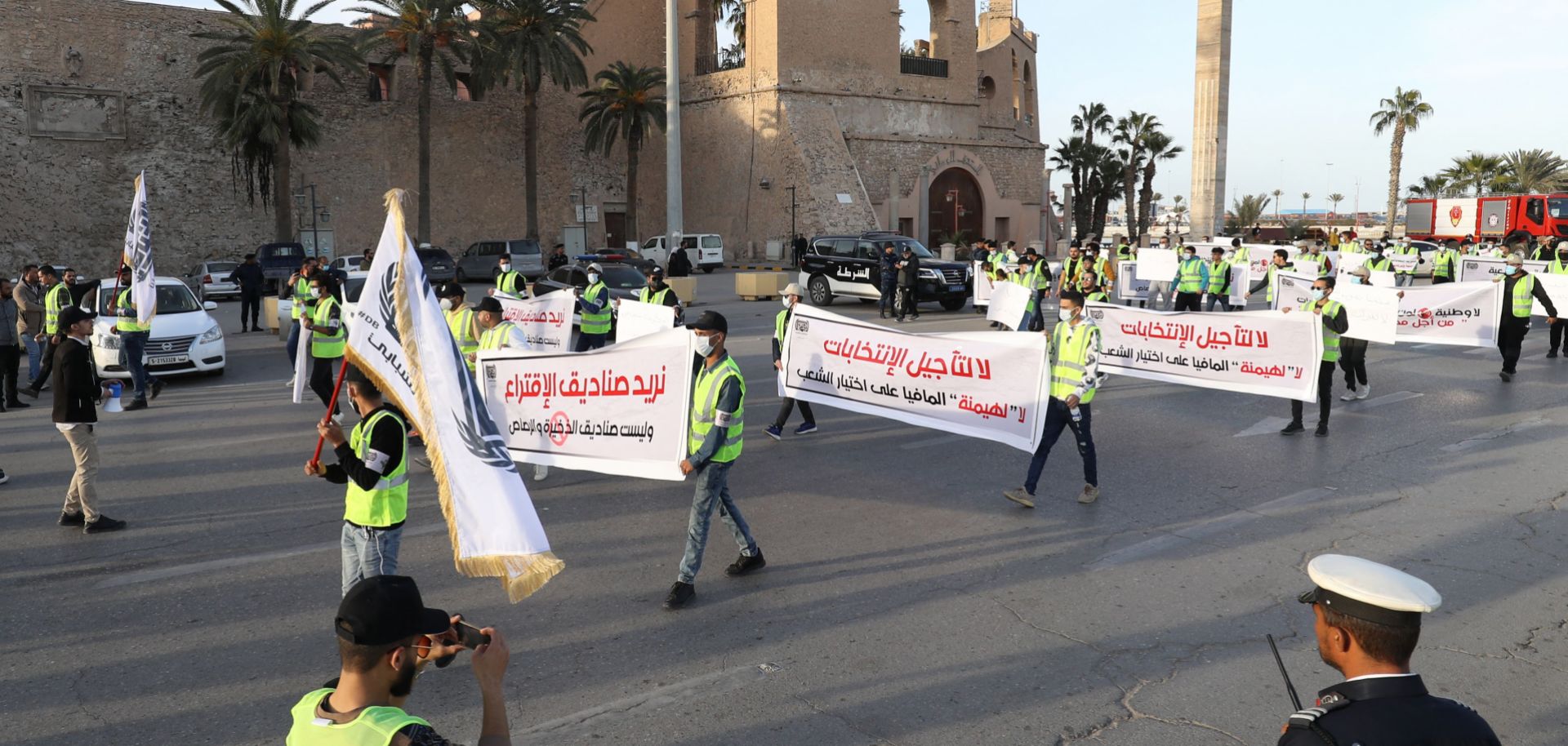
A group of activists protest against the postponement of Libya’s presidential election in Tripoli's Martyrs Square on Dec. 25, 2021.
Delays to Libya’s planned presidential election will resolve neither the disagreements over how the ballot should be organized nor the controversy surrounding the top candidates. The vote, whenever it is held, will thus fail to truly unify the country as intended, and could eventually spur more violence by deepening divisions between warring Libyan factions. On Dec. 21, Libya’s High National Election Commission called off the planned Dec. 24 presidential election, blaming the country’s parliament, the House of Representatives (HoR), for failing to resolve disagreements over the country’s presidential election law and saying it was up to the HoR to decide a new date. On Dec. 22, the commission proposed a one-month delay to Jan. 24, when the presidential vote could coincide with planned parliamentary elections, which are just as divisive as the presidential election. The HoR met on Dec. 27 to discuss the path ahead, but the discussion quickly fell apart over the same issues, with no clear path forward agreed upon.
- The presidential and parliamentary elections aim to cap the now more than seven-year Libyan political crisis that has seen rival governments set up in eastern and western Libya since the country’s last elections in 2014. The current Government of National Unity (GNU) was formed in March 2021 as a single, unified government after intense negotiations among Libyan stakeholders. But the GNU is only a caretaker government tasked with organizing elections.
- A delay to the elections was expected, despite pressure from Western countries to move forward with the planned Dec. 24 vote, as the election commission failed to present a list of final candidates approved to run in the election.
The disputes over the election process lay bare the country’s stark divisions, which have only worsened in the decade since Moammar Gadhafi was overthrown in 2011 and are likely to result in further delays to the ballot. Under the U.N.-led peace process, which has been running since 2014 to bring an end to the civil war that has plagued the country since Gadhafi’s ousting, the Tripoli-based GNU and the Benghazi-based HoR were supposed to organize a constitutional referendum along with national presidential and parliamentary elections. They were also supposed to pass laws to underpin both the elections and the referendum. But members of the GNU and HoR have yet to fully agree on an election law (and likely never will) due to fundamental disagreements over who is eligible to run the country, the role of the military, and how to split governance and revenue between eastern and western Libya. The constitutional referendum, meanwhile, was essentially abandoned from the start due to difficulties in reaching an agreement on touchy subjects like oil revenue and national resource distribution.
- The speaker of Libya’s HoR, Aguila Saleh, pushed the current presidential election law through the legislature in September without presenting the final draft for a vote, thus bypassing parliamentary procedures. Saleh — an ambitious political figure who has led the parliament since 2014 — has since announced his own bid for the presidency, as has Libyan Arab Armed Forces chief Khalifa Hifter thanks to a clause in the law allowing military leaders run in the election. A number of western Libyan leaders have voiced concern with this clause and Hifter’s candidacy, given that Hifter launched an offensive against Tripoli to try to take over the country by force in 2019 and has on multiple occasions declared a coup against governments based in Tripoli.
- In September, the HoR also passed a no-confidence motion against the GNU and Prime Minister Abdul Hamid Dbeibah in an attempt to pressure Dbeibah’s government, the international community and Libya to accept elections sooner rather than later and under its new election law.
- The ongoing civil war has only deepened the historic divisions between western and eastern Libya. Delaying the Dec. 24 vote by a month or even a year is thus unlikely to erase the disagreements over the election law and Libyans’ mistrust of the leading presidential candidates.
The longer the delays to presidential and parliamentary elections persist, the greater the risk of a renewed split in Libya’s governance. The HoR, which has typically led eastern Libya’s government since 2014, has already revoked recognition of Prime Minister Dbeibah’s government and will either eventually try to back an executive branch or central government authority rivaling Dbeibah’s if it becomes clear that there will be no elections. This could either be done more “officially” by appointing a new prime minister to rival Dbeibah, or it could be done de facto through Hifter or Saleh’s own power structures in which either essentially obstructs Dbeibah’s ability to govern in eastern Libya. Such a split would place Libya back where it was prior to the formation of the GNU, with an internationally recognized government in Tripoli that isn’t recognized in most of eastern Libya. This could prompt Hifter or Saleh to close down oil exports from the country’s east, as Hifter did between January and September in 2020.
Such a split could see Libyan rivals resort to violence and use oil as a coercive tool against one another. Hifter could launch another military offensive against western Libya, but such a foray will remain unlikely as long as foreign deployments by Russia (in support of Hifter) and Turkey (in defense of western Libya) remain in place. Renewed violence in rural Libya is more probable, with rivals fighting on the margins over control of areas like the southwestern region of Fezzan, which is home to the country’s largest oil field. However, should the tense situation in Ukraine spiral into a greater crisis, Russia may shift its calculus to support renewed military escalation in Libya as a way to divert Western attention away from Ukraine to North Africa.
- The Petroleum Facilities Guard (PFG), which is tasked with protecting key assets of Libya’s oil industry, shut down the Sharara oil field in Fezzan (along with three other nearby oil and gas fields) in December ahead of the planned elections over pay and wage disputes. The PFG is nominally supposed to be a part of Libya’s military apparatus, although local branch commanders control regional influence. Increased competition and violence between eastern and western Libyan factions could see the PFG become more politicized as rival militaries fight for control over the security force.
- Although the deployment of Russian private military contractors in Libya initially supported Hifter’s Tripoli offensive, that support evaporated as Turkey got involved and the offensive stalled, leading Russia to look for ways to consolidate its influence in Libya through mediation talks and fostering political ties with western Libyan figures including Dbeibah.
Holding the vote, however, will also risk reigniting conflict as the top presidential candidates are all controversial with rivals who would likely revolt and reject their election as rigged and/or not legitimate. In a presidential poll conducted of 1,106 registered voters by Tripoli-based Diwan Research in early December, GNU Prime Minister Dbeibah received 50% support, followed by Gadhafi’s son Seif al-Islam who received 14% and Hifter who received 7% (the 95 other registered presidential candidates all received less than 5% support). All three of these candidates, however, have immense baggage associated with their candidacy, which means they would each face serious challenges to the legitimacy of their rule:
- Dbeibah is technically not supposed to be allowed to run in the election and several lawsuits were filed (although dismissed) against his candidacy over the issue. A U.N. inquiry into bribes into the selection process of the GNU’s prime minister concluded in March that his election by just five votes was in part due to bribery and that his supporters — his family is one of Libya’s wealthiest business families — offered bribes as high as $200,000 to vote for him. Dbeibah has also openly stated to Western diplomats that he intends to lead Libya longer than the GNU’s mandate. Dbeibah’s ties to western Libya make it difficult to imagine that he would ever be accepted as legitimate by Hifter and his forces and means that he will have little to no authority in eastern Libya.
- Seif al-Islam is Moammar Gadhafi’s second-oldest son and the most powerful remaining member of the Gadhafi family. Earlier in 2021, Seif al-Islam made his first public appearances and foreign media interviews since the onset of the civil war to garner support among the Qadhadhfa tribe and those who want a return to the stability seen during his father’s reign over Libya. Libya’s revolutionaries who compromise some of the country’s most powerful militias, however, are unlikely to accept Seif al-Islam as their leader, nor will Hifter who was pushed into exile and opposed Gadhafi before returning to Libya after he was overthrown. Moreover, Seif al-Islam would remain a problematic figure for the West to work with. The International Criminal Court indicted him for crimes against humanity and issued a still outstanding warrant for his arrest in 2011. Seif al-Islam has also been sentenced to death in absentia by a court in Tripoli.
- Hifter is unlikely to garner substantial support in the historic Tripolitania region, which is home to more than half the country’s population, due to his 2019-20 offensive on Tripoli and his two coup announcements against the then-single government in the city in early 2014. Hifter would be able to use his influence in eastern Libya to generate a high level of support there, but the region’s smaller population means it's unlikely for him to win the national vote without significant differences in voter turnout in eastern and western Libya. Many of western Libya’s most powerful militias directly fought against Hifter during his offensive. Hifter has so far been unwilling to subject his forces to any layer of civilian oversight, and although he has hinted that he might bow to authority a civilian leader elected by Libyans (and not imposed by U.N. peace negotiations), it’s hard to imagine the eastern military commander would back a president who isn’t a close ally if he loses the election.
With a presidential candidate who could paper over Libya’s divisions highly unlikely to emerge, the elections risk yielding competing governments or a government unable to implement authority over half the country, casting even more doubt on the future of Libya’s political structure. Libya’s myriad of militias, which already may stand to lose the most politically and economically from a more “legitimate” government, will likely exploit any disagreements to entrench themselves and protect their political patrons, meaning that any government that forms will have limited influence throughout the country and some level of conflict in the future may be inevitable. Renewed civil war comparable to the 2014 and 2019-20 conflicts that saw fighting on the outskirts of Tripoli is a distinct possibility, while more localized conflict — especially over water, road, oil and gas infrastructure — is almost certain. But more fundamentally, the failure of the peace process and the complete lack of progress towards stabilizing Libya after more than a decade of conflict will result in more questions being asked whether or not a unified Libya should be an end goal or whether partition, either de jure or de facto, offers a more promising path toward stability.
