
Potential changes to the way oil revenue and exports are shared and distributed in Libya could have significant ramifications for the country's sovereignty and ongoing civil war by establishing de facto splits in Libya's financial system.
- In a June 29 statement, Libya's National Oil Corporation (NOC) said that it was “hopeful” that a deal could be reached in its negotiations with the country's internationally-recognized Government of National Accord (GNA) and other regional countries. The NOC also announced on July 1 that it had told workers to prepare to resume work at oil fields soon.
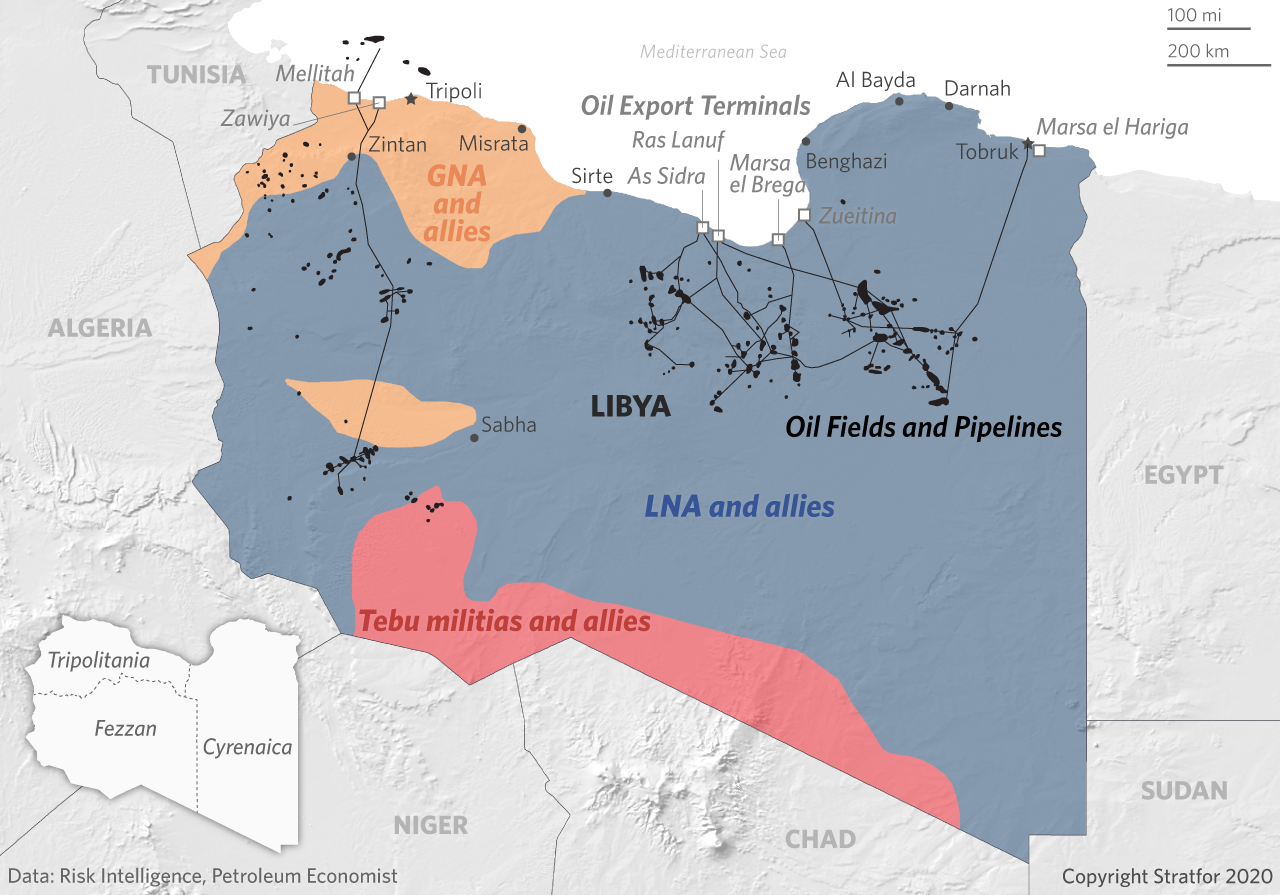
- Led by France, the United States, the United Nations and Egypt, these negotiations have centered on directly splitting oil revenue between Libya's three regions of Cyrenaica, Fezzan and Tripolitania. This new system would, in turn, bypass the country's Tripoli-based Central Bank of Libya (CBL), which is where Libya's oil revenue is currently deposited.
- It remains unclear exactly how Libya's oil revenue would be divvied up in any agreement, but possibilities include basing the split on the amount of oil produced in each region and/or the population size of each region. A proposal that's been discussed would also involve setting up a bank for each region where revenue would be deposited.
Granting each region the power to set up their own bank to handle revenues would resolve the biggest concern among the tribes currently blocking oil exports in eastern Libya.
- Eastern Libya has long called for a greater share of oil revenue, demanding that the CBL increase its transparency and be audited by international parties. Officials in the region have also been backing their own rival CBL.
- In January, Khalifa Hifter's Libyan National Army (LNA) and eastern tribes shut down the region's oil export terminals over concerns that the CBL was funneling the revenue to support rival militias from Libya's west and help the GNA to hire Syrian mercenaries.
- But on June 29, a group of eastern Libyan tribes and notables released a statement saying they were ready to reopen the terminals and restart production if international negotiations resulted in an agreement that prevented revenue from being disbursed to militias.
A deal that bypasses the CBL would also represent a significant departure from the international community's current view on the indivisibility of Libya's main institutions, which could lead to further structural divisions in the country.
- At the start of Libya's civil war in 2011, the United Nations enshrined in a resolution that the NOC, CBL and Libyan Investment Authority were the only entities that could fulfill their respective functions from Libya. The resolution is intended to keep Libya's lucrative oil industry and financial institutions from being split between rivals and becoming a theater of competition.
- In 2014, the United States also stepped in to prevent oil exports that weren't organized by the CBL from leaving eastern Libya.
- While Eastern Libyan tribes' key demand is a greater share of Libya's oil revenue, the region has also set up its own national oil company as a rival to the NOC, and will likely push for a split of the NOC in the future.
A successful deal could mark the first step toward a de facto partitioning of Libya by outlining clear mechanisms to divide the country's oil revenue and oil industry. This would only drive more competition between eastern and western Libya over the physical control of oil resources. A divided Libya would also likely see a strengthening of Turkey's allies and the Muslim Brotherhood in the west, as well as a strengthening of Egypt's allies in the east.
