
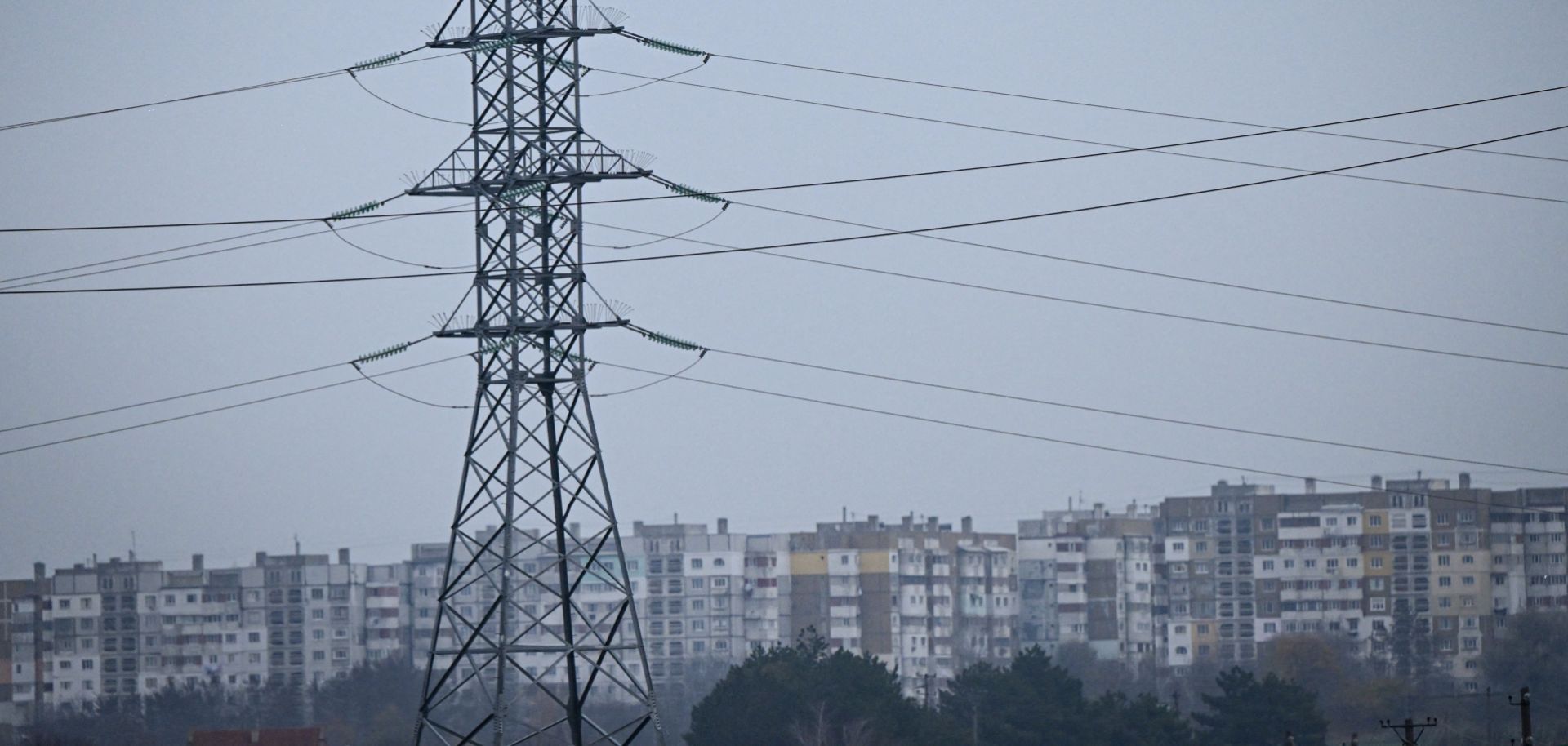
Power lines are seen on the outskirts of Balti, the second-largest city in Moldova, on Nov. 2, 2022.
While Moldova’s economic and political situation will remain fragile in the coming months, a deterioration of living conditions sufficient to change Chisinau’s pro-Western course or oust the government remains unlikely, in part because of growing support from the West. In a speech before Romania’s parliament on Nov. 1, Moldovan President Maia Sandu pledged to maintain her country’s pro-Western course and support of Ukraine despite what she called unprecedented Russian energy and political “blackmail.” Sandu said she wanted “everyone to know that Moldova chooses to be free and continue on its European path no matter the circumstances” and that “we are willing to pay the price of our freedom.” But Moldova’s commitment to that course will remain under strain for the foreseeable future, given the immense scale of the challenges facing the country. Year-on-year inflation is nearly 35%, and Sandu acknowledged that Moldovans are now often spending as much as 75% of their household income on utility bills, which have increased tenfold compared with last year. These difficulties are largely driven by the country’s energy crisis, which worsened significantly on Nov. 1 when the country’s pro-Russian breakaway Transdniestria region stopped supplying the rest of Moldova with electricity, which precipitated widespread blackouts.
- Transdniestria is home to Moldova’s largest gas-operated power station, which historically supplies about 70% of the country’s electricity needs but sharply cut output following the 40% cut in Russian natural gas deliveries on Nov. 1. Russia’s state-owned gas giant Gazprom cut flows on the grounds that Chisinau is not fully compliant with the contract it signed last year related to the payment of old debts, which constitute hundreds of millions of dollars to be paid over many years.
- Moldova has historically purchased the other 30% of its electricity not produced domestically in Transdniestria from Ukraine. But now those purchases from Ukraine are under strain as Kyiv has curtailed exports amid Russia’s air campaign targeting Ukrainian civilian power infrastructure. Russia conducted mass air attacks on Ukraine’s power grid and energy systems on Nov. 15 and 17, after which Ukraine's Prime Minister Denys Shmyhal admitted that almost half of his country’s energy infrastructure is now offline. An attack on Nov. 23 again knocked out power across most of Ukraine and Moldova.
- Romania has stepped in to help Ukraine with electricity deliveries, on Nov. 2 agreeing to meet 90% of Moldova's previous electricity imports from Ukraine. But on Nov. 15, the Isaccea-Vulcanesti line that supplied Romanian electricity to Moldova through the Transdniestria region and Ukraine was downed, causing speculation that Russian or pro-Russian actors had sabotaged the line on Ukrainian soil to disrupt electricity to Moldova.
Russia will continue to use Transdniestria to destabilize Moldova, but a complete Russian gas cutoff to Moldova is unlikely because of the collateral destabilization this would cause in Transdniestria. On Nov. 22, Gazprom threatened to cut off natural gas supplies to Ukraine corresponding to volumes of gas it claims the Ukrainians are siphoning and not allowing to reach Moldova. Reduced flows through Ukraine would represent the first step toward a complete cessation of Russian gas supplies through Ukraine to Europe. But such a move would be detrimental to the Transdniestria region, which receives its gas from territory controlled by the Moldovan government. Romania and Ukraine would be unwilling to supply the pro-Russian Transdniestria region (and possibly incapable given both countries’ own domestic electricity shortages), meaning a total cut-off of Russian gas to Moldova would likely prompt a mass flight from Transdniestria and turn some remaining residents against Moscow. Furthermore, with the risk of a Russian invasion of Moldova largely gone for the time being following Russia’s retreat from the southern Ukrainian city of Kherson, locals may become even more skeptical of their reliance on Russia. Finally, Russia’s intelligence services consider the breakaway region a useful place to base agents operating in Ukraine, Moldova and Western countries, which Moscow would not seek to jeopardize by destabilizing the region. Instead, Russia may intend to redirect deliveries to Moldova and Transdniestria southward via the Turkstream pipeline, which would allow Russia to further decrease supplies through Ukraine without threatening supplies to Transdniestria.
- Many people in Transdniestria are increasingly frustrated by the growing perception that their well-being is being sacrificed to further Moscow’s efforts to influence the rest of Moldova. On Nov. 3, the head of Transdniestria’s Ministry of Economic Development acknowledged the region is “on the verge of a humanitarian crisis.” Transdniestria’s president Vadim Krasnoselsky has also said he’s approached Gazprom and has asked the Russian authorities to step in and do whatever it takes to get more gas into Transdniestria.
- Since Nov. 1, Gazprom has supplied Moldova's Moldovagaz with only 5.7 million cubic meters of gas per day, 40% less than in October. Moldova has received 3.4 million cubic meters of those supplies each day, with Transdniestria receiving the remaining 2.3 million. Transdniestria’s foreign minister has acknowledged that solving the breakaway region’s energy shortage is not possible without Russia supplying more gas to Moldova. Transdniestria’s largest enterprises have had to curtail work due to power cuts, further hurting its fragile economy.
Declining living conditions in Moldova will fuel the pro-Russian protest movement in the country, which will likely grow in the coming weeks and seek to challenge the pro-Western government in Chisinau. Since September, pro-Russian political forces in Moldova have staged demonstrations calling for Sandu’s resignation and early elections to ensure continued energy supplies from Russia. The movement has been largely led by Ilan Shor, an Israel-based Moldovan oligarch and the leader of Moldova’s populist Shor Party. His supporters held days-long protests in the country’s capital of Chisinau in October chanting slogans against the government’s pro-Western policies and carrying banners with slogans such as “No to Cold War, no to cold winter.” The movement has repeatedly attempted to erect camps outside government buildings as well. On Nov. 13, thousands of anti-government protesters returned to the streets of Chisinau to express their anger over the energy crisis and skyrocketing inflation.
- On Oct. 11, Sandu called on the government to give special powers to security forces to crack down on street protests after the mayor of Chisinau used city vehicles to block the capital's main thoroughfare in an apparent gesture of support for the protesters.
- The political situation in Moldova has caused concern in the United States, which on Oct. 26 sanctioned 12 entities and nine individuals involved in the pro-Russian protest movement, including Shor and another oligarch and former parliamentarian Vladimir Plahotniuc. Washington said it was seeking to “counter the government of the Russian Federation’s persistent malign influence campaigns and systemic corruption in Moldova” by sanctioning those who intended to “return Moldova to Russia’s sphere of influence.” Sandu welcomed the U.S. move and on Nov. 2 said there was clear evidence that the social unrest was being organized by the Russian intelligence services as part of “a hybrid war on Moldovan territory.”
- Igor Dodon, Moldova’s pro-Russian former president and current leader of the Party of Socialists of the Republic of Moldova, was released from house arrest on Nov. 19 in connection with multiple criminal charges after the country's Supreme Court of Justice rejected the anti-corruption prosecutor's office's request to extend his home detention. Dodon immediately vowed to supporters outside the courthouse that he would continue to protest against Moldova's pro-Western leadership, which could enable Shor’s movement to more effectively team up with more traditional pro-Russian political forces led by Dodon.
In the coming months, Moldova’s Western supporters are likely to increase financial assistance to prevent a humanitarian crisis in the country and a surge of Moldovan migrants to other parts of Europe. Social discontent and anti-government sentiment will likely continue growing in Moldova as economic conditions worsen and colder temperatures set in. If the energy crisis worsens significantly, some Moldovans will join the pro-Russian protest movement. But many others are likely to instead seek refuge in Europe, mostly in neighboring Romania. The increasingly dire situation in Moldova has already prompted Western nations to become more proactive in alleviating the country’s crisis, a trend that will likely continue during the winter as increased heating demands worsen energy shortages and risk leaving people in the cold. This support will be critical in not only maintaining stability in Moldova, but also in reducing fatigue and budgetary constraints in Romania, which has footed a disproportionate amount of the bill for supporting Moldova, and whose electricity sales have led to higher prices for domestic consumers.
- In May 2021, Romania's Justice Ministry acknowledged that almost 650,000 Moldovans — almost one-quarter of Moldova’s population — already possessed Romanian passports. And since then, many more have sought to obtain such passports: as of Nov. 25, it’s estimated that about 1 million Moldovans, or around 40% of the country’s population, have likely applied for Romanian citizenship.
- On Nov. 21, about 50 countries and institutions met in Paris at the third meeting of the Moldova Support Platform, a conference aimed at gathering “concrete and immediate assistance” for the country, resulting in over 100 million euros worth of new financial aid pledges.
