
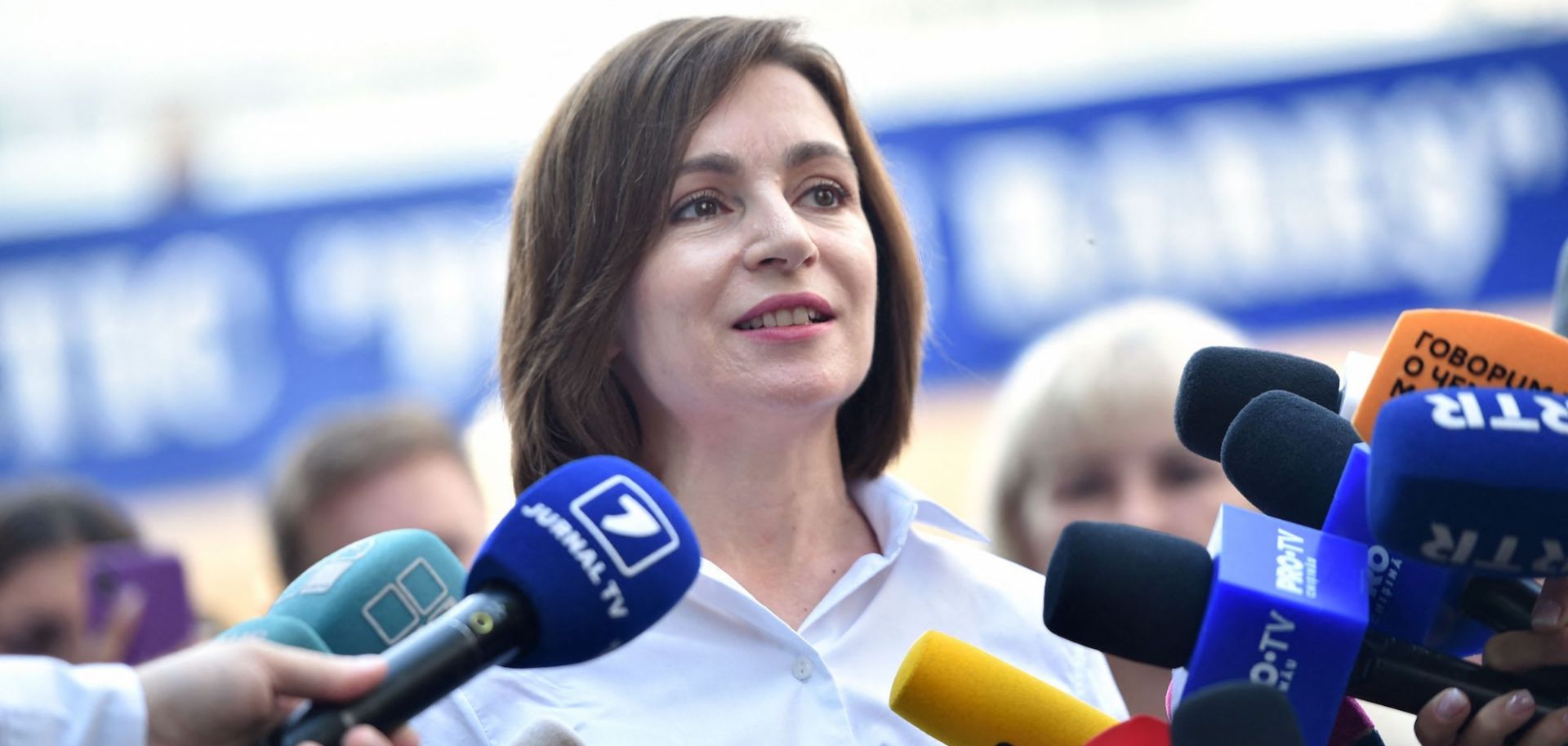
Moldovan President Maia Sandu speaks with journalists outside a polling station in Chisinau on July 11, 2021.
The election of the most pro-EU government in Moldova’s history will open the door for reform, but Russian influence will prevent progress in the breakaway state of Transdniestria. Moldova elected its first female president in November. And now for the first time, a single pro-European party will also hold a majority in the ex-Soviet state's parliament. Pro-European president Maia Sandu called the July 11 snap election after months of obstruction following her election last year. Her Party of Action and Solidarity (PAS) exceeded expectations by capturing an absolute majority of the votes, nearly 53% — putting it on track to gain 48 seats to occupy 63 of the 101 in Moldova’s parliament. The Pro-Russian Electoral Bloc of Communists and Socialists, led by ex-Presidents Igor Dodon and Vladimir Voronin, lost 3 seats — bringing its total to 32. The new Moldovan government’s first priority will likely be anti-corruption judicial reforms as a first step toward securing loan support from the International Monetary Fund (IMF) in order to aid in the country’s economic recovery. The government will also look to increase economic resilience and growth by moving forward with various forms of enhanced economic cooperation with the European Union, of which it is not a member.
- PAS has ultimately emerged as the beneficiary of Moldova’s June 2019 constitutional crisis, given that the July 11 election saw the complete collapse of all other parties in the country, including the Democratic Party of oligarch Vladimir Plahotniuc who fled Moldova amid the upheaval in 2019.
- Following Sandu’s election in November 2020, Moldova’s then pro-Russian parliament enacted a flurry of steps intended to sabotage her ability to govern. This included repealing a 2016 banking law originally passed as a precondition for IMF loans and scrapping IMF-backed pension age increases.
- In a recent interview, PAS Vice President Mihai Popsoi said he hopes “it will be possible for Moldova to apply to join the EU during our new mandate.” Brussels will slow walk any such talks due to enlargement fatigue within EU member states, but official discussions of even the possibility will draw the ire of Moscow.
The new government’s capacity for making deep reforms will be tested by remaining corrupt elites and their business interests. PAS’s majority in parliament is slim and it isn’t clear that all of the new deputies will be fully loyal to Sandu’s agenda. PAS deputies are very unlikely to defect to the opposition or openly critique Sandu. But there’s nonetheless a possibility that some new deputies could still seek to subtly water down or slow reform efforts in parliament in service of parochial interests. Indeed, as evidenced by neighboring Ukraine, even a nominally pro-reform majority can prove insufficient to enact rapid or sweeping reforms due to the pervasive influencers.
The Moldovan government's priorities will immediately run into opposition from Russia, which sees its geopolitical interests threatened by increasing economic cooperation with the West. Russia knows that overly supporting the losing socialist and communist bloc in Moldova’s parliament is a questionable long-term strategy, and risks unnecessarily provoking tensions with Chisinau in the near term. Following initial contacts, Moscow will tune its strategy with Moldova as its new government’s true priorities — and ability to accomplish them — become clearer. Moscow's rhetoric toward Moldova is likely to be more subdued than toward other ex-Soviet states like Ukraine, Belarus or Georgia, where pro-European rhetoric is aggressively pushed back against. Pro-European governments in Ukraine, Belarus and Georgia are given little respect because their shared borders with Russia make the coercive threat of Russian hard power very real, which Russia has demonstrated repeatedly in recent years. Instead, Russian conduct and rhetoric toward Moldova are more likely to mimic that toward Armenia, another small nation with which Russia does not share a border. Russia exercised significant restraint in its approach to Armenia after the country elected a pro-Western government in 2018 on an anti-corruption agenda targeting Russian influence. In Moldova, Russia is similarly likely to outwardly insist that it will not obstruct the new government’s domestic agenda so long as Moscow’s interests are respected.
Russia is unlikely to completely forgo attempts to undermine the Moldovan government, as its domestic reform priorities invariably entail a slow but irreversible waning of Russia’s influence in the country. Anti-corruption reforms and European integration will directly affect economic ties to Russia. For this reason, Russia will likely continue to support behind the scenes steps to undermine Sandu and her government through political intrigue and economic levers — hoping that a wave of disappointment following the failure of reforms to pass or have significant impact will allow Russia to reassert its traditional influence over the country in a few years. But Russia will still strive to keep those efforts out of the public eye.
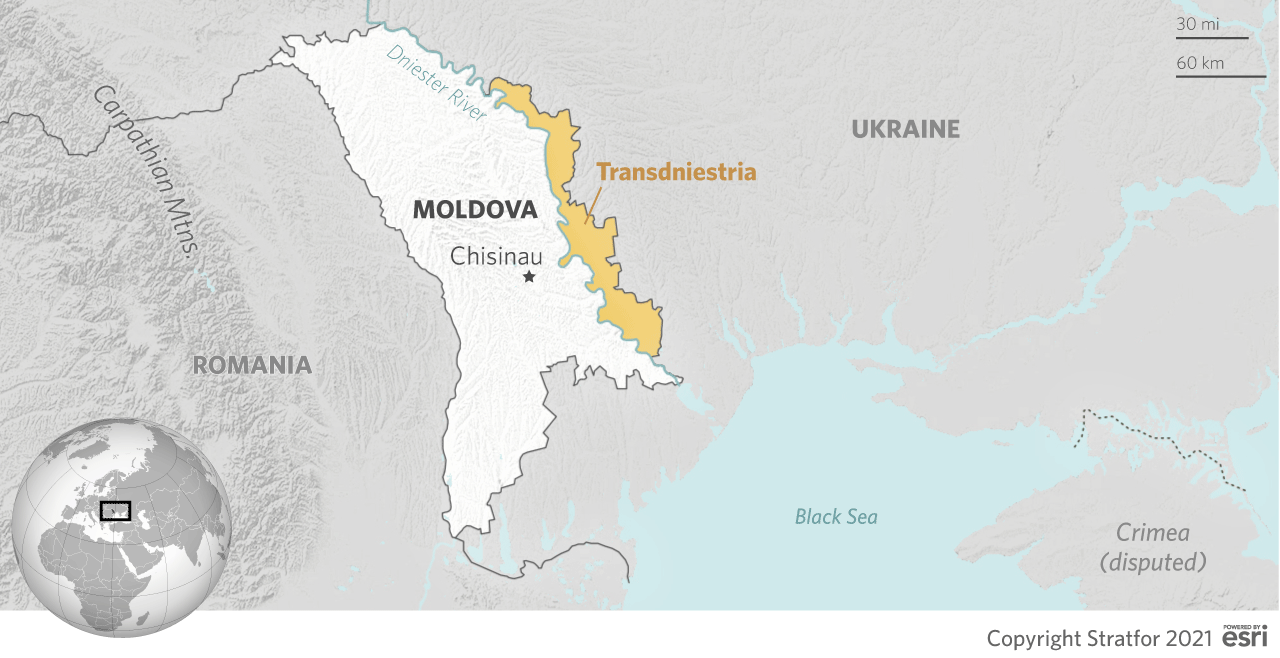
For the first time in decades, the Moldovan government could finally be in a position to work with Ukraine to resolve the frozen conflict in Transdniestria, but it is unlikely to do so for fear of Russian retaliation. Moldova will be enticed to work with the friendly government in Ukraine to pressure the predominantly Russian-speaking breakaway region of Transdniestria, which declared independence from Moldova after the Soviet Union collapsed in 1991. Sandu has promised to cooperate with the Ukrainian government to curb smuggling and organized crime activity that occurs along the unofficial Transdniestria border. With a supportive majority in parliament, she now has the domestic power to follow through on that pledge. Sandu’s nascent government, however, will likely ultimately determine that doing so is not worth provoking Russia, which still has the ability to undermine Moldova both politically and economically.
- Transdniestria won its autonomy with the help of the Russian military after waging a civil war in 1992. The region has since remained effectively independent from Moldova.
- Around 220,000 people, or about two-thirds of the citizens living in Transdniestria, hold Russian passports, which Russia uses to justify its control over the Transdniestrian dispute. Russia maintains a peacekeeping force of about 1,500 soldiers in the breakaway state to preserve the status quo.
