
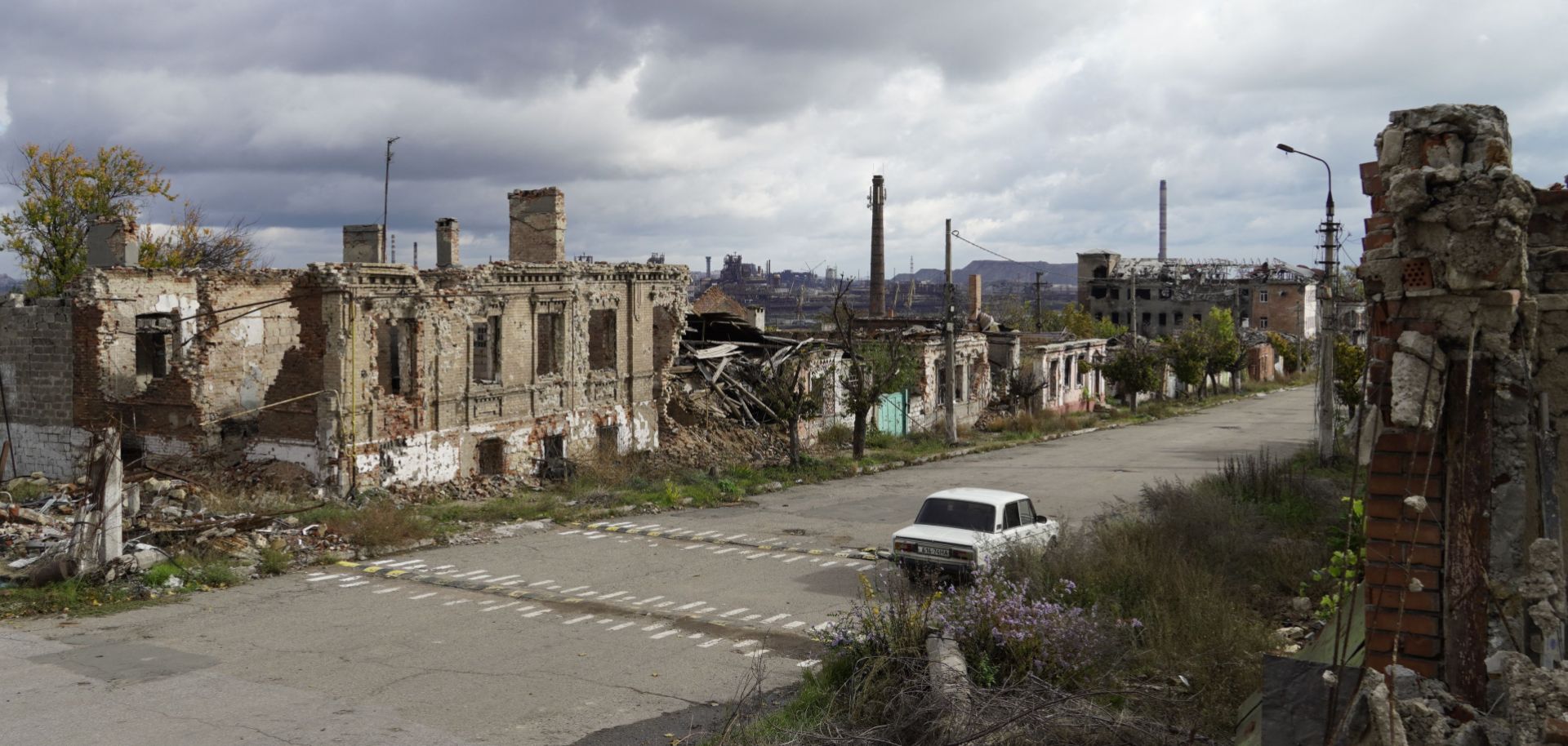
A picture taken on Oct. 28, 2022, shows the Russian-controlled port city of Mariupol in southeastern Ukraine.
In Ukraine, Russia will continue to utilize military tactics learned in Syria, like depopulation and even potentially the use of banned weapons. But without a break in Western support for Kyiv, these tactics will not make a strategic difference in the war, incentivizing Russia's military to increase its pace of attacks on civilian infrastructure and Ukrainian civilians. On Oct. 8, Russia appointed a new military commander for its Ukrainian war — General Sergei Surovikin, whose most recent military experience was in the Syrian civil war in a series of rotations from 2017-2020. Surovikin's appointment led to widespread speculation that in the face of a depleted Russian ground force and successful Ukrainian counterattacks, he would more heavily shift Russia's military tactics to those utilized in its Syrian campaign, like widespread attacks on civilians to displace the population and the potential use of banned weapons like chemical attacks. Indeed, throughout October, Russia began to escalate its attacks against Ukraine's civilian infrastructure, striking power plants and causing widespread blackouts, while also renewing attacks on the capital of Kyiv for the first time in months.
- General Surovikin succeeds another Syrian campaign veteran as commander of the war effort in Ukraine. U.S. officials said that General Aleksandr Dvornikov was also reportedly appointed full commander of the war this past spring following Russian troops' retreat from Kyiv in March. But Dvornikov's tenure saw few major gains besides the fall of besieged Mariupol and Sievierodonetsk. Dvornikov also oversaw the targeting of civilians and non-military infrastructure, largely in Mariupol and the Donbas, where the Russian campaign refocused its efforts. Dvornikov was replaced after a Ukrainian offensive in September captured the key city of Izyum in the Kharkiv oblast in a rapid offensive.
- Russia's intervention in Syria in 2015 focused heavily on the use of special forces, the air force and military police to support the Syrian government and its Iranian allies on the ground. Often under Russian leadership, these combined forces besieged rebel enclaves, regularly targeted civilian infrastructure, and utilized banned weapons like sarin gas to force surrenders that often would see the civilian population forced to relocate to another rebel-held territory. Russian air force units were a particularly important part of breaking the years-long battle for Aleppo in late 2017, where these tactics eventually broke rebel resistance. Today, Russian jets continue to strike civilian targets in the rebel-held Syrian province of Idlib as Moscow backs pressuring rebel groups by undermining humanitarian conditions in the war-torn region.
- The United States and European allies did not respond to most Russian-led human rights violations in Syria with a strategic shift against Moscow or its ally, Syrian President Bashar al Assad, concerned about the risks of escalation in a country of comparatively marginal strategic importance to all sides. For Russia, this lack of response from the West fed into a narrative of success in Syria that now informs Russian military thinking in Ukraine.
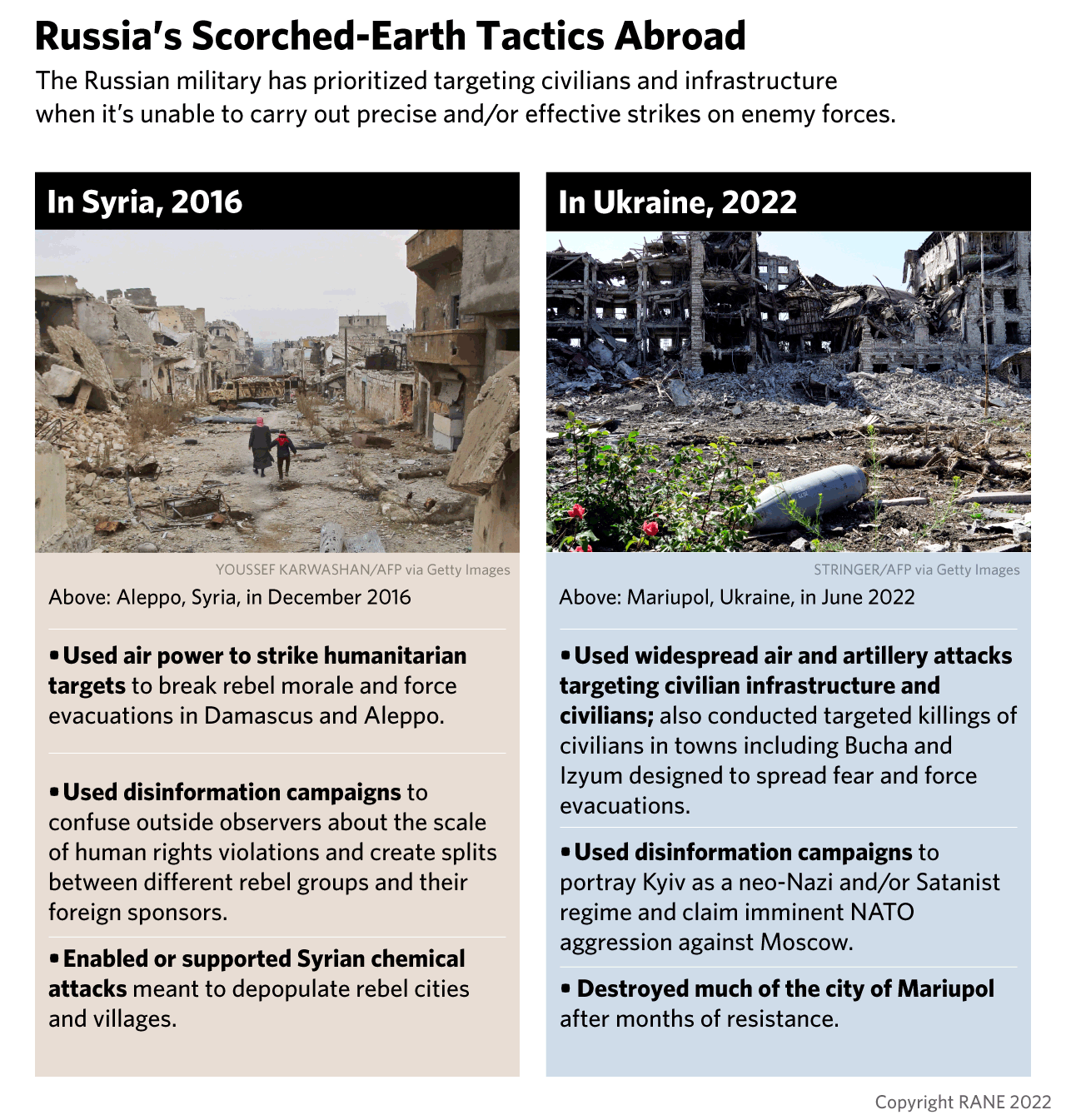
Russia attacked only a limited set of civilian targets during the first few weeks of the war, based on the assumption that Ukraine's government would collapse quickly. But since the defeat at Kyiv in March, Moscow has adopted a more intense and widespread campaign against Ukrainian civilians that has started to look increasingly similar to its military campaigns in Syria and Chechnya. Intercepted Russian communications from before the war indicate that Moscow expected a fast military victory against Ukraine, leading the initial phase of the campaign to focus on a drive to Kyiv and a rapid seizure of much of the country's south without widespread targeting of civilian infrastructure. When Ukrainian resistance forced a Russian retreat from Kyiv in March and bogged down Russian forces around Mariupol in the south, Moscow utilized its scorched-earth tactics seen in Syria and, before that, in the Chechen Wars in the 1990s. Mariupol's civilian infrastructure was targeted and destroyed, with much of the population displaced, until the city fell in May. Russian warplanes and missiles also began to strike civilian targets in other Ukrainian cities (like Kyiv, Kharkiv, Mykolaiv and Odesa) to intimidate the population and create political and military pressure on Ukrainian President Volodymyr Zelensky's government to retreat forces or surrender. Instead, the attacks rallied the Ukrainian population in favor of the war effort. Russia also brought around 2.8 million Ukrainians to Russia itself, some against their will, from captured territories, in a bid to demographically engineer these regions.
- Up until recently, Ukraine's electrical grid had largely been functioning without major interruptions. But since Surovikin took over as Russia's lead military commander in the war on Oct. 8, Kyiv says over 30% of the country's power plants have been targeted and destroyed, which has led to widespread blackouts across Ukraine.
- Since Russian troops retreated from Kyiv earlier this year, the capital city had seen a decrease in attacks by Russian air power. But this, too, has changed in recent weeks amid a series of airstrikes targeting Kyiv, as Russia's military shifts back to its former strategy of trying to displace and demoralize civilians across the country with the help of newly supplied missiles from Iran.
Russian strikes on civilian infrastructure and non-combatants will harden Ukraine's resolve to fight on and reinforce NATO's resolve to keep providing Kyiv military support. While causing panic inside Ukrainian cities, Russia's attacks also inspire anger and solidify public support for the counter-offensives against its military occupation of Ukrainian territories. The Russian attacks are also not widespread enough to interrupt Kyiv's command and control of its armed forces, interrupt the logistics that resupply troops on the frontline or displace enough civilians to seriously hamper the war effort. Meanwhile, Russian human rights violations reinforce the political narratives that help justify public support for Ukraine in NATO nations.
- Russian strikes on Ukrainian civilian infrastructure have been unable to cut supply routes to NATO, partially because they haven't been widespread enough to break the rail and road links between Romania, Poland, Hungary, Slovakia and the frontlines. NATO equipment and logistics are also not as dependent on railways. But most importantly, Ukraine's wide land borders give NATO numerous major and minor road routes to access that are either out of range for Russian drones and warplanes or risk interception by Ukrainian air defenses. This contrasts with Russia's position in Crimea, which is far more vulnerable to being cut off from other countries due to its isolation by the Black Sea and the Sea of Azov, and because Russia relies heavily on rail lines to support its forces.
- Europe and, to a lesser extent, the United States are facing rising energy prices and an overall cost of living crisis. But despite this, neither the U.S. government nor any European government has openly considered ending its military support to Ukraine in exchange for the resumption of cheap energy exports from Russia. This is due in part to documented Russian military atrocities at places like Bucha, Izyum and Russia's continued strikes on Ukrainian civilians, which make it difficult for Western governments to justify ending support for Ukraine to their constituents.
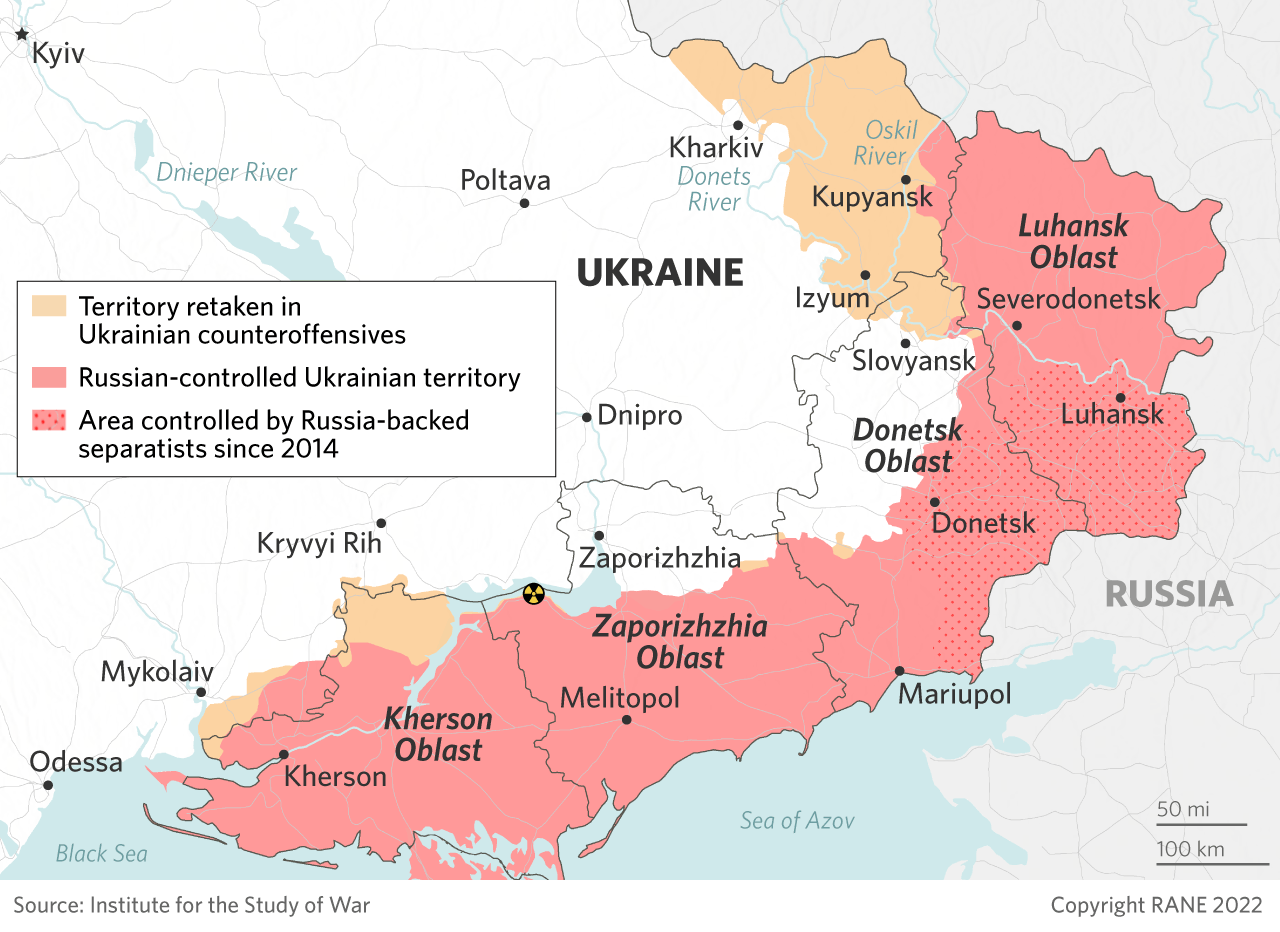
- Ukraine's military has also made advances near the Russian-occupied city of Kherson, where Russian forces are reportedly withdrawing under military pressure — signaling that Russia's attacks on civilian infrastructure are not halting Ukraine's military counter-offensives.
Russia's military leadership is likely to escalate its use of attacks on civilian infrastructure to show even limited progress to the Kremlin, which could lead to more focused efforts to depopulate regions along the frontlines like Kherson, Zaporizhzhia, Izyum and/or Kharkiv, including through the use of banned weapons. The use of scorched-earth tactics in Syria generated praise in Russia for General Surohivkin and other generals, creating a precedent for advancement in the military career through the utilization of such tactics. With Russia's mobilization campaign still unlikely in the near term to rebuild the Russian military to the point where it can conduct wide-scale offensive operations or even hold territory already gained, these scorched-earth tactics could increasingly become a metric of success for the Kremlin. As Ukrainian forces take territory, Moscow could focus more heavily on civilians near the frontline in an attempt to increase the refugee burden on Kyiv and Europe, destroy infrastructure that might be used by the Ukrainian military, and demoralize Ukrainian forces re-taking territory to find their cities and homes in ruins. Russia could utilize banned chemical weapons in this effort — especially chemical weapons that are harder to track, like mustard or chlorine gas. Any confirmed use of chemical weapons, however, would probably be met with increased support for Ukraine by NATO and other countries, along with more Western sanctions against the Russian economy.
- Despite Russia's mobilization of around 300,000 conscripts, reports indicate that Russian units are understrength and that most of these new soldiers will take many weeks to be ready for combat. Many of their units are also underequipped, making it unlikely they'll be able to halt Ukrainian counter-offensives in the near term.
- Russia maintains large stockpiles of numerous chemical weapons, including the highly deadly VX and sarin gasses, as well as the less-lethal mustard and chlorine gasses.
