
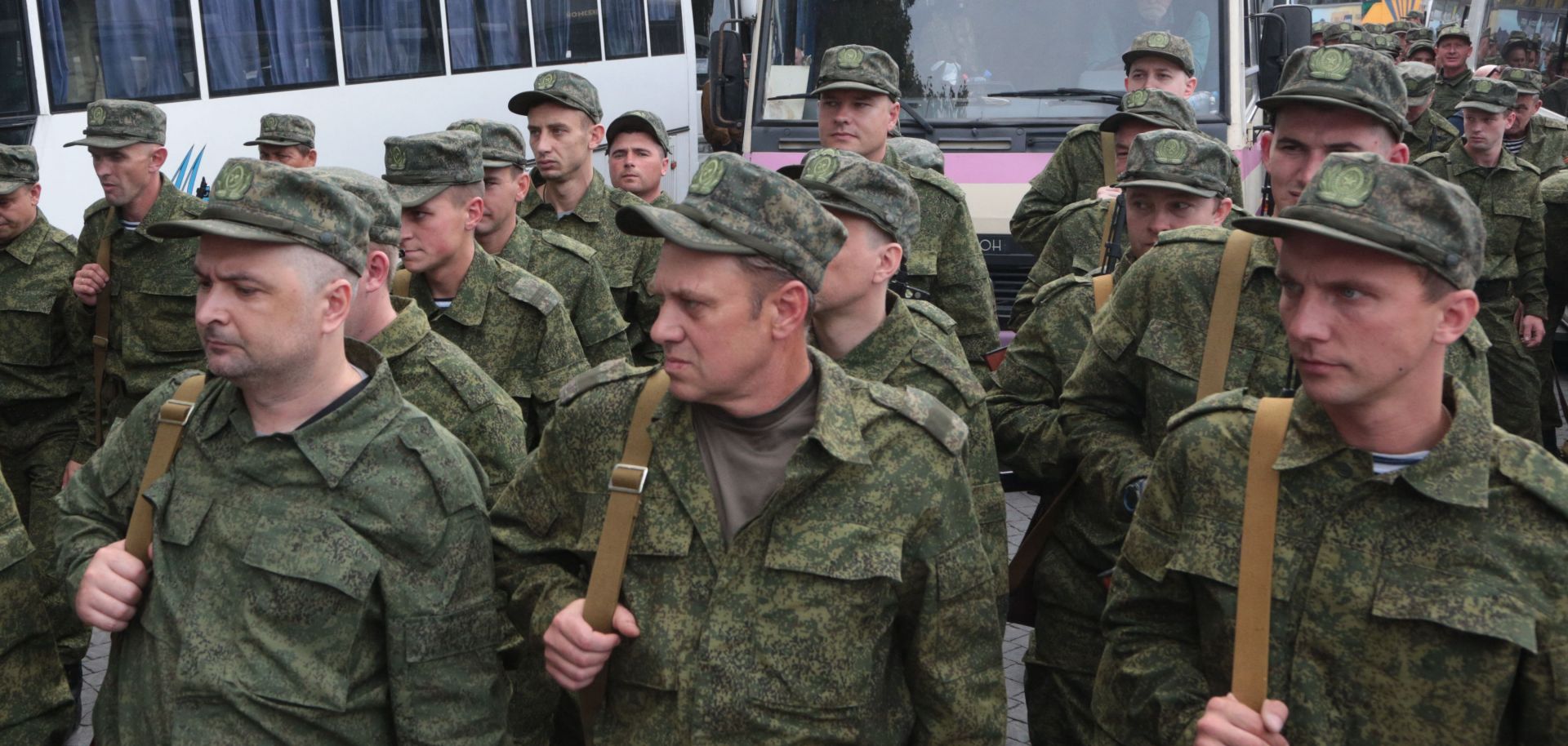
Reservists drafted during Russia's partial mobilization attend a departure ceremony in Sevastopol, Crimea, on Sept. 27, 2022.
Russia's mobilization will create near-term economic strains while worsening its long-term economic outlook, adding to demographic challenges and brain drain, and leading to major workforce reductions and internal migration. On Oct. 4, Russian Defense Minister Sergei Shoigu said 200,000 people had already been drafted into the armed forces as part of Russia's ''partial mobilization'' to call up 300,000 reservists with previous military experience to deploy to Ukraine. The same day, however, reports citing officials in the Russian presidential administration stated that approximately 700,000 Russians had left the country in the two weeks since the Sept. 21 announcement of the mobilization. The exodus, which has caused long lines at nearly all of Russia's land borders, has persisted amid reports that some of the freshly mobilized troops have received minimal training and poor equipment before being sent to the frontlines, and that the 300,000 figure is merely the initial target for the ''first stage'' and to be expanded in the coming months as Russia's military difficulties in Ukraine persist.
- On Sept. 29, Russian President Vladimir Putin for the first time publicly acknowledged that the mobilization had not gone smoothly, claiming that widespread ''mistakes'' had been made and should be corrected. On Oct. 3, the governor of Russia's far eastern Khabarovsk region admitted that up to 50% of those who had received draft summons in the region had received them incorrectly, suggesting Russian authorities in some regions are very concerned about meeting targets and for that reason are mobilizing people who are either too confused or intimidated to resist.
- Reports citing Kremlin sources have claimed that Moscow may seek to mobilize between 700,000 and one million people in the coming months, as additional manpower is likely necessary to stop further Ukrainian advances; if that succeeds, more troops will likely be needed thereafter as President Putin's ambitions will likely rise and he will seek to return to offensive operations in the Donbas or other areas of southeastern Ukraine.
Russia's mobilization will likely focus on ethnic minorities in rural areas in Russia's economically depressed regions to try to reduce public backlash. Reports in the Russian press suggest that Moscow and St. Petersburg will be disproportionately untouched by the mobilization. Authorities reportedly are aiming to mobilize as few as 20,000 soldiers in the first wave of mobilization, well below 1% of the reservists between the two cities. By contrast, rural areas — in particular, regions populated by ethnic minorities in the Caucasus, Urals and Siberia — are seeing comparatively larger mobilizations of 4% or even 5% of their reservists. Moscow likely hopes that concentrating mobilization in these more rural, far-flung regions will confine popular backlash — and combat losses — to areas outside of Russia's Northern European core and ethnic Russian populations, among whom high losses would be more likely to critically undermine support for the war. Furthermore, on Oct. 6, independent Russian investigative journalists calculated that 23 of the 26 regions with the highest proportion of recruits are those with incomes below the national average, suggesting a deliberate effort to concentrate mobilization in economic backwaters and thereby lessen the overall impact on the Russian economy.
- Despite the Kremlin's efforts, the mobilization has sparked some public protests. In the southern Dagestan region, for example, demonstrations against the region's reported 13,000-man quota lasted for several days in late September and resulted in violent clashes with security forces. Smaller-scale incidents of protest and attacks on security forces have also been reported in other cities across the country. The unrest, however, has so far not resulted in any meaningful policy change and remains unlikely to do so.
Despite the Kremlin's attempts to contain blowback, mobilization will fuel near-term economic challenges. Already, the Russian government is taking on large new fiscal responsibilities and trying to reduce the economic consequences of mobilization for individuals in order to incentivize compliance with the draft. On Sept. 28, Russian legislators in the Duma passed a law freezing loan repayments, including mortgages and consumer loans, for draftees and all others serving in the war, as well as their immediate family members. As many of those currently mobilized are likely to be forced to stay in the army for many months or years, this will effectively leave those creditors (i.e. major Russian banks) with significant nonperforming loans — destabilizing banks' balance sheets, which the government may have to remedy by providing them federal assistance. This risk is accentuated by laws saying that, in the event of the death of a participant in the ''special operation'' in Ukraine, his loan obligations and those of his dependents will be terminated, making banks responsible for even more debts, fueling a private debt bubble in the country that has been growing since Russia's initial invasion of Crimea in 2014. Meanwhile, reports indicate that the mobilization is disproportionately harming Russia's transportation sector and thereby fueling inflation; delivery costs are up as much as 50% in some regions in recent days — and up to 80% since the start of the war — as truck drivers (who cannot secure exemptions from mobilization) are in short supply and increasingly needed by the Russian military because drivers of logistical vehicles have experienced significant losses.
- Russia's central bank raised its interest rate to 20% at the start of the war but has since cut it to 7.5%. But between Sept. 21 (when the mobilization started) and Oct. 6, some 754.1 billion rubles (approximately $11.8 billion) were withdrawn from ATMs across Russia. This outflow of ruble deposits, combined with rising inflation, could force the central bank to stop further rate cuts and potentially even raise rates to prevent a renewed growth in inflation, further hampering Russia's economy.
- In an updated forecast published on Sept. 26, the Organization for Economic Cooperation and Development (OECD) said it now expects Russia's economy to shrink by 5.5% in 2022, marking an improvement from the 9% contraction it forecast in June. But the OECD also now expects Russia's slowdown to last longer and now projects a 4.5% contraction in 2023 compared with the 4% contraction it previously forecasted.
- In August, Russia ran a current account deficit for the first time since the invasion began due to falling oil and gas prices. Russia's finance ministry forecasts that the deficit will amount to 1.7 trillion rubles in 2022 and will further increase to 3 trillion rubles (at least 2% of GDP) in 2023.
- Based on statistics from Russia's central bank, independent analysts calculated on Aug. 31 that, for the first time in the history of the Russian banking system, the total overdue debt on retail loans (excluding mortgages) exceeded 1 trillion rubles (roughly $15.6 billion). Between January-July 2022, the growth rate of delinquent debt doubled in Russia — with the overall amount growing by 8% — compared with data from July 2021 to Jan. 2022. Overdue mortgage debt by the beginning of Aug. 2022 amounted to 4.8 billion rubles. On Oct. 2, a national bankruptcy moratorium that had been in place since April 1 expired, and Russian creditors have again been able to initiate insolvency proceedings against their debtors. Households' debt as a share of net disposable income in Russia has also been rising steadily in Russia since the early 2010s.
Looking farther ahead, Russia's mobilization will also worsen its demographic outlook and intensify the country's ''brain drain.'' Compared with the COVID-19 pandemic, which mostly affected older Russians, the war in Ukraine will have a much more painful and prolonged impact on Russia's population (and, in turn, its economy), as those who are being called into military service in Ukraine are disproportionately younger males in their most economically productive years. Many of these young men will likely be subsequently killed in battle, or severely wounded to the point where they're unable to have families or hold certain jobs upon returning home. The growing loss of men who may have otherwise had children and paid into the country's pension system will not only further strain Russia's labor force, but contribute to the country's declining birth rates. This will be exacerbated by the fact that hundreds of thousands of Russians who have fled the country in response to the mobilization are also disproportionately younger, better educated and wealthier.
- The recruitment of 300,000 males initially targeted by the government's ''partial mobilization'' would have been manageable for the Russian labor market on its own. But in the coming weeks, at least 300,000 more Russians are estimated to either emigrate or be drafted into military service, which — combined with the roughly 700,000 Russians who have already fled the country — would represent the loss of about 1.3 million people (or at least 2% of Russia's entire workforce). If adding in those killed and wounded in the war, the irreplaceable loss to the labor force will grow even higher this year.
- Since 2020, Russia's population has undergone its largest peacetime decline in recorded history, a trend that has only accelerated in the months since the start of the war. On July 29, Russia's statistics agency reported a decline of 430,000 people between January and May of this year — an average of 86,000 people a month, the fastest monthly rate ever recorded. This rate has almost doubled since 2021 and nearly tripled since 2020, according to The Moscow Times.
Russia's relations with neighboring states, meanwhile, will also become strained as those countries harbor Kremlin opponents and run out of resources to handle large immigrant populations. The mobilization is prompting a growing number of Russians to flee their home country. But for many, legally exiting Russia remains difficult, as the list of countries where Russians can enter without visas is short — and the list of countries where Russians legally stay without receiving a residence permit or other status is even shorter. Obtaining visas to Western countries can be challenging as well. Meanwhile, rents in places more accessible to Russians, such as in Kazakhstan and Georgia, are skyrocketing as spare housing runs out, which is already generating grievances from some locals. Even in places where fleeing Russians are being warmly received, locals are likely to be hesitant to support their governments — which are already stretched economically — expending large economic resources to cope with the influx of Russians, especially as winter begins. Finally, tensions may only grow as Moscow is likely to cast neighboring countries harboring large numbers of anti-Putin Russians and draft dodgers as anti-Russian, harming bilateral relations.
- Kazakhstan and Georgia, in particular, have seen protests against Russian citizens entering their countries after President Putin announced the mobilization. Growing grassroots anti-Russian sentiment and public demonstrations against Russians could eventually lead to harassment of Russians, which Russian state propaganda will likely use to cast the countries as anti-Russian — further damaging bilateral relations and possibly prompting Russia to retaliate against those neighboring states.
- The mobilization has led to speculation that the Kremlin is considering various further restrictions on movement within or out of the country. Such measures would be unpopular and represent a shift in Moscow's strategy, thereby making them relatively unlikely. However, if border closures were enacted, it would mark the first time Moscow has restricted emigration since the Soviet Union's strict exit visa system was scrapped.
In combination, these trends will lead to competing incentives between Russian state officials and Russian business leaders by pitting successful mobilization and economic stability against one another — resulting in a long-term reduction in the workforce and significant internal migration as people seek to avoid getting drafted. On Sept. 23, Russia's defense ministry announced that draft exemptions would be granted to citizens working in some financial organizations, as well as those working in the IT, communications and media industries. Meanwhile, Russia's energy ministry sent a letter to leaders of the country's most powerful energy, mining and ore processing companies just hours after President Putin announced the mobilization, requesting compliance with the president's order and that 100% of their employees voluntarily stop by military recruitment offices by Oct. 5. The energy ministry's order indicates how some Russian ministries are acting preemptively to demonstrate loyalty to the government by prioritizing the mobilization, while bureaucrats in other ministries are more focused on securing draft exemptions for workers in the industries they oversee and thereby preserving business continuity. Private companies face a similar choice, and many will likely protect their employees to preserve their productivity amid a labor shortage by arguing that they fall under the exempt criteria, for example by designating them as essential IT specialists. Furthermore, individual Russians will likely go to great lengths to transition into the named sectors and jobs where such exemptions are believed to exist, including by moving cities to secure such work. Meanwhile, jobs where such exemptions are rarer — for example, construction, transportation and manufacturing — will have to offer high pay and other benefits to attract or maintain employees, harming companies' profitability. Such a large shakeup to internal labor market dynamics will be further exacerbated by the overall reduction in the labor force, reducing growth prospects for decades to come. This is a major problem given that Russia's labor force has progressively declined each year since 2007, according to the World Bank. Businesses and ministries are thus caught between a rock and a hard place, wanting to show complete loyalty and support without risking their own operations.
