
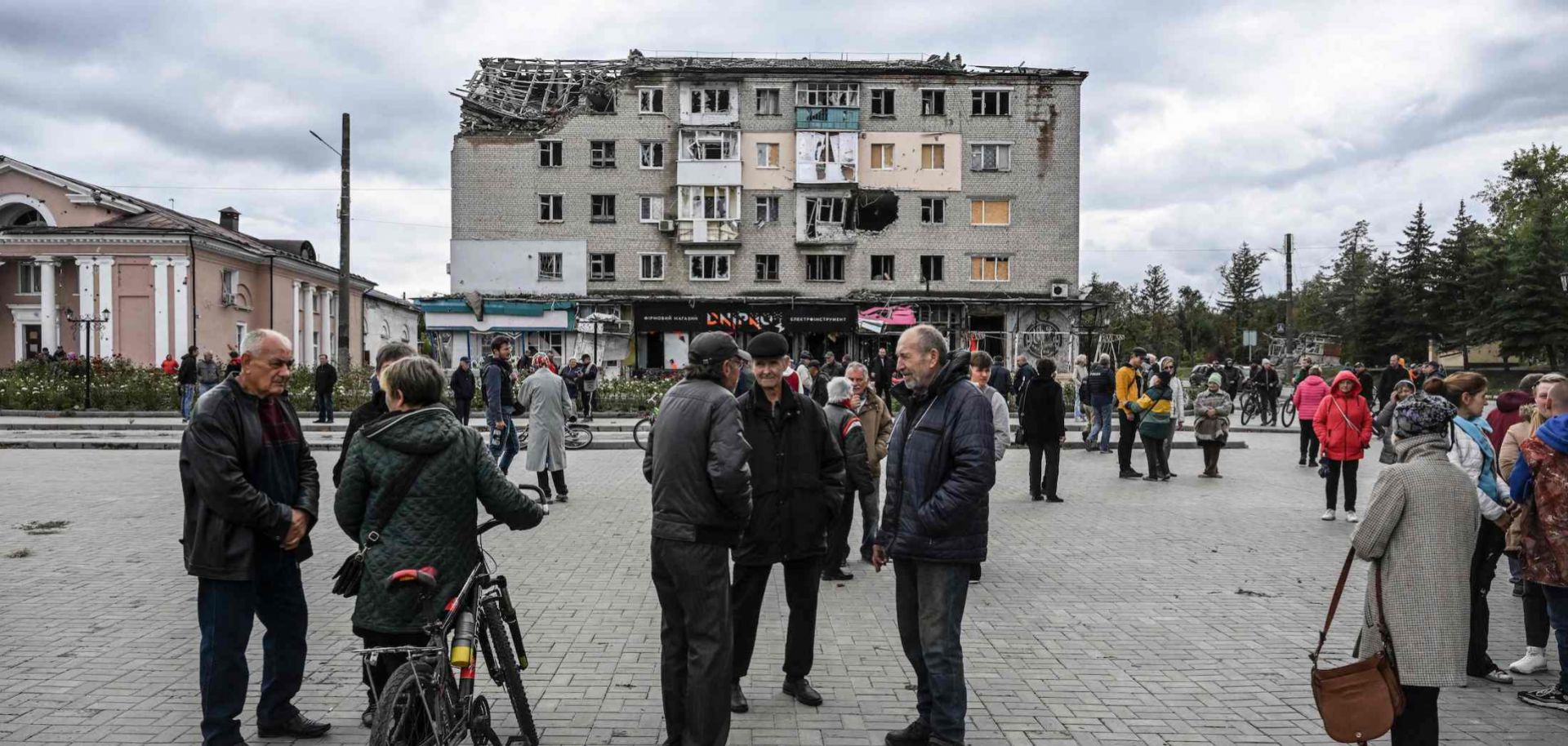
Local residents gather on a square in Izyum, eastern Ukraine, on Sept. 14, 2022.
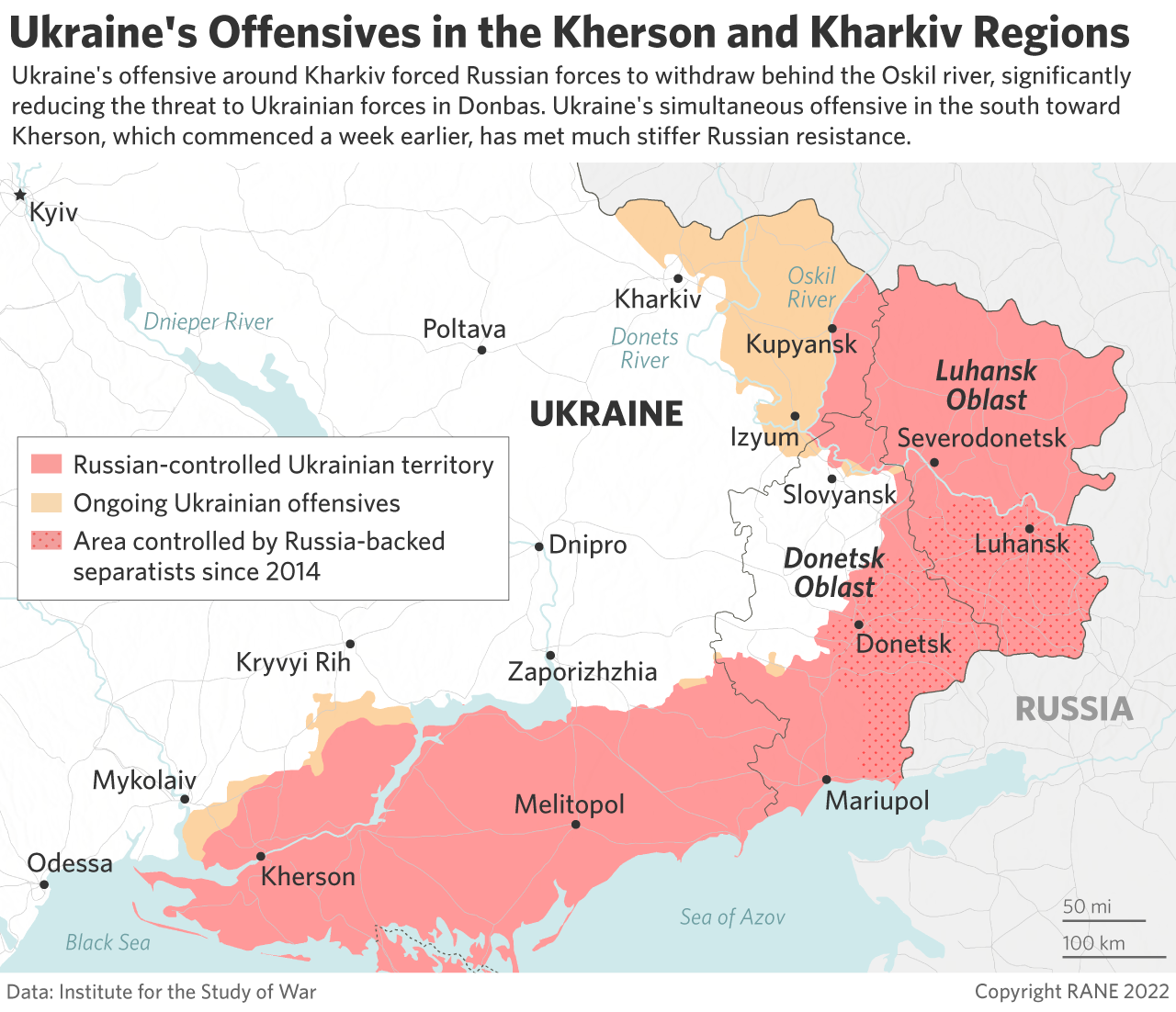
Ukraine's counteroffensive in the Kharkiv region will relieve the threat to Ukrainian forces in the eastern Donbas region, increase calls in Russia for mobilization and escalation of the war, and fortify the West's strategy of pressuring Russia while providing military aid to Ukraine. On Sept. 5, Ukrainian forces began a new offensive against Russia with a breakthrough south of Kharkiv, Ukraine's second-largest city. Ukrainian forces subsequently conducted one of the fastest advances since the opening weeks of the invasion, advancing well over 70 kilometers (44 miles) in multiple directions in just three days and threatening thousands of Russian troops near the strategic city of Izyum with encirclement. By Sept. 9, Russian forces began retreating to new defensive positions on the east of the Oskil River. Russia's defense ministry labeled the apparent retreat as merely a ''regrouping'' in order to ''intensify its efforts in the Donetsk region'' and thereby further the primary objective of Russia's so-called ''special military operation'' in Ukraine of ''liberating'' the Donbas. Ukraine's counterattack significantly improved its military position by eliminating Russian forces' bridgehead on the western bank of the Oskil around Izyum, from which they had threatened the northern flank of Ukrainian forces in Donbas. Russia's loss of this position, and large amounts of equipment near Izyum and Kupyansk, will all but ensure that Russian forces will not fully secure the Donbas region by the end of the year and limit Russia's offensive potential across the entire front in the coming months.
- Ukraine's offensive in Kharkiv came a week after it commenced offensive operations on the other end of the front near Kherson on Aug. 29. These later attacks so far have had relatively little success, but Russia's redeployments to this sector drew in part from forces previously deployed near Izyum, making the Kharkiv sector vulnerable to Ukraine's latest offensive. Ukraine's simultaneous offensives will enable Ukrainian forces to maintain the initiative, making Russian forces reactive and disrupting their ability to launch large-scale offensives as Russia commits units it was preserving for its own offensive to stabilize the front line.
- On Sept. 12, Ukrainian President Volodymyr Zelensky said his forces had recaptured over 6,000 square kilometers (2,300 square miles) — an area several times larger than all of the additional territory that Russia has seized since withdrawing its forces from northern Ukraine in April. Reports indicate the initial Ukrainian breakthrough occurred in an area with a high proportion of soldiers from the self-proclaimed Luhansk People's Republic, who were likely targeted due to reports of poor equipment and low morale. The equipment Russia abandoned in Kharkiv is likely more detrimental to its near-term war effort than personnel losses, although Russia's manpower shortage persists.
In Russia, both state propaganda and grassroots pro-war sources have become more alarmist and pessimistic about the trajectory of the conflict in the wake of Ukraine's offensive, which will accelerate the decline in the war's popularity among Russians and embolden anti-Putin nationalist forces calling for escalation. In Russia, both official and unofficial media largely acknowledged, to varying degrees of alarm, that Russian forces suffered a significant defeat. In his weekly recap program on Sept. 11, chief Kremlin propagandist Dmitry Kiselyov admitted the recent retreat of Russian forces followed ''the most difficult week on the front'' in Ukraine since Russian forces began invading the country in February. Guests on Russian talk shows have also engaged in rhetoric not normally allowed, with some speculating that a Ukrainian victory appears all but certain unless Russia declares war on Ukraine and conducts a mass mobilization — a narrative that has been widely echoed in unofficial outlets on social media in recent days as well. Putin has not made any moves toward a national mobilization and remains unlikely to do so, as the odds of it guaranteeing a Russian victory are slim given Russia's limited stockpiles of modern equipment and the potential to politically destabilize the country. But the idea of such a ''last resort'' mobilization is nonetheless continuing to gain momentum within the public discourse, which will make more Russians doubtful that a decisive victory can still be achieved in Ukraine. As a result, a growing number of disaffected nationalists will increasingly see Putin as a liability whose reluctance to conduct a mass mobilization and other missteps will ultimately be blamed for failure in the war. While this does not pose an immediate threat to Putin's hold on power, if the Russian military continues to face setbacks in Ukraine, ultranationalist forces in Russia could destabilize his regime, in particular in the lead-up to the 2024 presidential election.
- Putin has avoided official mobilization measures due to fears that they would be highly unpopular and threaten his rule by revealing that Russia's ''special military operation'' did not go according to plan. By placing many Russians who previously felt untouched by the war at personal risk, a national mobilization would undermine the Kremlin's narrative that has so far maintained stability in Russia, and would likely also prompt a renewed wave of Russians seeking to flee the country. But nationalists are increasingly arguing that a declaration of war and mass mobilization may be needed to win the conflict in Ukraine should Russia continue to suffer defeats reminiscent of Kharkiv.
- Throughout the week beginning Sept. 12, numerous guests on Russian state media programs engaged in very rare criticism of the country's leadership, arguing that Russia does not have sufficient manpower and equipment to achieve its goals in Ukraine and that Putin has been misled by his advisors. This rhetoric was also observable among far-right sources, which until last week had remained optimistic about Moscow's special military operation. Some commentators even asserted that if the Kremlin continues to oppose mobilization measures, Russia may need to secure its gains in Ukraine by using tactical nuclear weapons to deter further Ukrainian resistance.
- The growing calls for Russia to escalate in response to setbacks are reflected in the statements of prominent officials. On Sept. 13, presidential spokesman Dmitry Peskov said there was no discussion of a nationwide mobilization to bolster its forces in Ukraine, remarks in conflict with those of he head of Russia's Communist Party, the second largest political party, who said his country was at ''war'' in Ukraine and explicitly called for ''the maximum mobilization of forces and resources'' during his speech opening the fall session of the Duma.
Ukraine's swift recapture of most of the Kharkiv region will fortify the West's course of applying economic pressure on Russia and supplying military aid to Ukraine before higher levels of war fatigue could beset Kyiv's allies in the coming months. Ukraine's success on the battlefield has undermined Russia's narrative that weapons deliveries will not have an effect on the battlefield or prevent Russia from achieving the goals of its operation. The fact that Russian sources themselves are increasingly warning that Moscow may lose the war further weakens the Kremlin's narrative. Ukraine's ability to use its Western-supplied arms to great advantage against Russia will likely increase the pressure on governments in countries like Germany, France and Italy to supply larger amounts of and/or more sophisticated equipment to Ukraine. Ukraine's military successes are creating a window of opportunity for continued Western support before Europe's energy crisis (and subsequent war fatigue) is expected to worsen as colder temperatures increase demand in the coming months. This means that in the short term, many European governments are likely to authorize further weapons deliveries and financial support for Ukraine with little immediate threat of major political backlash for doing so.
