
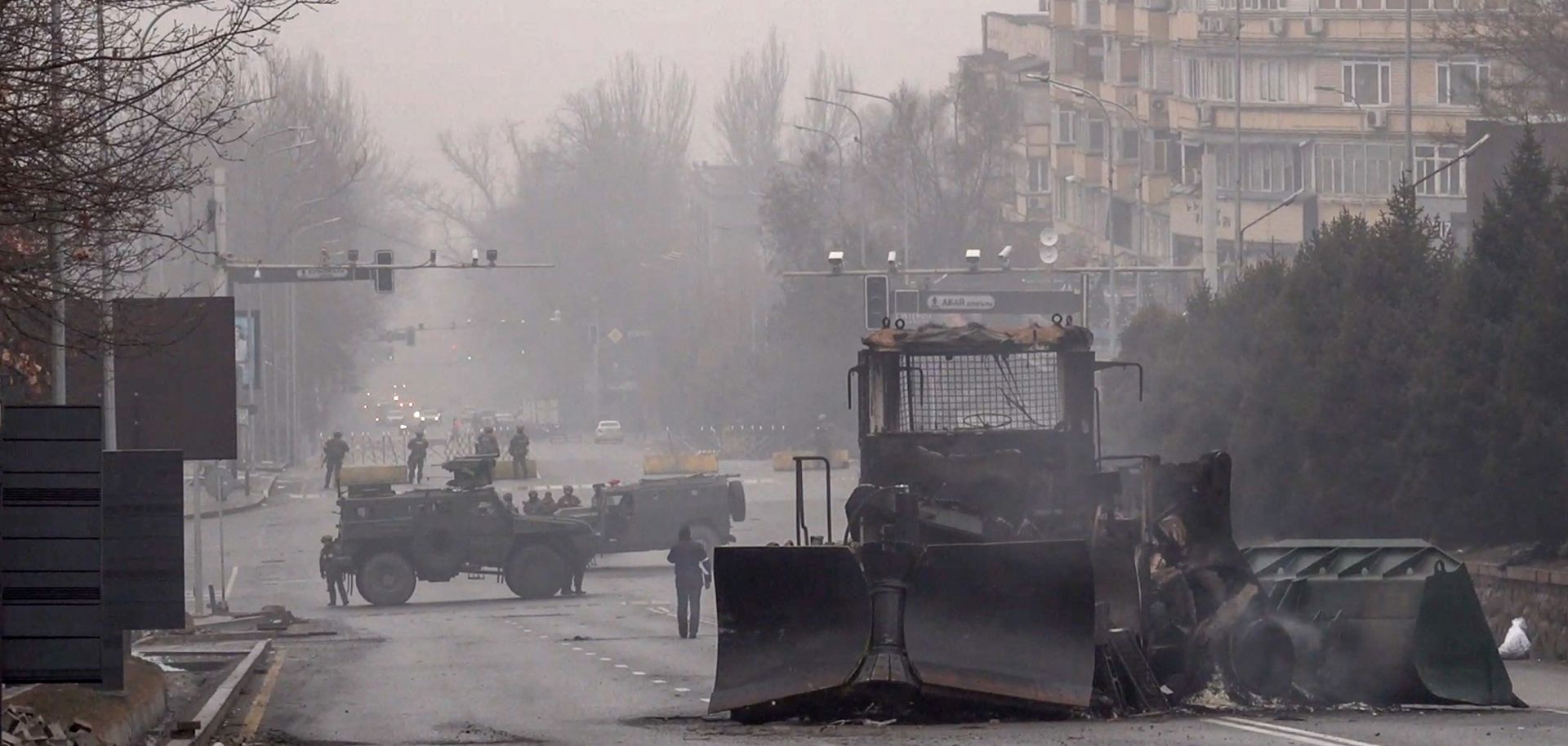
Servicemen and their military vehicles block a street in Almaty, Kazakhstan, on Jan. 7, 2022, following violent protests in the city.
The protests in Kazakhstan will likely wind down amid a Russian-led intervention, but the methods used to overcome the crisis will challenge the country’s governance model and strain its government’s pro-Russian geopolitical alignment. On Jan. 6, the leaders of the Russian-led Collective Security Treaty Organization (CTSO) agreed to invoke the organization's Article 4 obligations to send "peacekeeping" forces to Kazakhstan following a request from the country’s president Kassym-Jomart Tokayev on Jan. 5. The current contingent of CSTO forces is no larger than 2,500. But more troops could be deployed if necessary, according to the alliance’s Secretary-General Stanislav Zas, who said that troops’ mission and locations would be dependent on the situation in the country, but the deployment is not expected to last more than “a few days or few weeks.” With cable and mobile internet access still intermittent in most regions, accurate reports regarding the protests remain limited. But available information suggests that armed resistance is rapidly declining amid the Kazakh government’s “antiterrorist operation” in the country’s largest city of Almaty, where protesters overran the airport, administrative buildings and presidential residence on Jan. 5. Some peaceful protests may continue in parts of the country, but will not pose a threat to the government.
- The CSTO deployment marked the first time that the alliance agreed to invoke Article 4 to deploy military forces, having refused requests on at least two other occasions: from Kyrgyzstan during unrest in 2010, and from Armenia in 2021 amid clashes on its disputed border with Azerbaijan.
- The Russian units involved in the “peacekeeping” mission include the 45th Separate Special-purpose Brigade and 31st Separate Guards Air Assault Brigade, as well as elements of the 76th and 98th Airborne Divisions. Units from the Central Military District's 41st Army typically based in the Urals designated for contingency rapid response operations in Central Asia are among those currently deployed near the Ukrainian and Belarusan borders, while one of Russia’s primary peacekeeping units, the 15th Motor Rifle Brigade, is already deployed to Nagorno-Karabakh.
The deployment of CSTO forces to the country will help quell the current round of protests, but risks setting in motion a cycle of anti-Russian sentiment in the country that will strain relations with Moscow. The CSTO deployment sent a strong signal to Kazakh security forces and officials that Kazakhstan's government under President Tokayev has Russia's full backing. But Russia’s involvement in Kazakhstan’s internal affairs risks fueling anti-Russian sentiments in the country now and likely for many years to come. Many supporters of the protests will resent the foreign intervention in Kazakhstan’s domestic affairs — adding to already significant anti-Russian sentiment in the country, which could increase as the ethnic Kazakh and primarily Kazakh-speaking population continues to grow relative to the Russian population. More incidents of harassment or discrimination against Russian nationals in Kazakhstan would push Moscow to respond with more accusations of “Russophobia,” straining bilateral relations.
- On Nov. 9, Russian Foriegn Minister Sergei Lavrov condemned what he called a wave of “recent manifestations of xenophobia towards Russian-speaking citizens of Kazakhstan,” which he said were aimed at cultivating local nationalism and discrediting cooperation with Russia. Lavrov cited several high-profile cases of discrimination that the Kazak government had failed to adequately respond to in 2021, including incidents in which members of the nationalist movement Til Maydani ("Wave of Language") insulted and violently harassed Russian-speaking employees at banks, shops and government agencies in the country.
Rising nationalist sentiment among young Kazakhs and pressure to liberalize from the growing urban population will drive demand for change in the country in the coming years and pressure Tokayev’s government toward reform. The potential for unrest is likely to continue rising due to the frustrations of the country's urban middle class, which is disenchanted with the regime for being illiberal and beholden to foreign interests, including Russian ones. The Tokayev government will thus face a choice whether to lean hard into further repressions, or to seek to increase its popularity by slowly continuing modest but legitimate political reforms in the coming years by continuing a policy of distancing itself from the era under the country’s controversial former president Nursultan Nazarbayev. While the government will use a combination of both strategies, it appears likely that the Tokayev government will favor a strategy of increasing its popularity. Indicators of which strategy the government will prioritize may appear in the coming weeks. Harsh repressions are inevitable in the near term, but a continued reluctance to disperse well-attended protests outside Almaty would suggest a commitment to regional Kazakhs for substantive political reforms as opposed to just economic support. Additionally, increasing displays of anti-Russian sentiment among the protesters could push the government to view a distancing from Russia as necessary to ensure its popularity. Later, a flurry of political activity shaking up the county’s stagnant party system — such as the registration of new parties or a fracturing of the ruling Nur Otan party — would suggest the Kazakh government is seeking stability through the popularity of modest reform rather than sheer repression.
- Many urban Kazakhs see Tokayev as only marginally preferable to Nazarbayev due to a long relationship between the two men and Tokayev’s own corruption scandals, and are unlikely to approve of Tokayev going forward unless he begins to undertake legitimate reforms toward liberalization and national dialogue.
- On Jan. 7, the office of Kazakhstan’s General Prosecutor stated that confirmed participants in the protests could face life in prison. Large jail sentences could be one way that the government will seek to head off the demographic and other trends pushing the country toward more open politics, including anti-Russian sentiments.
Despite domestic pressures towards reform, Kazakhstan’s most influential neighbors, Russia and China, will continue to support harsh government crackdowns on dissent. The protests exemplify why Russia and China — concerned about the rise of both democratic and liberal ideologies on their shared periphery, as well as nationalist and religious sentiments — may explore ways to slow political change in the country and weaken Kazakhstan’s “multivector” foreign policy. Moscow and Beijing are well aware that should current trends continue, demands for political reform in Kazakhstan will likely also continue growing and fuel similar protests in the future. For this reason, both Russia and China will pressure Tokayev to enact harsh measures similar to those seen in Belarus to keep the possibility of democratic political reforms at bay. Moscow could, for example, blame the West (and in particular, the United States) for the protests and push the Kazakh government to end its visa-free regime with the U.S. government that began in 2017, which Russia sees as a contributor to liberalizing tendencies and U.S. soft power influence in Kazakhstan.
- On Jan. 7 Chinese President Xi called the unrest in Kazakhstan a “Color Revolution” and suggested external interference (likely an allusion to the United States) caused the protests. The Chinese government is quick to reject anything resembling democratic revolution in its periphery, but Beijing sees the events in Kazakhstan as particularly threatening to its interests given the Central Asian country’s shared border with China’s restive Xinjiang region. Thus, China will continue to support the Kazakh government’s harsh repression of protests. China’s leaders are unhappy about the regional influence victory the CSTO intervention represents for Russia in Central Asia, a region where Beijing and Moscow have competed for influence since the collapse of the Soviet Union. But Beijing is supportive of the mission if it brings the political status quo back to Kazakhstan.
The protests also underscore why the United States will maintain restraint toward Kazakhstan to avoid pushing the country deeper into Moscow or Beijing’s orbit by unnecessarily antagonizing Kazakh leaders and citizens. Washington understands that despite its great physical distance, it is the inevitable beneficiary of the Kazakh government’s “multivector” foreign policy that seeks to play Moscow and Beijing off each other, and of which Tokayev is a long-time proponent. The United States is unlikely to slap sanctions on Kazakh authorities similar to those enacted on Belarus or Belarusian officials in the wake of repressions in that country, despite the violent crackdown in Kazakhstan posing the same human rights violations, as Washington may deem it benefits from a Kazakh foriegn policy that seeks to avoid being drawn too deeply into Russia or China’s orbit. Believing that over the course of the coming years, internal pressure will push the Tokayev government to eventually agree to conduct political reforms and modest liberalization, Washington will likely avoid action or charged rhetoric that could unnecessarily inflame bilateral tensions or push the Kazakh government to intensify its crackdowns on dissent or retaliate against U.S. organizations and businesses in the country.
- On Jan. 6, U.S. State Department spokesman Ned Price said Washington was ready “to assist Kazakhstan in solving political and economic problems” that he said caused the protests in the country, adding that assistance, in particular, can be provided “in the fight against corruption.” Price also called on the protesters to “exercise restraint.” The statements and lack of action are in contrast to the rhetoric and sanctions Washington has used in response to unrest and repression in Russia, Belarus, or other countries.
- U.S. companies are the leading oil producers in Kazakhstan, underscoring the Kazakh government’s desire to not let Russia and China control the largest sources of the state’s budget revenue by balancing with U.S. influence.
