
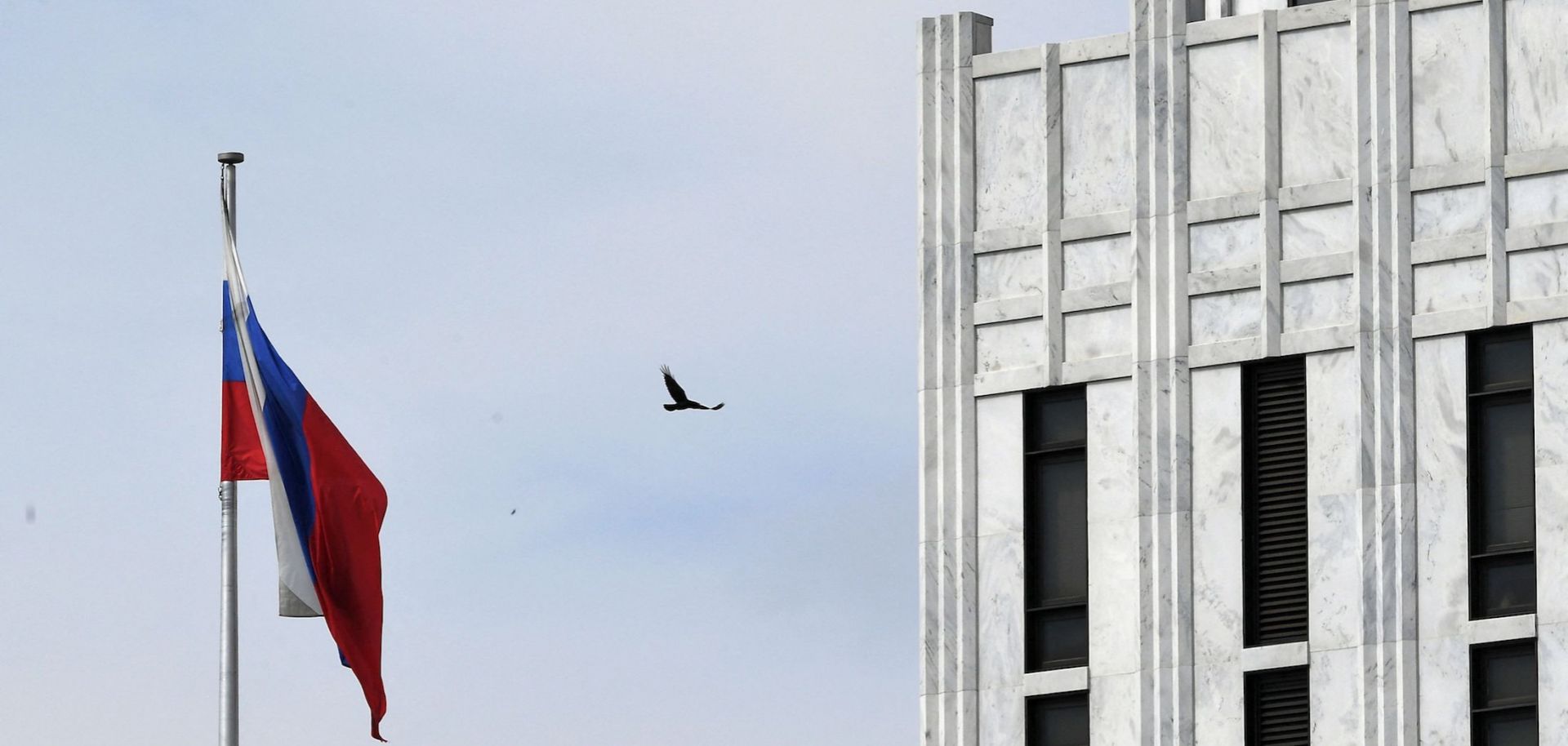
A bird flies past the flag outside the Russian embassy in Washington D.C. on April 15, 2021.
New U.S. sanctions on Russia will worsen the two countries’ already fraught relations and compel the Kremlin to respond to what it will perceive as an escalation. On April 15, the administration of U.S. President Joe Biden announced new sanctions on Russian financial markets, individuals and entities in response to Russia’s involvement in the 2020 SolarWinds cyberattack, attempted interference in the 2020 U.S. presidential election, and ongoing occupation of Crimea. These new sanctions follow those that the United States and European Union imposed in March over Russia’s attempted assassination and subsequent jailing of opposition leader Alexei Navalny. At the time, the Biden administration pledged to impose separate penalties for grievances specific to the United States, including the SolarWinds cyberattack and election interference.
- Biden signed an executive order strengthening presidential authority to impose sanctions, which the U.S. Treasury Department used to issue a directive prohibiting U.S. financial institutions from taking part in the primary market for ruble or non-ruble denominated bonds issued after June 14. Language in the executive order also leaves open the possibility for future sanctions targeting Russia’s strategic economic sectors.
- The U.S. Treasury also sanctioned six Russian technology companies linked to malicious cyber activities, along with 16 individuals and 16 entities connected to Russian election interference, as well as five individuals and three entities linked to Russia’s occupation of Crimea.
- The U.S. Department of State announced that it is expelling 10 Russian embassy officials. In addition, the White House for the first time officially labeled the Russian Foreign Intelligence Service (SVR) as the perpetrator of the SolarWinds cyberattack.
The announcements will further inflame U.S.-Russia tensions amid the two countries’ various ongoing disputes, including over the recent military escalation in eastern Ukraine. Moscow and Washington have traded recriminations for weeks, stemming in part from Biden’s characterization of Russian President Vladimir Putin as a “killer” during an interview broadcast in mid-March. Since then, personal tensions have turned into more substantive ones amid a significant uptick in violence between Russian-backed separatists in eastern Ukraine and the Western-backed government in Kyiv.
- Aside from acute tensions over Ukraine, Russian prison authorities’ refusal to grant Nalvany access to an outside doctor despite the opposition leader’s deteriorating health also continues to draw condemnation from the West. Additional U.S. and EU sanctions linked to Navalny’s poisoning and subsequent jailing are all but guaranteed were he to die in prison.
- The United States has also promised additional sanctions, which are expected in the coming weeks, to prevent the completion of the controversial Nord Stream 2 natural gas pipeline linking Russia and Germany. Even if the pipeline becomes operational, language in Biden’s executive order lays the groundwork to further target Russian individuals or entities in the energy sector, including those tied to any attempts to potentially disrupt energy supplies to other countries, such as Ukraine.
- Even if these more immediate flare-ups quiet down, the United States and Russia have persistent disagreements in many other areas that will keep relations icy. These disputes include Russia’s crackdown on domestic dissent (which is likely to worsen in advance of parliamentary elections in September), Russian support for anti-democratic regimes in countries like Belarus and Syria, and Russia’s growing military presence in the Arctic.
Moscow will see the new U.S. sanctions as escalatory, warranting reciprocal responses that are likely to take multiple symmetric and asymmetric forms. Since the U.S. and EU sanctions in March, various senior Russian officials have warned that additional U.S. penalties would ensure strong Russian responses, even if U.S. sanctions are unlikely to cause significant economic harm. Less than an hour after the United States announced its new sanctions on April 15, the Kremlin summoned the U.S. ambassador for “a difficult talk” and promised “inevitable” retaliation. A spokesperson also said that the new sanctions would not help the chances for a possible summit between Biden and Putin.
- Russia typically responds to diplomatic expulsions with tit-for-tat ejections, suggesting that U.S. diplomats in Moscow are likely to also be expelled in the coming days. Moscow will likely impose asset freezes and travel bans on U.S. individuals and entities as well, mimicking those the United States imposed. In addition, the Kremlin will probably use its controversial “foreign agents” law to further restrict the activities of employees at U.S.-funded media outlets connected to Radio Free Europe/Radio Liberty.
- Actions targeting U.S. commercial entities are also probable, based on the Kremlin’s belief that the recent U.S. sanctions go beyond traditional penalties on Russian government figures to include economic interests. Russia may escalate its targeting of U.S. social media firms and/or interfere in the local operations of U.S. businesses. It could also impose restrictions on Russian individuals, companies and state firms doing business with U.S. companies or making investments in U.S. financial markets.
- Most combatively, Russia could take action in the security sphere. The United States had promised to pair the latest round of sanctions with cyberattacks that would be seen by Russian leaders but not the general public, suggesting the Kremlin may believe it is justified to take similar actions, perhaps against U.S. companies. Russia may also exploit ongoing tensions in eastern Ukraine to prolong its military buildup along the border or provide additional military support for separatists. It could demonstrate its influence in other contested areas as well, including by conducting provocative operations near U.S. forces in the Arctic, Syria, or elsewhere.
