
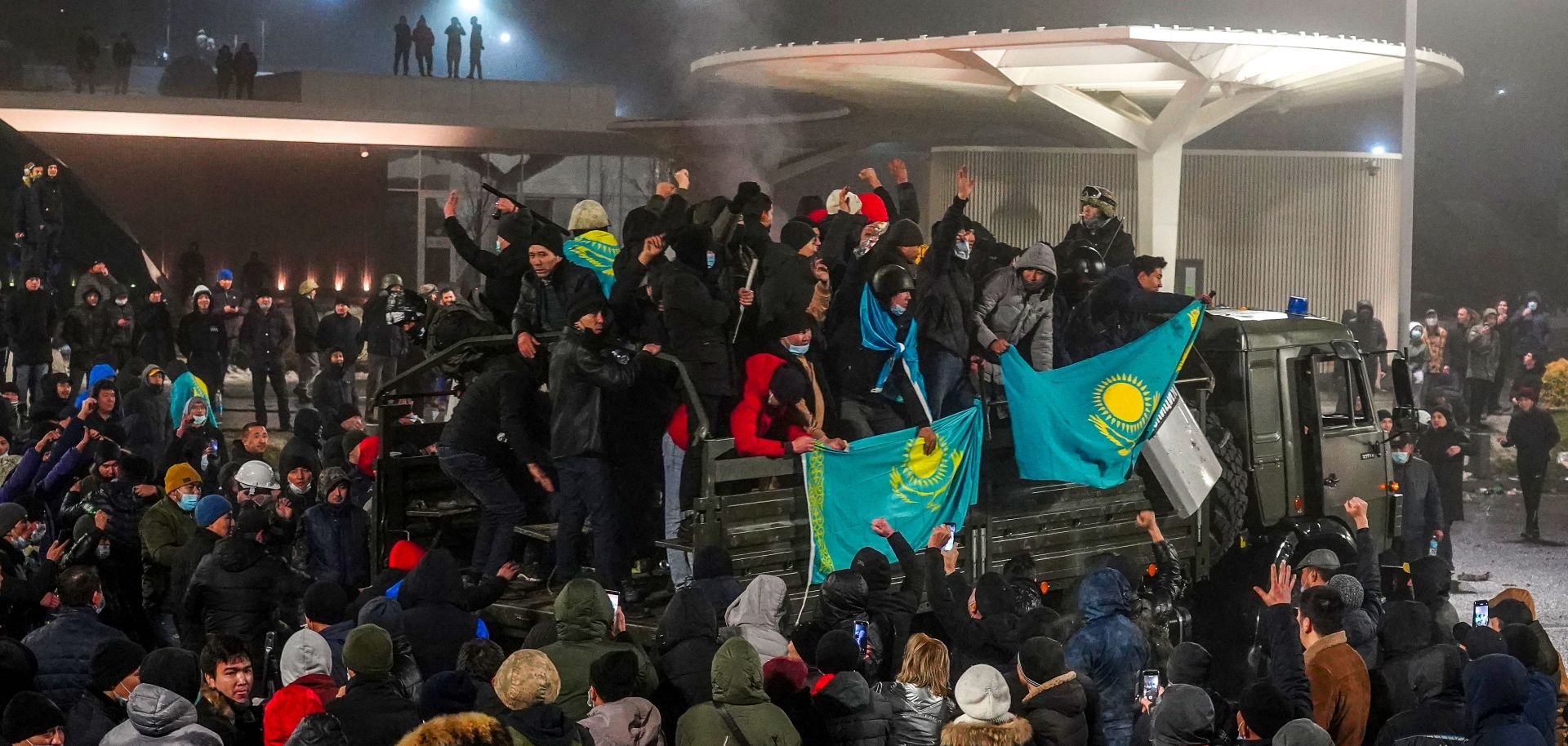
Protesters participate in a rally in Almaty, Kazakhstan, on Jan. 5, 2022.
The mass protests, riots and looting griping Kazakhstan will weigh heavily on Russia and Belarus as they consider their own options regarding an eventual power transition. On Jan. 4, mass protests in several major cities in Kazakhstan grew in size and became more violent. And by Jan. 5, protesters had overrun the city administration, airport and presidential residence in Almaty, the country’s largest city and former capital, prompting authorities to shut off internet access nationwide and declare a national state of emergency. The scale, tactics and demands of the protests are all unprecedented for Kazakhstan, where mass protest activity is extremely rare and usually limited to small-scale actions, with security services relying on preemptive detentions to prevent social unrest. The demonstrations, which were initially sparked by a sharp rise in fuel prices on Jan. 2, are now verging on an armed uprising in Almaty — shattering the country's perceived stability, while showing how discontent over inflation and the rising cost of living, even under authoritarian regimes, can swiftly and suddenly ignite unrest when combined with other political and economic grievances. But perhaps most importantly, the crisis has cast doubt on the notion that Kazakhstan's power transition plan, initiated in spring 2019, was successful and could serve as a partial model for Russia, Belarus, or other countries in the region.
- On Jan. 5, Kazakh President Kassym-Jomart Tokayev said he considered the protests an "external" and "terrorist" threat and asked the Collective Security Treaty Organization (CSTO) to "provide assistance.” As Kazakh police and soldiers may be reluctant to violently suppress their countrymen, the government may believe foreign personnel will be more willing to use harsh suppression measures under the guise of an “anti-terrorist” or “peacekeeping” operation.
- Videos have circulated on social media that appear to show some police officers marching in solidarity with the protesters in the western cities and firearms being massively distributed to protesters in Almaty. These videos, along with isolated reports, have fueled rumors that Kazakh security forces are on the verge of revolt. But there remains no indication of a greater fracturing among the country’s ruling elite or mass defections from security forces needed for a successful uprising.
President Tokayev will attempt to overcome the crisis with a combination of brute force, restricted information flows, promises of modest political reform, and an intervention by “peacekeeping” personnel from CSTO partners. The Kazakh government has already moved to reinstate the lower fuel prices to satisfy protesters' initial economic grievances. But in many cities, protesters are now also demanding sweeping political changes that were once unthinkable in Kazakhstan, including the departure or prosecution of the country’s former president and current “Father of the Nation,” Nursultan Nazarbayev. To assuage these concerns, President Tokayev announced in a televised address on Jan. 5 that he had assumed leadership of the country's national security council from Nazarbayev. Later that day, Tokayev also moved to remove a Nazarbayev relative from his cabinet, along with others seen as allies of the former president, replacing them with those loyal to him. Through these steps, Tokayev is attempting to solidify his control over the government and demonstrate that he is moving further away from Nazarbayev’s regime and the corruption associated with it.
- In the city of Taldykorgan, demonstrators tore down a large statue of Nazarbayev, who served as Kazakhstan’s president from 1990-2019. Many of the protesters insist on an end to the control the former president’s family and corrupt networks still wield over the nation’s economy.
- Speculation has swirled, chiefly from sources in Moscow and ostensibly in an effort to mollify the protesters, that Nazarbayev is prepared to leave Kazakhstan "for medical treatment” amid the unrest.
With the transition model used by Kazakhstan now discredited, Russian President Vladimir Putin and his Belarusian counterpart, Alexander Lukashenko, will seriously reassess their own power transfer plans. The Kazakh power transition process that began in 2019 involved Nazarbayev stepping back from daily management of affairs by leaving the presidency while remaining the head of the country’s national security council under the honorific title of “Elbasy” (meaning "Leader of the Nation"). Tokayev, who is not from Nazarbayev’s immediate family, was chosen to become Kazakhstan’s next president in an attempt to show that leadership of the country would not be passed along familial ties. As the country remained stable since the transition process began in spring 2019, the idea of the “Kazakh scenario” being a viable variant for power transition in Moscow became widely discussed. Following the onset of protests in Belarus in August 2020 after President Alexander Lukashenko’s disputed re-election, Moscow quietly chided Minsk for not beginning such a power transition process earlier. The Belarusian government ultimately largely modeled its recently unveiled constitutional reform plan (which for now is still slated to be put to a referendum in February) off of the Kazakh power transition, as the plan foresees Lukashenko leaving the presidency for a similar new role away from daily politics and management as the head of the All-Belarusian People’s Assembly. Roughly similar succession scenarios were discussed in Moscow as well. But Putin is now more likely than before to seek re-election when his current presidential term ends in 2024, seeing a power transition as too risky given the example provided by Kazakhstan's current upheaval. Lukashenko, meanwhile, will be pressured both internally and possibly from Moscow to reconsider or rework his succession plan entirely, possibly delaying the February referendum on the constitutional changes.
The crisis could also be a factor in dissuading the Kremlin to back off its most escalatory scenarios in Ukraine. The volatile situation in Kazakhstan could limit Moscow’s options for an escalation or intervention in Ukraine in the coming weeks, as the Kremlin could conclude that simultaneously increased tensions on two of its large land borders would be imprudent. Furthermore, some of Russia’s forces normally based in the Urals designated for contingency rapid response operations in Central Asia, such as units from the Central Military District's 41st Combined Arms Army, are believed to be among those currently deployed near the Ukrainian and Belarusan border. Finally, while it is still unlikely that Kazakhstan’s political crisis spirals into a full-blown armed conflict or prolonged standoff, Russia may be compelled to deploy military forces to its border with Kazakhstan in case they are needed to secure Russian-speaking areas of the country, possibly drawing forces away from Ukraine.
