
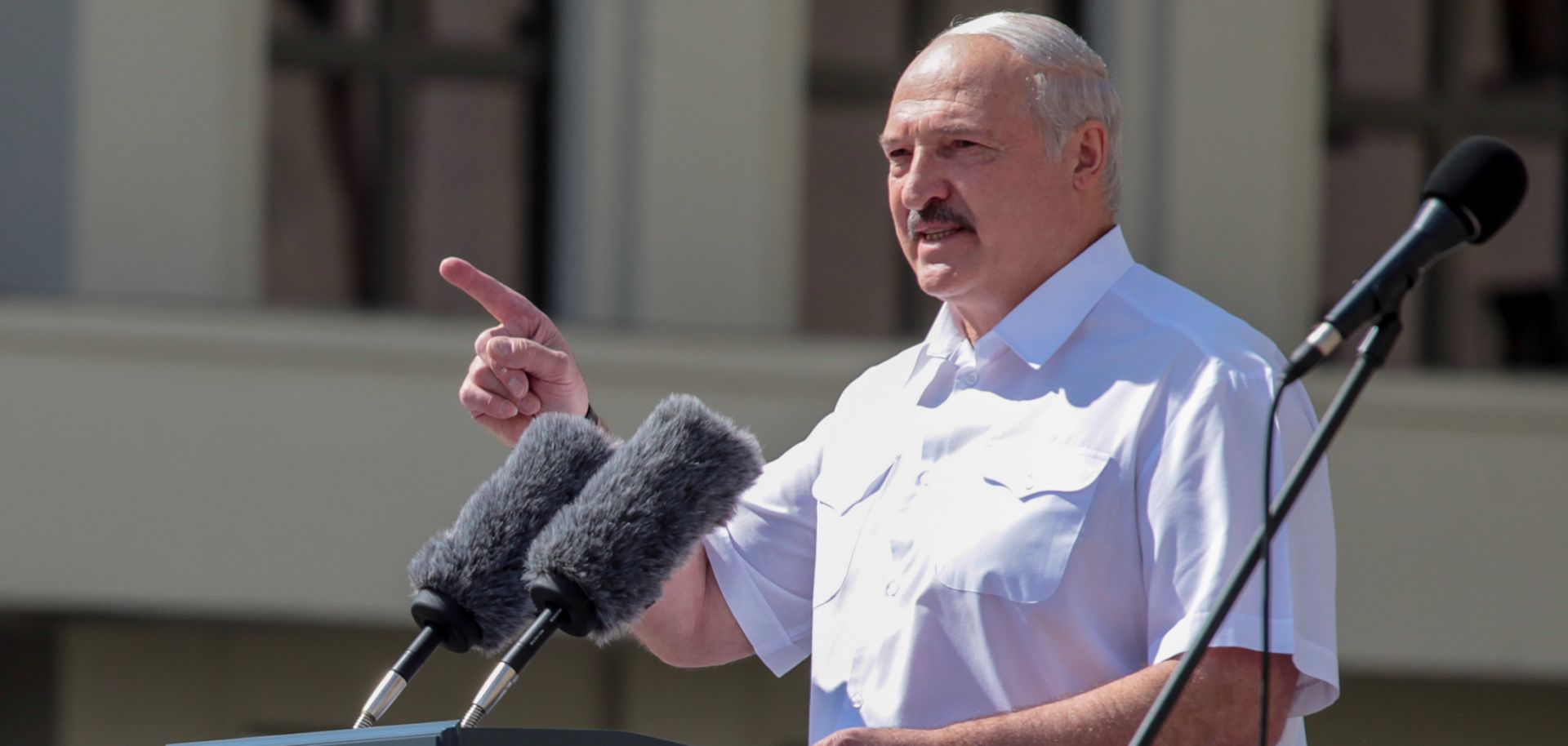
Belarussian President Aleksandr Lukashenko delivers a speech Aug. 16, 2020, during a rally held to support him in central Minsk, Belarus.
Belarussian President Aleksandr Lukashenko is seeking to retain power and influence through a new constitutional reform process while also signaling that he will seek Russian support, a strategy that will probably revive anti-government protests and risk escalating into a standoff between Russia and the West. Speaking on Feb. 11 at the opening of a two-day government summit to discuss the country's future, Lukashenko struck a decisive tone and offered vague promises of constitutional changes that he said would be completed by the end of the year and put to a referendum by early 2022. According to Lukashenko, last year Belarus survived a foreign-backed "blitzkrieg" similar to current protests in Russia and he argued that like-minded forces in both countries needed to "stand up" to foreign powers in what will be a "decisive" year.
- Lukashenko announced that a review of the distribution of government powers is already underway, but offered no specifics beyond saying that he is "absolutely convinced that our country should remain a presidential republic."
- According to Lukashenko, the key precondition for his retirement is "peace and order" without "any protests, any revolution attempts." He also indicated that, even if he steps down from his current post, he wants to remain influential and supports mechanisms to limit the authority of a potential successor not aligned with his and his allies' interests.
- Lukashenko also offered multiple appeals for Russian support, pointedly stating that "to lose Belarus would be mortally dangerous Russia" and that he expects "Belarus to remain an absolute priority for Russia." The same day Lukashenko spoke, Russian newspaper Kommersant reported that plans are being finalized for him to travel to Russia later this month to meet with President Vladimir Putin, who is expected to offer a new loan.
Lukashenko's statements will disappoint and galvanize anti-government campaigners to resume mass protests this spring to pressure the government. Last year, Lukashenko suggested that he was prepared to make meaningful reforms to defuse a political crisis following a disputed presidential election in August that was widely seen as fraudulent. In its wake, mass demonstrations roiled Belarus and led to multiple clashes between protesters and security forces. Smaller public displays of anti-government sentiment have continued during the winter.
- In his public address on Feb. 11, Lukashenko all but admitted to ballot rigging when he stated that local officials could have fiddled with results, but that he won anyway.
- On social media, exiled opposition leader Sviatlana Tsikhanouskaya slammed the Feb. 11-12 government assembly as "fake" and her top aides urged supporters to take to the streets to protest the meeting. The opposition plans to resume mass demonstrations on March 25, an unofficial holiday that traditionally sees large opposition protests.
- Local political observers widely characterized Lukashenko's statements as falling well short of addressing protesters' demands. According to one quoted by AP, "Lukashenko didn't offer a plan of modernizing the country or any clear compromise with the society, and that means that the conflict remains unresolved and protests will continue."
Renewed unrest later this year could force Russia to intervene more decisively than it did last year, setting up a possible confrontation with Western powers. Last year, Russia was reluctant to become too involved in the Belarussian political crisis because the protests did not threaten the Kremlin's fundamental interests in Belarus as a strategic buffer state oriented toward Moscow rather than Europe. Unlike the 2013-2014 revolution in Ukraine, which replaced a pro-Russian government with a pro-Western one, thereby forcing the Kremlin's hand, last year's demonstrations in Belarus focused on country-specific grievances and were not necessarily in opposition to Russian interests — even if Moscow is inherently wary of mass protest movements.
- By linking the circumstances and fates of Belarus to Russia, Lukashenko risks binding the two countries together in the eyes of protesters, who would then be more likely to take stronger anti-Russian stances in renewed demonstrations. Recent media reports that the two countries are planning to hold a record number of joint military drills before their massive quadrennial Zapad exercise in September will provide further fodder to this impression.
- Lukashenko's pro-Russian rhetoric — particularly when combined with demonstrations that become more stridently anti-Russian — raises the cost to Moscow of not supporting him in the face of renewed unrest. The Kremlin has many tools beyond direct military intervention to support Lukashenko, including covert security support and financial aid, which differ in the degree to which they would be seen by Western states as provocative, and thereby requiring a proportional response.
- Russian support to Lukashenko that is both more aggressive and public, especially amid renewed mass protests, similarly could push Western powers to more forcefully back the Belarussian opposition. Europe and the United States are recalibrating policies to more strongly push back against the Kremlin in the wake of the Feb. 2 jailing of Russian opposition leader Alexei Navalny and subsequent recriminations. This suggests that at least some Western countries may view support for Belarussian demonstrators as a similar test of wills with Moscow, which could result in a standoff in Belarus between Russian and Western proxies.
