
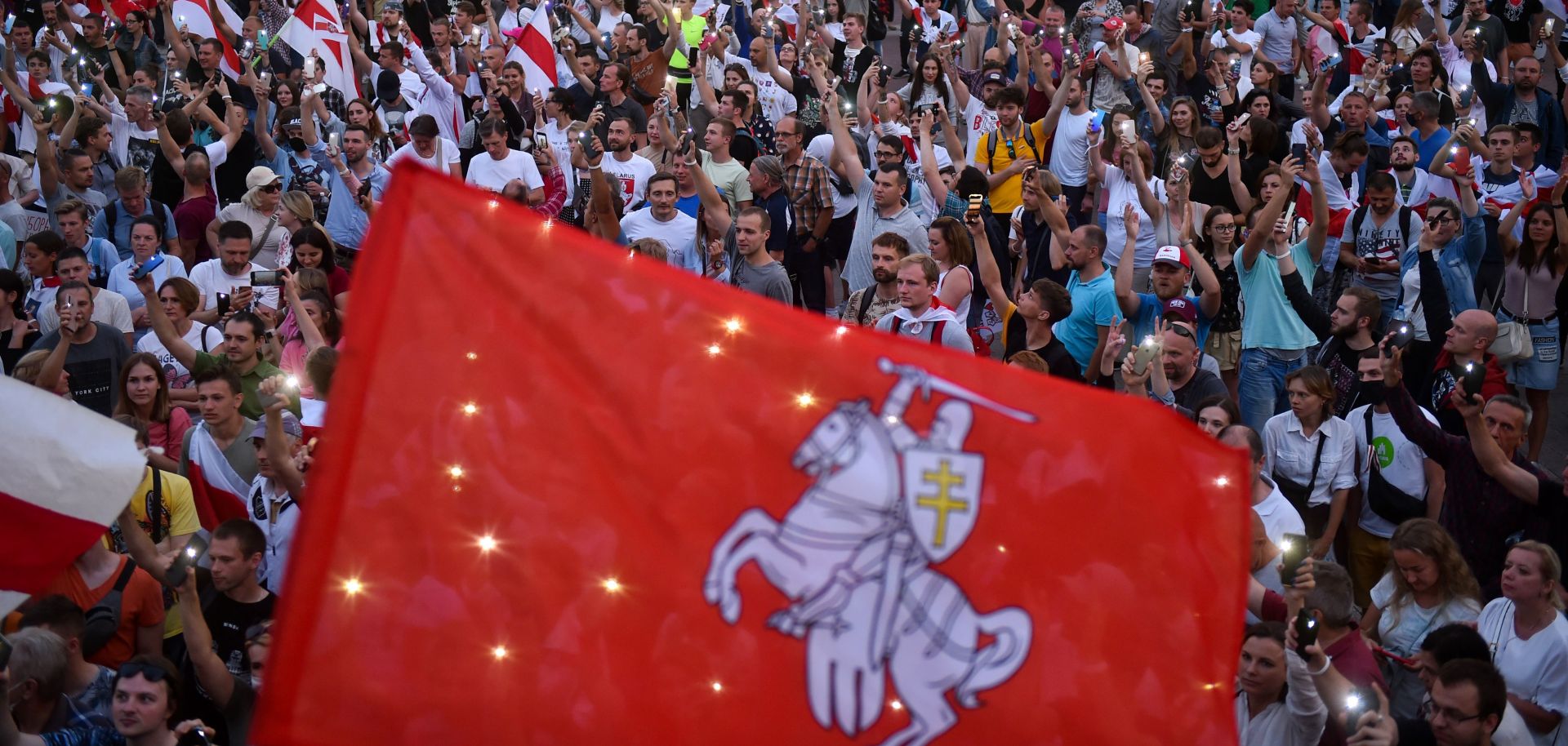
Opposition supporters protest against Belarusian President Alexander Lukashenko’s disputed electoral victory in Minsk on Aug. 18, 2020.
The Belarusian protest movement is positioning itself to gradually shutter President Alexander Lukashenko’s access to all levels of government and industry, which could eventually force his exit by robbing him of any power or legitimacy. While peaceful marches through Minsk and other cities make for impressive demonstrations of the opposition’s resolve, they don’t necessarily force political change. The opposition movement, however, has gradually increased demands for active statements of support from the Belarusian industry and local and regional levels of politics, which could eventually undercut the embattled president’s position. Protesters are seeking to achieve this by effectively forcing political and industry representatives to make a choice between allegiance to their opposition movement or Lukashenko, with an implied understanding that whoever chooses the latter will be barred from any power structures in a potential post-Lukashenko government. Personnel in key management or leadership positions who have benefited from the status quo under Lukashenko will be difficult to win over. But the opposition’s bottom-up approach of mobilizing the electorate and laborers against their representatives and superiors is increasing the pressure on them to fold.
Playing the Long Game
The large protests that occurred on Aug. 15 and 16, and the persistent demonstrations throughout all hours of the day, are a testimony to the staying power of the protest movement despite initial violent security crackdowns. While it initially led to a lull in protest mobilization, security forces’ aggressive approach during the first week of protests following the Aug. 9 election came at a cost for the government, as the clashes with protesters that erupted amid the crackdown risked devolving into something beyond security forces’ control. Continued violence against civilians in the streets also risked testing the resolve and loyalty of police and military personnel. But as the government scaled back its aggressive tactics, the protest movement rapidly grew again as fear subsided, resulting in unprecedented demonstrations that saw hundreds of thousands march across the country.
Through a slow burn, the opposition movement is showcasing its willpower to engage in a longer struggle to gradually erode the systemic power structures underpinning Lukashenko’s presidency. Opposition leaders have repeatedly called on Belarusians to demand their political and industry representatives — including mayors, regional governors and factory managers — publicly support the protest movement. The same strategy will eventually extend to the leaders or members of security forces, who the opposition had been trying to woo even before the Aug. 9 election. This slow process, however, will raise the risk for cracks to begin appearing in the movement, and could make it more difficult for protests to maintain momentum. Belarusian authorities will also actively counteract the opposition’s mounting pressure by pulling key personalities closer or reverting to aggressive repression tactics to directly disrupt protest activity.
Bracing for Battle
The opposition movement’s ability to start pooling financial resources will support both the continued organization of protests and growing labor strikes. Groups of volunteers in Belarus have started providing replacement income to striking workers. The labor strikes are critical to the movement’s goal of eroding Lukashenko’s power, which is backed by an economy largely composed of state-owned enterprises. Providing even limited levels of financial support to these workers will enable them to sustain strikes for longer, and will convince others to join. The funds for this originally came from individual contributions from opposition supporters, but recent charity sales of artwork and online fundraisers have already helped raise over $3.3 million in additional financing. Meanwhile, Lithuania raised plans at the European Union to provide financial support to Belarusian protesters that have been mistreated by government forces, while Poland announced a $13 million fund for Belarusian academic scholarships and independent media. It remains unclear if and when (or how) such funding from Brussels or Warsaw would be made available to protesters in Belarus. But substantial financial support from foreign states would provide a significant boost to the movement’s ability to maintain pressure against Lukashenko.
The outcome of Belarus’s postelection crisis, however, remains far from certain, as Belarusian authorities will continue to adapt their own approach to weaken the opposition’s reach. Lukashenko has already targeted some elements of the opposition’s strategy very directly by threatening to dismiss or suspend wages for those supporting the protest movement. Competing opposition organizations that support Lukashenko’s rule have also begun popping up: Representatives of the Liberal Democratic Party, for example, have created their own “People’s Patriotic Movement” with a platform that promises electoral reforms in lieu of full-blown political liberalization. Lukashenko’s security forces are also once again becoming more active, taking advantage of the smaller turnout at protests this week due to poor weather. Authorities may see targeting these smaller demonstrations for dispersal or detainments as a way to re-emphasize the security domain, which they have controlled better than the political narrative. But with growing international and domestic support for the opposition, Lukashenko's forces are poised for a heated battle.
