
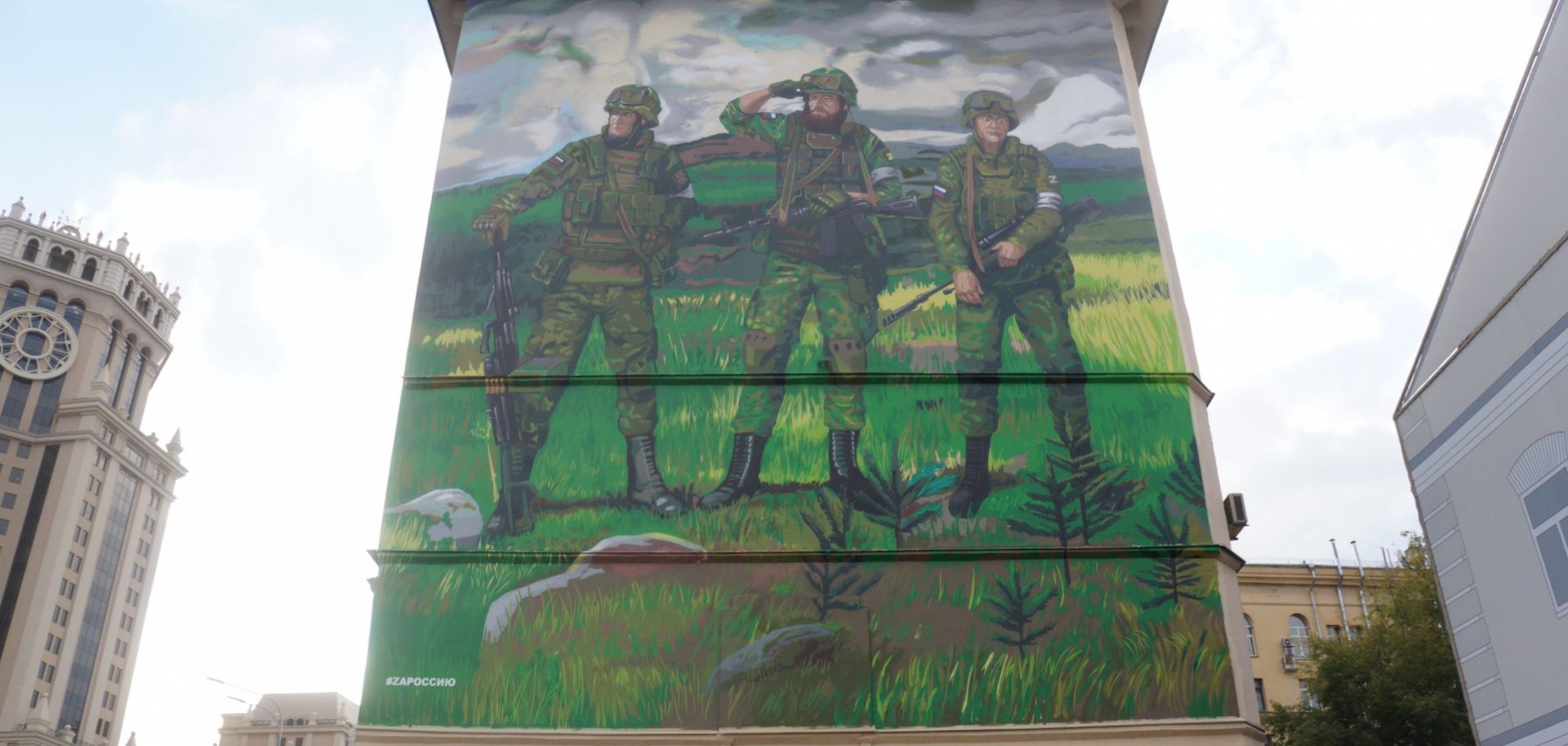
A pro-war mural showing soldiers with weapons is seen on Sept. 22, 2022, in Moscow, Russia.
Russia's mobilization measures and impending annexation referendums in Ukraine will significantly aid Moscow's ability to continue the war into next year, but they are unlikely to greatly reduce Western military support for Ukraine, and will come at the cost of greater international isolation and domestic instability. On Sept. 20, the leaders of the four self-proclaimed pro-Russian occupation authorities in Ukraine's Luhansk, Donetsk, Zaporizhzhia and Kherson regions declared their intention to conduct ''referendums'' on their regions joining the Russian Federation from Sept. 23-27. On the same day, lawmakers in Russia's State Duma approved adjustments to the criminal code stipulating harsher penalties for failing to report for military duty, surrendering or refusing to fight. Then on Sept. 21, Russian President Vladimir Putin said Russia supported the referendums and announced he had signed a decree authorizing a partial mobilization of the Russian armed forces, a measure he said was necessary to ''defend Russia's people, sovereignty and territorial integrity.'' Russian Defense Minister Sergey Shoigu has since said the initial mobilization would call up 300,000 reservists with previous military experience.
- Putin's decree is deliberately vague. Its paragraph about the numbers of mobilized and mobilizing forces is redacted, and grants the Kremlin broad authority to expand and tailor the mobilization to Russia's needs — with or without directly notifying the Russian public. Russia's defense ministry will be responsible for creating specific mobilization quotas for each region of Russia that local authorities will be responsible for meeting. The changes to Russia's criminal code work in tandem with the mobilization, as those who signed three-to-six month contracts over the spring and summer will now find their terms of service extended indefinitely, risking years in prison should they attempt to leave military service.
- Russia's conscripts remain legally barred from participating in combat roles, despite widespread evidence they did so in the war's opening phase. Conscripts who should be demobilized in the fall of 2022 for completing their one-year of mandatory service could easily be forced directly into continued army service, as they fall under all three of the primary categories for the mobilization, meeting the criteria of being under 35 years old, having experience in a military specialty, and being already trained.
Recent setbacks on the battlefield in Ukraine, combined with growing signals from Russia's international partners to end the war, likely drove Moscow's decision to conduct mobilization. Russia's need to declare a partial mobilization to continue the war was clear as early as May. However, the Kremlin had postponed the decision in hopes that it could successfully ''liberate'' the Donbas region — the primary stated goal of Moscow's so-called ''special military operation'' — without having to resort to such a measure. While Russian reports citing Kremlin sources in June, July and August suggested the Kremlin intended to conduct annexation referendums on Ukrainian territories in mid-September, reports from early September suggested the Kremlin decided to delay the referendums until November or December in hopes of capturing more of the Donbas by then. But the Kremlin's plan changed suddenly after Ukraine's successful counterattack in the Kharkiv region in the first week of September made it clear to leaders in Moscow that Russian forces were not only highly unlikely to seize significantly more territory in the Donbas by the end of the year, but were also at risk of losing ground they had already taken there. Furthermore, reporting suggests that during the Sept.15-16 Shanghai Cooperation Organization summit in Uzbekistan, several of the leaders signaled to Putin that they wanted the war to end as soon as possible because of the detrimental effect it was having on their own economies and global markets. Having received such a negative response from the foreign partners most critical to Russia's near- and long-term economic survival, Putin likely felt additional pressure to attempt to accelerate ending the war by ''escalating to de-escalate'' with referendums, mobilization and nuclear threats. Moscow likely also hopes this would help it more convincingly both frame the war as a defensive one and blame the West for its continuation on the international stage.
- On Sept. 16, Indian Prime Minister Narendra Modi told Putin that ''today's era is not an era of war,'' while Putin acknowledged Chinese ''concerns'' about the war prior to talks with President Xi Jinping the day prior. Turkish President Recep Tayyip Erdogan said in a Sept. 19 interview that he had urged Putin to end the war and insisted that ''the lands which were invaded will be returned to Ukraine.''
- On Sept. 19, Ukrainian forces recaptured the settlement of Bilohorivka in the Luhansk region in the Donbas — denying Russia complete control over the administrative borders of that region for the first time since July 3, when Russian Defense Minister Shoigu informed Putin that Russian forces controlled the entire area.
While hesitance in the West (and particularly in Europe) to further support Ukraine may grow following the annexation referendums, it is unlikely to decisively alter Western support for Ukraine or reduce pressure on Russia. Moscow likely intends to use the annexations to both justify Russia's mobilization and subsequent threats of nuclear retaliation to stop attacks on the areas it controls, which it hopes will cause the West to balk at further supplies of weapons to Ukraine and/or at allowing Ukraine to strike the annexed territories with them. But leading European leaders have firmly indicated that they would not recognize the referendums and would maintain support for Ukraine. EU member states are likely to push for preserving their current strategy of supporting Ukrainian troops and economically pressuring Russia. This will likely see Europe maintain some military aid to Ukraine while imposing additional sanctions on Russia over the annexations that will probably be largely symbolic — framing these actions as a mere continuation (rather than escalation) of their approach to the ongoing conflict. In addition to military support and additional sanctions, Putin's announcements on the referendums and mobilization will likely force EU member states to make additional decisions on whether to make it easier for young Russians to seek refuge in the European Union or further tighten restrictions on Russians entering some EU countries (by, for example, limiting tourist visas as some Eastern European states have), which would effectively drive Russian men into Putin's army, albeit low morale ones.
- On Sept. 21, European Council President, Charles Michel, said that the European Union's support for Ukraine ''will remain steadfast.'' On Sept. 20, before Putin's speech, both German Chancellor Olaf Scholz and French President Emmanuel Macron also said the European Union would not recognize Russia's ''sham'' referendums in Ukraine. However, Belgium Prime Minister Alexander de Croo warned against Europe ''add[ing] fuel to the fire,'' which suggests that some EU member states are likely to call for a continuation of the bloc's current strategy instead of an escalation in sanctions or military support for Ukraine.
Despite its threatening rhetoric, Russia is unlikely to enter a direct military confrontation with NATO or use tactical nuclear weapons in Ukraine, because Moscow maintains other ways of retaliating and escalating the war. Despite Moscow somewhat pushing up its timetable, its strategy to win the war remains largely the same. Russia will continue to use time to degrade Ukraine and the West's ability to continue the war, primarily by fueling war fatigue and economic pain in the West. But should Moscow believe that its leverage is slipping or that its further escalation threats are not being taken seriously enough, Russia is likely to increase attacks on Ukrainian civilian infrastructure — including in Kyiv and other highly populated areas — in order to make the country increasingly uninhabitable and increase flows of Ukrainian refugees to nearby EU countries. The use of chemical or nuclear weapons, or a retaliatory strike on a NATO country, cannot be ruled out. But for now, Russia is unlikely to resort to such drastic measures, as they would be unlikely to ensure victory in Ukraine and would lead to additional economic, political and military costs for Moscow.
Russia's moves to address its manpower shortage will not significantly alter the situation on the frontlines in the coming weeks, but it will help its ability to secure the ground it holds in Ukraine in the mid-to-long term. Russia will need many weeks to organize, train and transfer new units to the front line in Ukraine, most likely anywhere between three-to-six months. The 300,000 reservists are an insufficient increase in manpower to significantly alter the battlefield because Ukraine has mobilized approximately 600,000 personnel, with the possibility to move several thousand more, into military service. Russia's latest announcement would bring its troop levels from approximately 200,000 to 500,000 — not even ensuring parity with Ukrainian forces. This suggests Russia's measures are instead intended to hold the territory it currently occupies rather than seize significantly more. The amount therefore will not give Russia a manpower advantage, but it will likely be sufficient to deny Ukraine the advantage it needs to successfully conduct swift and major counterattacks similar to that seen in Kharkiv. While Russia can expand its mobilization beyond 300,000 reservists, it is unlikely in the near term because it would be domestically unpopular and further damage Russia's ailing economy. Since Russia lacks the equipment to effectively arm and supply a larger military deployment, the mobilization of more reservists is also not guaranteed to result in seizing significant Ukrainian territory.
Putin's decision to make such a risky move suggests he is unlikely to give up on Russia's territorial gains in Ukraine, dimming the prospect of a de-escalation of the ongoing conflict. Public approval ratings among Russians for both Putin and his ''special military operation'' in Ukraine have remained high since the start of the war in February, despite trending downward in recent months. But sociological data suggest that, by contrast, a majority of Russians do not support mobilization. The lives of many Russians, who previously may have been apathetic about the Ukraine invasion, will be now directly touched by the war for the first time as their sons, brothers and husbands are called into military service. Meanwhile, ultranationalist elements will criticize the measures as evidence that Russia's special operation has failed, but that the Kremlin still lacks the resolve to take the necessary steps to secure a decisive victory, which they claim could be achieved by declaring war and conducting a full mobilization. While support for the mobilization may slightly increase following Putin's endorsement of the measure, it is unlikely to stay high through this winter. Indeed, reports indicate that many Russians are already attempting to flee the country, with long lines forming at airports and at border checkpoints with nearly every country neighboring Russia. This underscores the mobilization's unpopularity, which will grow so long as hostilities continue — likely prompting Moscow to consider further tightening restrictions on leaving the country or even closing its borders to military-age males. Putin's declaration of such a controversial and socially disruptive measure is also a strong indicator that he has no intention of withdrawing from seized areas of Ukraine, because the Kremlin is unlikely to pay the high political price of such a mobilization only to concede additional Ukrainian territory.
