
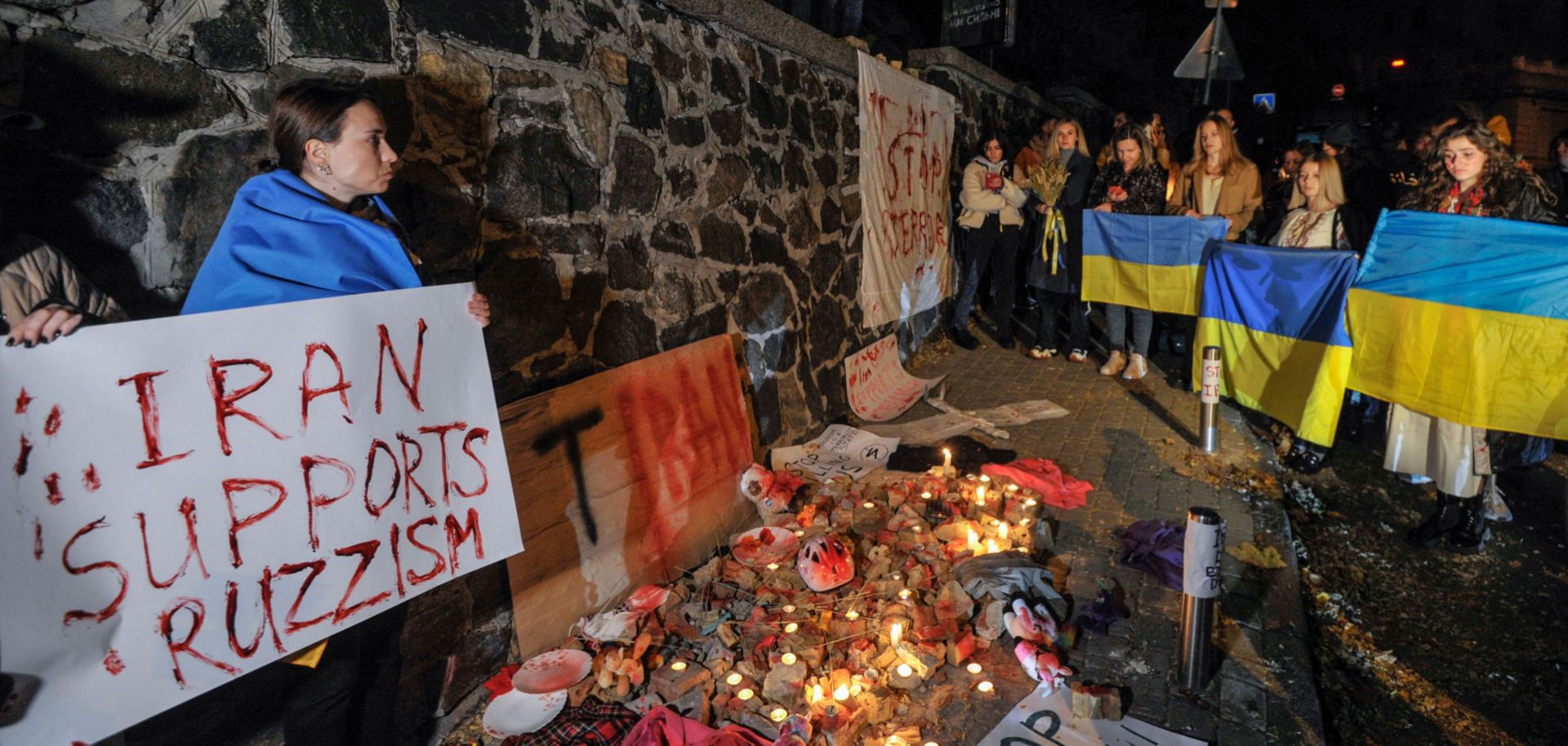
People demonstrate outside the Iranian embassy in Kyiv, Ukraine, on Oct. 17, 2022, after the city was hit by swarms of drones sold by Iran to Russia, leaving at least three dead.
Israel will increase civilian and intelligence aid to Ukraine as its rival Iran increases military support for Russia, feeding into the deterioration of overall Russo-Israeli ties that could result in economic and political retaliation. On Oct. 19, Israel said it will help Ukraine develop a ''red alert'' system to detect and warn civilians of incoming Russian missiles and drones, similar to the early-warning system Israel uses to prepare its own people for imminent air strikes. Israeli Defense Minister Benny Gantz said his country would still not provide Ukraine with any military hardware, despite repeated pleas from Kyiv for more advanced air defense systems (like Israel's Iron Dome system) to block repeated Russian strikes on critical Ukrainian infrastructure. But the announcement still marks a notable shift in Israel's approach to the ongoing Russo-Ukrainian war, which has so far seen the Israeli government maintain a neutral stance for fear of provoking Russian retaliation.
The increased aid to Ukraine comes as Israel's regional rival, Iran, is boosting support to Russia. Despite widespread public sympathy for Ukraine, Israel has been hesitant to fully back Kyiv, as it needs Russian acquiescence for operations against Iran in Syria. But Israel appears to be shifting its tone in response to recent reports that Iran is not only supplying Russia with ballistic missiles and drones, but that Iranian Revolutionary Guards Corp (IRGC) troops are also helping train Russian forces at a military base in Crimea. The revelations regarding Iran's growing support for Russia's war spurred Israeli Diaspora Minister Nachman Shai on Oct. 17 to call on Israel to openly arm Ukraine. In response to Shai's statement, former Russian President Demitri Medvedev said such a move would ''destroy'' Russo-Israeli relations.
- Israel relies on Russian defense cooperation to strike Iranian targets in Syria, where Russia still maintains an air force presence and has an S-400 missile system deployed. Russia has also threatened to close the Jewish Agency, the institution responsible for Jewish visitation and immigration to Israel.
- Iranian-Russian relations go back years. Russia helped set up Iran's civilian nuclear program and Moscow has been a major arms supplier for Tehran despite Western sanctions. The two are also mutual allies in Syria, where they both intervened to support the government of Bashar al-Assad.
Israel will likely continue to provide Ukraine with intelligence to help Kyiv fend off Iran-backed Russian troops. Israel has provided Ukraine with intelligence information about Russian troop locations and Iranian drone deliveries. As the war rages on and Iran deepens its cooperation with Russia, Israel will likely increase this strategic support to Ukraine, in addition to continuing to develop an early warning system for the war-torn country. Specifically, Israel may broaden the scope of such aid from the civilian sector to include intelligence compiled by the Israeli Defense Force (IDF) and Israel's spy agency Mossad that could help Ukrainian troops better target Russian and Iranian forces and supply chains. Israel could also offer intelligence on how to better utilize air defense systems already owned by Ukraine to shoot down Iranian-made drones and missiles.
But Israel remains unlikely to supply Ukraine with advanced defense systems due to various logistical, political and diplomatic constraints. For one, Israel needs its advanced air defense systems for its own protection. The country has a limited quantity of Iron Dome systems, and sending them to Ukraine would risk leaving Israel vulnerable to attacks from nearby enemies in the Palestinian territories, Iran and Lebanon. Israel's Arrow 3 ballistic missile interceptor, meanwhile, requires special launching pads that would have to be constructed in Ukraine to be effective — making it mission-inappropriate for the Ukraine war. Israel's other advanced weapons that were either purchased from or created alongside other countries are also subject to political constraints. Israel's Barak 8 air defense system, for example, was jointly developed with India, which has kept a neutral approach to the Russo-Ukrainian war that the Barak 8's deployment would risk upsetting. The U.S.-made Patriot missile system would require Washington's approval before being sent on to Ukraine as well. In addition to these logistical and political constraints, there is the risk that any advanced weapon systems supplied to Ukraine could either be destroyed over the course of the war.
Russia, for its part, will perceive even limited Israeli aid to Ukraine as a hostile act and will likely retaliate with diplomatic, economic, political and potentially even military action. In the near term, the Kremlin can use its political control of the Russian judiciary to close the Jewish Agency while also barring Jewish Russians from leaving the country to visit Israel, interrupting family and cultural ties for the estimated 900,000 Russian Jews living in Israel. Russia can also bar investment and trade with Israel, which has become a destination for some wealthy Russians trying to reallocate assets from Europe and the United States to escape Western sanctions. Politically, Russia can try to isolate Israel by using its online and media narrative-shaping campaigns to amplify anti-Israel and -semitic rhetoric and propaganda. Finally, Russia can create military complications for Israel's covert campaign against Iran in Syria, threatening to utilize its S-400 air defense system to block Israeli attacks.
- Anecdotal reports suggest that many wealthy Jewish Russians seek to move to Israel to escape the effects of sanctions and war thanks to the work of the Jewish Agency and Russia's working relations with Israel. This influx of wealth could be cut off in the advent of the agency's closure.
- Russia accounts for a relatively small percentage of Israel's overall trade volume. However, Russian wheat made up around 18% of Israel's total imports in 2020. As Moscow mulls retaliatory measures to deter Israel from supporting Ukraine, reducing or cutting off these exports could be a particularly alluring option, as the loss of Russian wheat supplies would exacerbate already high food prices in Israel at a time when inflation is becoming a big political issue for its government.
- Russia has already used its S-300 missile system in Syria to fire upon Israeli jets in May 2022, resulting in no casualties but signaling the dangers to Israeli warplanes over the skies of Syria. The incident did not cause a major diplomatic incident as Israel interpreted it as a ''one-off'' rather than a shift in strategy. While there are reports Russia has withdrawn some of its air defenses from Syria to Ukraine, the advanced S-400 system remains in country.
