
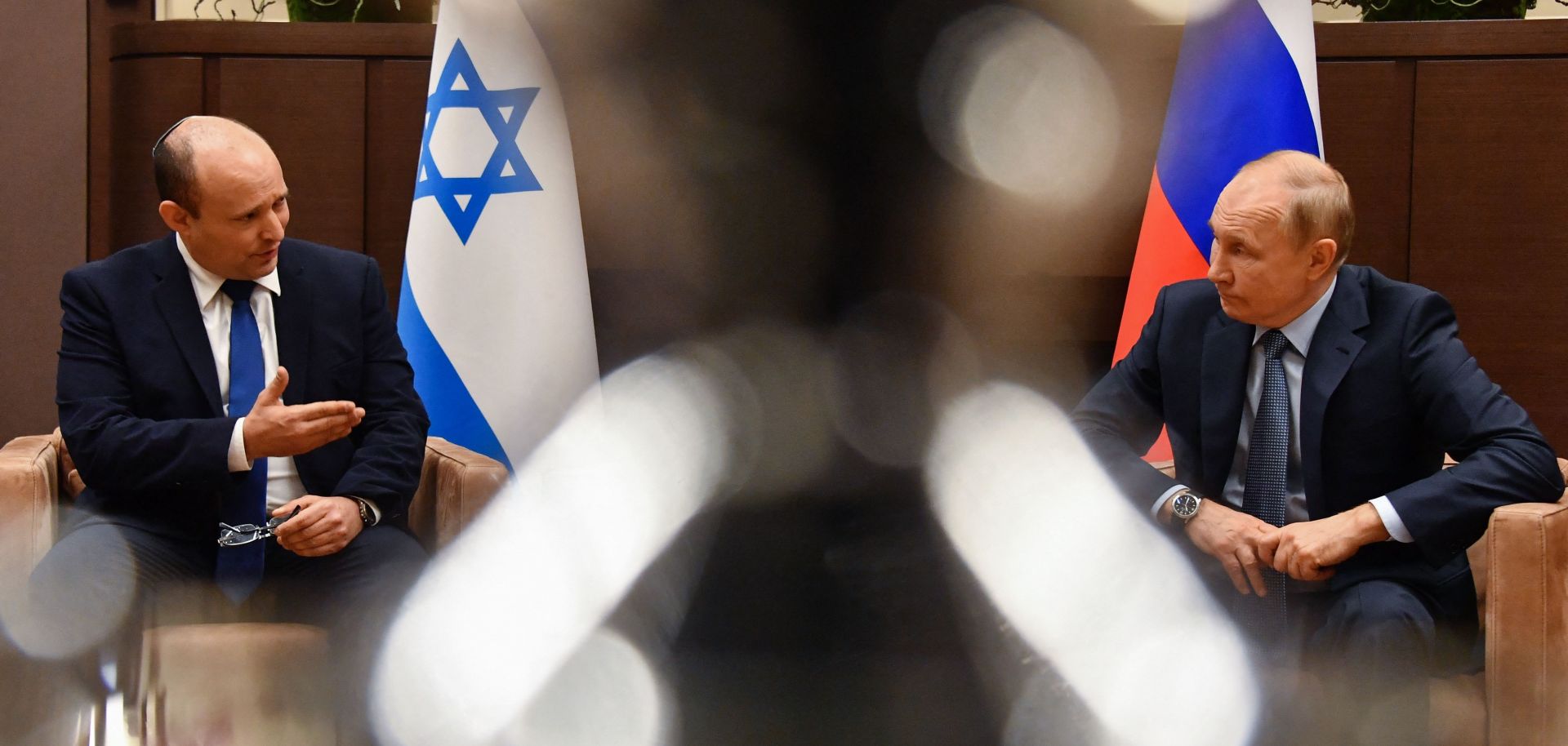
Russian President Vladimir Putin (right) speaks with then-Israeli Prime Minister Naftali Bennett (left) in Sochi, Russia, on Oct. 22, 2021.
Russian pressure on Israel to reduce support for Ukraine and ease airstrikes against Iranian targets in Syria could trigger a diplomatic crisis or accidental military escalation between the two — particularly in Syria, where the Israeli-Russian relationship is becoming tenser. On July 5, Russia's foreign ministry demanded Israel cease a long-running covert air campaign against Iranian targets in Syria after Israeli warplanes hit a reputed Iranian position relatively close to Russia's naval base in Tartus. That same day, Israel accused Moscow of threatening to close down the Jewish Agency in Russia, which aids Jewish immigration and visits to Israel (known as "Aliyah"). In June, Russia also criticized an Israeli airstrike on the Damascus airport that shut down the airport for days.
- Israeli-Russian ties in Syria have been largely pragmatic. Up until recently, Moscow had tolerated Israel's airstrikes aimed at degrading Iran's military influence, including those in Syria's Latakia province, where Russia's air and naval bases lie. But Russia's ongoing war in Ukraine has become a drain on its military resources in Syria, where Moscow has withdrawn some of its troops to fight in Europe. This has made maintaining Iranian military influence more important in fulfilling Russia's aim of consolidating Syrian President Bashar al Assad's control of the country. Moscow has, in turn, become warier of Israeli airstrikes against Iran in Syria, seeing them as potentially destabilizing for the al Assad regime. As part of this new concern, in May, a Russian-operated but Syrian-owned S-300 missile system reportedly targeted Israeli jets in Syria.
- Russia has also expressed strong displeasure about Israel's diplomatic and defensive material support for Ukraine. Israel has sent limited numbers of helmets and kevlar to Ukrainian troops fighting Russian forces. Roughly a month after Russia launched its invasion in February, Israel also allowed Ukrainian President Volodymyr Zelensky to virtually address lawmakers in the Israeli Knesset. These actions have angered Russia, which in early May, accused Israel of supporting unproven neo-Nazis in Ukraine and sending mercenaries to fight against Russia. During his visit to Israel on July 14, U.S. President Joe Biden reportedly asked Israeli Prime Minister Yair Lapid to expand Israel's military assistance to Ukraine, which would risk only further ramping up tensions with Moscow.
Russian-Israeli relations remain anchored by a strong mutual desire to avoid conflict, making it unlikely either country actively seeks a confrontation in Syria. Russia does not have an interest in Iran's regional anti-Israel campaign, which previously saw Moscow largely ignore Israeli air activity over Syria — especially when the targets of those strikes didn't affect the overall civil war. Israel, for its part, has also historically not objected to Russia's position in Syria and alliance with the al Assad regime, which does not target or otherwise impact Israel. This shared neutrality toward each other's actions in Syria has seen Russia and Israel regularly de-conflict in the country. Indeed, shortly after Russia invaded Ukraine, former Israeli Prime Minister Naftali Bennett flew to Moscow in early March to try to establish Israel as a possible facilitator for brokering a cease-fire with Kyiv. Despite the recent uptick in tensions over Ukraine, Russia and Israel also still have deep cultural, social and economic ties. And these ties remain intact, as Israel has notably not joined the Western sanctions campaign against Russia and continues to host some Russian oligarchs.
- The Soviet Union established the Tartus naval facility in 1971 as it backed Syria against U.S.-allied Israel in the Cold War. But hostilities between Moscow and Israel ended with the fall of the Soviet Union in 1991. The Russian Federation has since used the Soviet-era naval base in Syria to retain influence in the eastern Mediterranean, not to target U.S. allies like Israel in the region.
However, Russia's increasing reliance on Iran to secure strategic gains in Syria will increase its willingness to slow Israeli airstrikes against Iranian targets. Israel's airstrikes against Iran — which is a close ally of the Russian-backed regime in Damascus — now carry a greater risk of destabilizing the Syrian government, as the war in Ukraine continues to strain Moscow's ability to protect al Assad's forces. For Russia, continuing to allow Israel to launch such attacks also risks jeopardizing its relationship with Tehran — one of Moscow's key allies against the U.S.- and European-led economic isolation campaign. This increased economic and security reliance on Tehran's role in Syria will likely prompt Moscow to try to slow Israeli airstrikes. Through the de-confliction communication lines it has established with Israel, Moscow may try to try to convince Israel not to strike certain targets or areas, like the sensitive Latakia province and the Damascus airport, as well as other strategic sites that are either associated with Syria's economy or are particularly important to Iran. Russia might also threaten to give Syrian forces the green light to use Russian-made weapons, such as the S-300 air defense system, to more frequently target Israeli warplanes — either by locking on to the jets or by actually firing at them. In the most extreme case, Moscow might threaten to use the S-400 missile defense system against Israeli warplanes if they target locations Russia considers particularly sensitive. Russia, however, is unlikely to follow through on such a threat, as unlike Syria's S-300, the S-400 is directly operated by the Russian military. Using this system directly on Israeli warplanes would thus almost certainly trigger a direct military crisis between Russia and Israel, and potentially the United States.
- Israeli airstrikes harm the Syrian economy by damaging infrastructure (including border crossings, ports and airports). This deters trade and business Damascus needs, undermining Syrian stability.
Israel's warming ties with Ukraine make Russia more likely to continue cutting off its diplomatic and cultural ties with Israel as well. Over 150,000 Jews remain in Russia. Around 900,000 Jews in Israel are also Russian or of Russian descent. This deep cultural and social connection gives Israel a strong political incentive to maintain ties with Moscow, as evidenced by Isreal's resistance to imposing Ukraine-related sanctions. But this also gives Moscow some leverage to try to limit Israel's ties with Ukraine, as Russia can threaten travel bans, block communication, disrupt immigration and travel to Israel (Aliyah), and, in the most extreme cases, arrest prominent Jews in Russia. Russia is also a notable source of tourism for Israel, with Russian tourists making up around 10% of all tourists in 2021, second only to the United States.
Accidental escalation remains possible as Russia attempts to carry out this relationship reframe, which could result in a diplomatic rupture or a military confrontation in Syria. Israel may not meet Russian demands to pare down airstrikes, especially if U.S.-Iran nuclear talks collapse and spur a regional military escalation. Russia would then either have to risk its credibility as a protector of the Syrian government or a possible military confrontation with Israel. Even using Syrian-owned S-300s against Israel could spark a confrontation if Israeli warplanes destroy an S-300 battery and cause Russian casualties. Meanwhile, if Russia overuses its social and economic leverage to push Israel away from Ukraine, it could backfire by causing Israel to align more with Ukraine and the West's isolation campaign against Russia.
- Russian attempts to leverage its social and economic influence against Israel could embolden long-entrenched anti-Semitic elements in the country. Russian Jews are already reporting an increase in anti-Semitic incidents in Russia.
- Since the re-imposition of U.S.-led sanctions on Iran in 2018, Israel has escalated its covert campaign against Iran's nuclear and missile programs, including carrying out assassinations and reported drone strikes inside Iran itself. The covert campaign carries a latent risk of regional escalation.
