
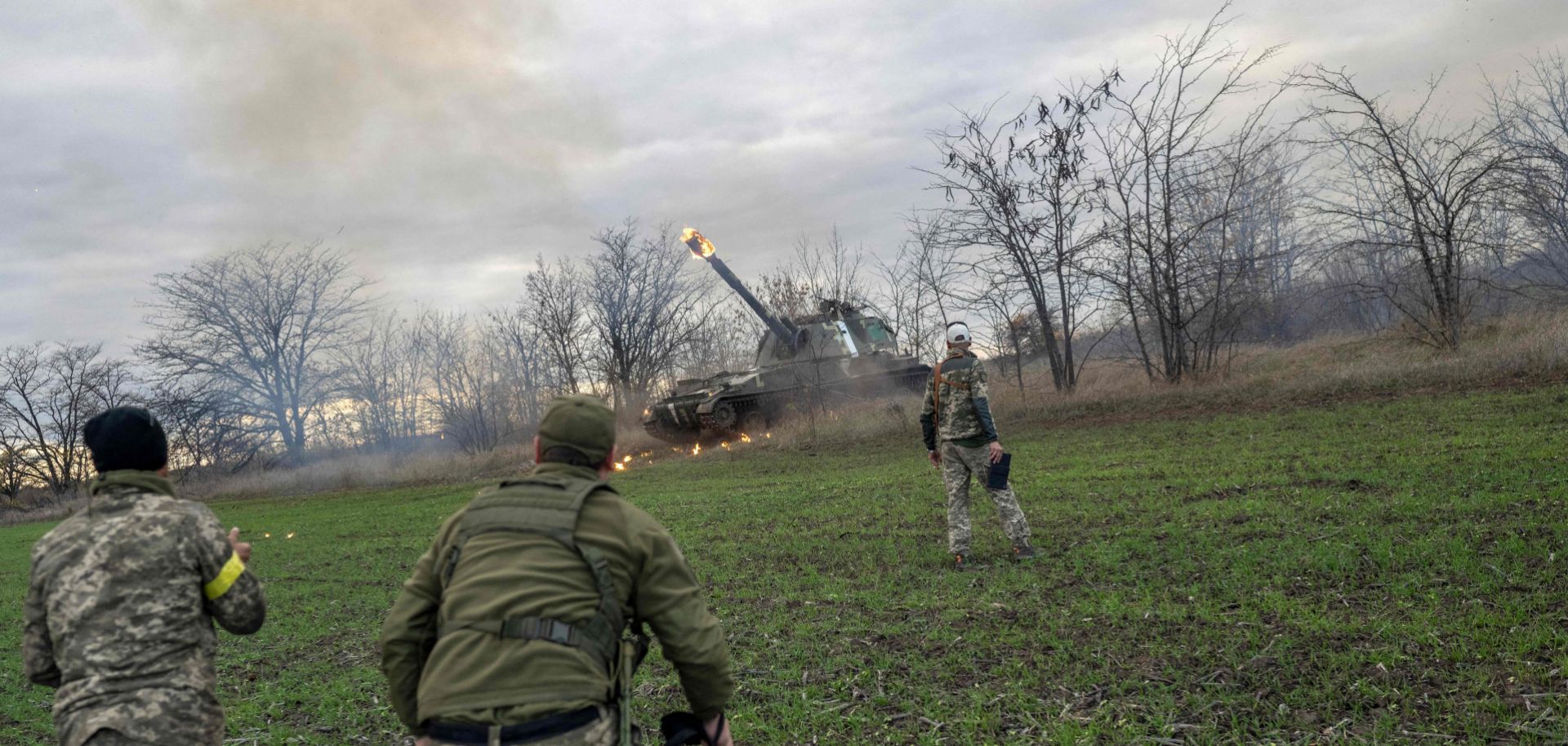
Ukrainian artillery unit members fire toward the city of Kherson in southern Ukraine on Oct. 28, 2022.
Russia's withdrawal from the strategic southern city of Kherson will shift the fighting in Ukraine eastward, make it harder for the Kremlin to justify its war at home, and spur unsuccessful talk in Moscow and the West of renewing cease-fire negotiations with Kyiv. On Nov. 9, Russian Defense Minister Sergei Shoigu ordered the withdrawal of troops stationed in Kherson, the strategic Ukrainian city located along the Black Sea and the Dnieper River that Russia captured in the opening days of its war. Shoigu made the decision at a staged briefing released to Russian state media with the general in charge of Russia's war in Ukraine, Sergei Surovikin, who explained that Ukrainian shelling had made it impossible to properly supply his troops on the right bank of the Dnieper River. The retreat follows reports of several Ukrainian attacks along the Kherson front, as well as rumors that some Russian forces in and around the city (including elements of the 76th and 106th Air Assault Divisions and the 22nd Army Corps) had already fled eastward to the other side of the Dnieper.
- Surovikin was appointed the commander of Russia's ''special military operation'' on Oct. 18. In his first interview with state media under the new role, Surovikin hinted at the possibility of Russian forces leaving Kherson by noting he would not rule out making ''difficult decisions'' regarding the region. Reports suggest that Surovikin had likely been pushing for a retreat from Kherson for weeks, but that Russian President Vladimir Putin had previously overruled the new commander's requests.
- Kherson was seized just days after the start of Russia's invasion on Feb. 24. It was the first significant urban center in Ukraine that Russia captured after launching its invasion, and remains the only regional capital in the country that has fallen under Russian control since the invasion began.
Russia's retreat will likely take several days in order to prevent Ukraine from disrupting the withdrawal and further endangering Russian forces. The goal of Russia's withdrawal is to maintain the combat capability of its troops by preventing losses to men and equipment. To ensure those men and equipment aren't harmed as they exit Kherson, the retreat will strive to be methodical. Russia will rely on several lines of defense in order to gradually pull back from line to line, maintaining battle order and control to prevent the several thousands of pieces of Russia's modern military equipment from being destroyed or abandoned. High proportions of Russia's elite airborne troops, as well as formations of the 22nd army corps and the 49th combined arms army, will also remain on the western bank of the Dnieper to screen the troops from Kherson. Ukraine, meanwhile, will likely launch attacks throughout the withdrawal to ensure it is as chaotic and costly as possible for Russia. Ukraine will also be tempted to try to prevent some of Russia's most combat-capable formations from leaving Kherson by effectively encircling them in the area. But given Russia's extensive mining and construction of fortifications in and around Kherson, such an operation would risk resulting in significant casualties for Ukraine, which must conserve manpower whenever possible against its much more populous opponent.
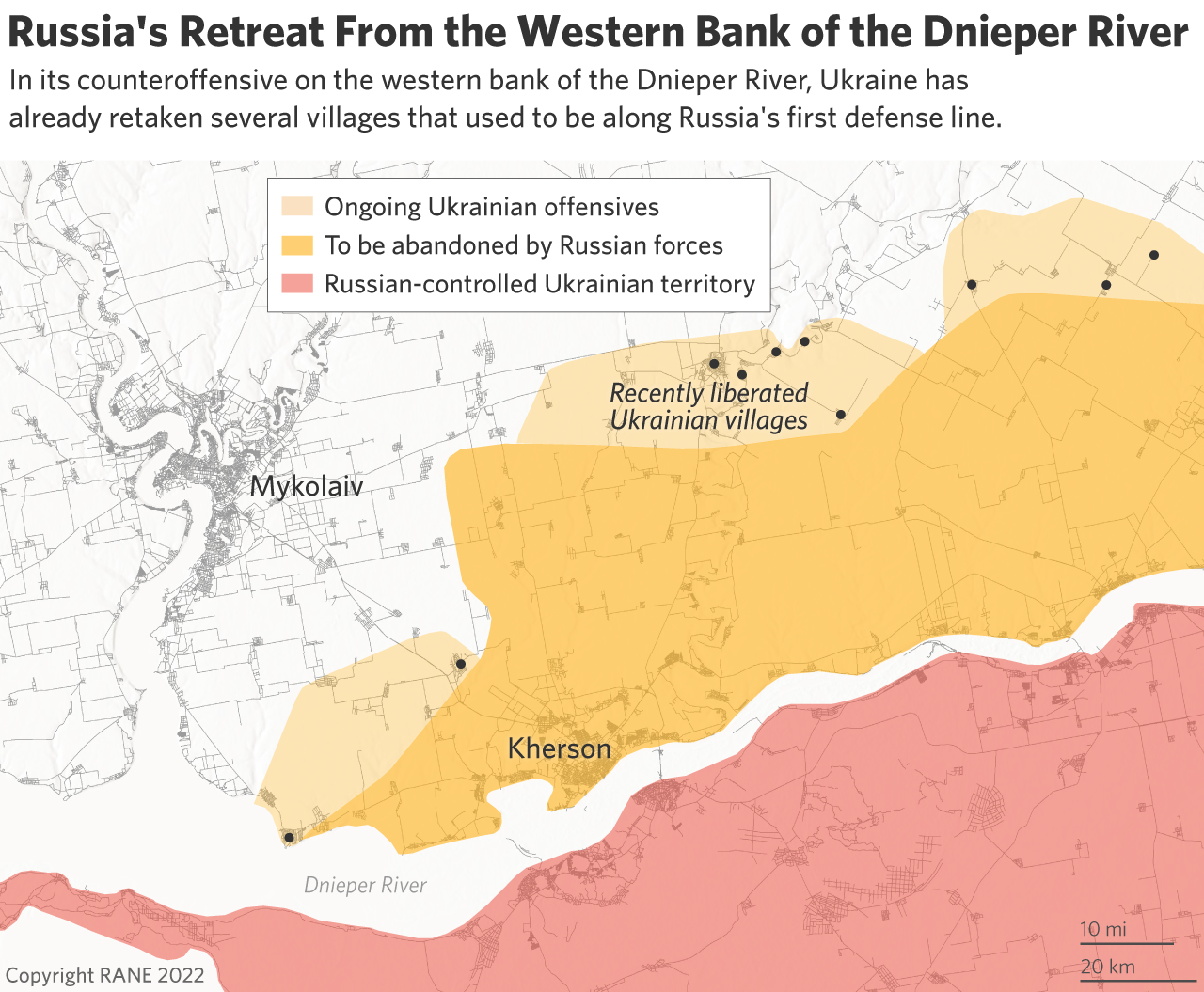
The Kherson retreat will compel Russia to double down on its scorched-earth strategy of targeting Ukrainian civilians and infrastructure. The Russian forces withdrawn from the western bank of the Dnieper will likely be repositioned eastward to the Zaporizhzhia and Donbas regions where Ukraine has recently been deploying more troops. But the growing concentrations of both sides' forces in those areas will make a major breakthrough in the war unlikely. Indeed, the retreat from Kherson is the latest in a series of setbacks Russia has faced on the battlefield in recent months amid persistent Ukrainian advancements. Moscow will perceive the loss of the strategic southern city as further evidence of its inability to break the Ukrainian military's unyielding resistance, which will in turn compel the Russian military to further focus its efforts on breaking the Ukrainian people's and the West's will instead. This will see Russia increasingly use precision weapons to launch attacks that result in civilian casualties and the widespread destruction of critical infrastructure — including Ukraine's electrical grid, communications facilities and decision-making centers.
The loss of Kherson will lead to further disenchantment and alarm among Russian citizens about the trajectory of the war in Ukraine. But the retreat won't keep Moscow from continuing to frame its special military operation as a success, despite the dwindling amount of Ukrainian territory that remains under Russian control. The retreat doesn't come as a surprise for Russians, given the Nov. 9 announcement followed weeks of reports that Russian forces had begun withdrawing from the city. This reduced shock value will, in turn, mitigate the public backlash in Russia from both hard-line and liberal factions casting the retreat as an embarrassment. But the loss of Kherson will nonetheless still cast further doubt in Russians' minds about the possibility of a victory in Ukraine. To justify the invasion as worth the costs to the Russian populace, it will be crucial for the Kremlin to retain control over the areas of Ukraine still occupied by Russian forces, with the land corridor to Crimea being the most important, followed by newly seized areas of Donbas. This means Russian forces are likely to expend large amounts of human and material resources to prevent further Ukrainian advances toward these annexed territories, to where fighting will inevitably shift as the eight-month war grinds on.
- Prior to the announced withdrawal from Kherson, high-ranking Russian officials had repeatedly indicated that Russia would never leave the city or other annexed territories of Ukraine. In a strongly-worded speech on Sept. 30, Putin said he wanted ''the Kyiv authorities and their real masters in the West'' to understand that Russia viewed the people living in the Russia-occupied regions of Luhansk, Donetsk, Kherson and Zaporizhzhia as ''our citizens[,] forever.'' In early May, the Secretary of the General Council of the ruling United Russia party reportedly told Kherson city residents that ''Russia [was] here forever,'' and that there would be ''no return to the past.''
- Notably, many pro-war Russian military bloggers and regime hardliners such as Chechen leader Ramzan Kadyrov and Private Military Company Wagner head Evgeniy Prigozhin praised Russia's decision to withdraw from Kherson. This suggests that public condemnation of Russia's withdrawal from the nationalist segment of Russia's information ecosystem will be relatively muted in the short term, but may still grow with time.
Russia's withdrawal from Kherson may lead to increased Western calls for renewed negotiations with Russia and a possible cease-fire over the winter, but Ukraine currently remains unlikely to rejoin talks. On Nov. 9, NBC reported that some Western officials increasingly believe that neither side can achieve their goals in the Ukraine war and believe the expected winter slowdown in fighting is an opportunity to restart diplomatic talks between Russia and Ukraine. Such reports of U.S. and EU officials either informally hinting at or openly calling for negotiations will likely increase amid the likely impending stalemate on the frontlines in eastern Ukraine. But Kyiv remains unlikely to return to negotiations, where it would likely once again face demands from Moscow to de facto relinquish control over all the Ukrainian territory Russia currently occupies, which is politically untenable for Kyiv. Additionally, a cease-fire could threaten Ukraine's currently advantageous position on the battlefield by granting Russia time to rearm and prepare troops for future offensives.
- On Nov. 10, U.S. President Joe Biden said Russia's order to evacuate troops from Kherson showed Moscow was having ''real problems'' with its military. Biden told reporters it was ''interesting'' that Russia had waited until after the U.S. congressional election to announce the withdrawal. Biden also said the retreat would allow both sides to recalibrate their positions over the winter, but it remained to be seen whether Ukraine was prepared to compromise with Russia.
