
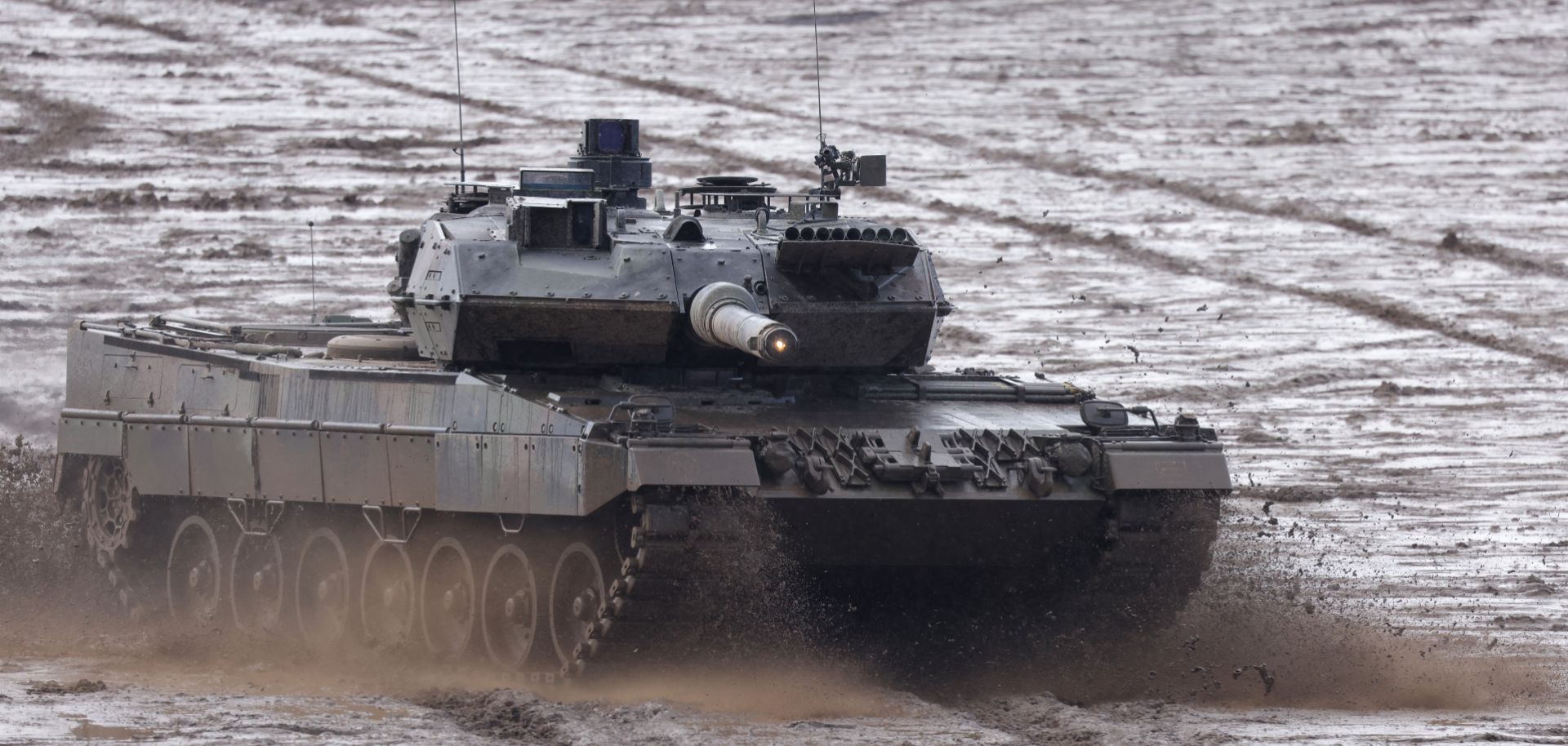
A Leopard 2 A6 heavy battle tank is seen at the Bundeswehr Army training grounds in Munster, Germany, on Feb. 7, 2022.
An impending agreement to supply Western main battle tanks to Ukraine won't alone ensure the success of Ukrainian offensives in 2023, but it will open the door for increased supplies of more advanced equipment that Kyiv needs to continue resisting Russia's invasion. After meeting with his Ukrainian and Lithuanian counterparts in the Ukrainian city of Lviv, Polish President Andrzej Duda announced on Jan. 11 that his country would transfer German-made Leopard 2 tanks to Ukraine as part of a coalition of states. Later that day, U.K. Prime Minister Rishi Sunak then confirmed that U.K. Defense Secretary Ben Wallace would ''work with partners'' in the coming weeks to increase support for Ukraine, including by providing tanks. On Jan. 12, German Vice Chancellor Robert Habeck, who is also the minister of economy and climate, said his country should not stand in the way when other countries decide to support Ukraine, regardless of what decision Germany makes. The statements confirm reports in recent weeks that Ukraine's defense donors have been working on an agreement to supply the war-torn country with Western tanks, which could be unveiled as soon as the next meeting of the Ukraine Defense Contact Group at the U.S. Ramstein Air Base in Germany on Jan. 20. In the coming days, attention will fall largely on the German government, which will need to give permission for the Leopard 2 deliveries and could, eventually, provide substantial numbers of the tank from its own stocks.
- The change in Western willingness to supply tanks is happening now because Ukraine has only a narrow window to conduct its own offensives and needs more powerful equipment to repel anticipated Russian offensives in the coming months.
- Ukraine has received main battle tanks before, namely from Poland and the Czech Republic, but these were exclusively modernized versions of Soviet tanks drawn from those countries' pre-war stocks. Spare parts and ammunition for them are limited, and these tanks' armor and firepower are considered inferior to Western main battle tanks of the same generation.
- Poland intends to deliver a company (approximately 14) of tanks, which are expected to be of the Leopard 2A4 model. Finland has also indicated its willingness to supply a similar number of its Leopard 2A4 tanks as soon as other European states begin doing so as part of an agreement. 13 European governments operate around 2,000 Leopard 2s, and several of those governments would be expected to provide some to Ukraine.
- The United States will be crucial in securing an agreement, as reports indicate German Chancellor Olaf Scholz's position depends heavily on that of U.S. President Joe Biden and U.S. participation in such an agreement, and support for providing tanks to Ukraine has bipartisan support in Washington. On Jan. 12, U.S. Senator Lindsey Graham said it was ''imperative'' that the Biden administration supply Ukraine with modern heavy tanks in order to ''encourage other Western allies to send theirs too,'' adding that ''with heavy armor, Ukraine will have the ability to militarily drive Russia off Ukrainian soil.''
Outstanding questions will determine the significance of the tank deliveries, though the deliveries on their own are unlikely to rapidly enable Ukraine to alter the war's trajectory by retaking the Crimea land corridor. In announcing his country's intention to supply tanks, U.K. Prime Minister Rishi Sunak's spokesman said it was ''accelerating support'' of a ''game-changing capability'' in Ukraine ''with the kind of next-generation military technology that will help win this war,'' referring to the 10 Challenger 2 tanks the United Kingdom will reportedly provide. Tank deliveries over the coming months could enable Ukraine to make considerable progress toward the 300 Kyiv has claimed Ukraine will need for successful offensives. However, the overall effect of the deliveries will depend on numerous factors, including precisely how many tanks Ukraine will receive, which models, and how many weeks crews will have to be trained on them before they are deployed to the front lines. Furthermore, while tanks could help Ukraine make incremental gains against Russian troops in the south of the country, they are unlikely to enable Kyiv to retake the land corridor connecting Russia to Crimea, which Kyiv needs to decisively alter the strategic balance of the war in its favor. This is because Russian forces are increasingly densely packed and entrenched in the area, where they are constructing concrete fortifications. There are also few natural barriers in the region on which Ukraine would be able to anchor major gains. It thus appears unlikely the tanks will be provided in a timely enough manner to enable Ukraine to quickly retake territory from Russian troops.
- Russia will loudly protest the supply of Western tanks to Ukraine, claiming they risk direct conflict between Russia and NATO. But Russia's response to the deliveries is likely to be largely tactical, moving anti-tank weaponry closer to the front lines, as Moscow is skeptical the tank supplies alone can result in Russia losing the war.
The Western supply of main battle tanks is nonetheless a significant milestone in the erosion of previous limits on support to Ukraine that will shift focus in Kyiv and Western capitals to additional systems that Ukraine needs for successful offensives, including advanced drones and fixed-wing aircraft. There is still no indication that the West will bolster Ukraine's long-range strike capabilities by, for example, providing the Army Tactical Missile System (a surface-to-surface missile) or other longer-range munitions that would have the biggest impact on making Russia's occupation of southern Ukraine untenable. Seeking to avoid escalation, Western provision of such capabilities will likely remain a last resort should Russia make major gains on the battlefield or engage in further escalation, like using nuclear or chemical weapons. Therefore, with tanks checked off the list and long-range strike capabilities still off the table, the discussion among Western leaders will likely shift to providing Ukraine with additional modern drones to bolster numerous other capabilities, including close reconnaissance, close support strike, and long loiter. This could see the United States provide Ukraine with Gray Eagle and Reaper drones, although such U.S. drones are often more complex and costly compared to other countries' equipment, and provisions will ultimately be determined by which countries are able to provide specific capabilities at the lowest cost. In any case, conversations will grow in Western capitals that embargoes on other advanced equipment supplies to Ukraine are also misguided, like the previous restrictive policy on tanks. This will likely increase calls for Ukraine to receive Soviet-era MiG-29 fighter jets (which Slovakia and Poland have offered to donate to Kyiv but have yet not done so, citing the lack of agreement among Western allies) and, eventually Western-made jets like the F-16 and F/A-18.
