
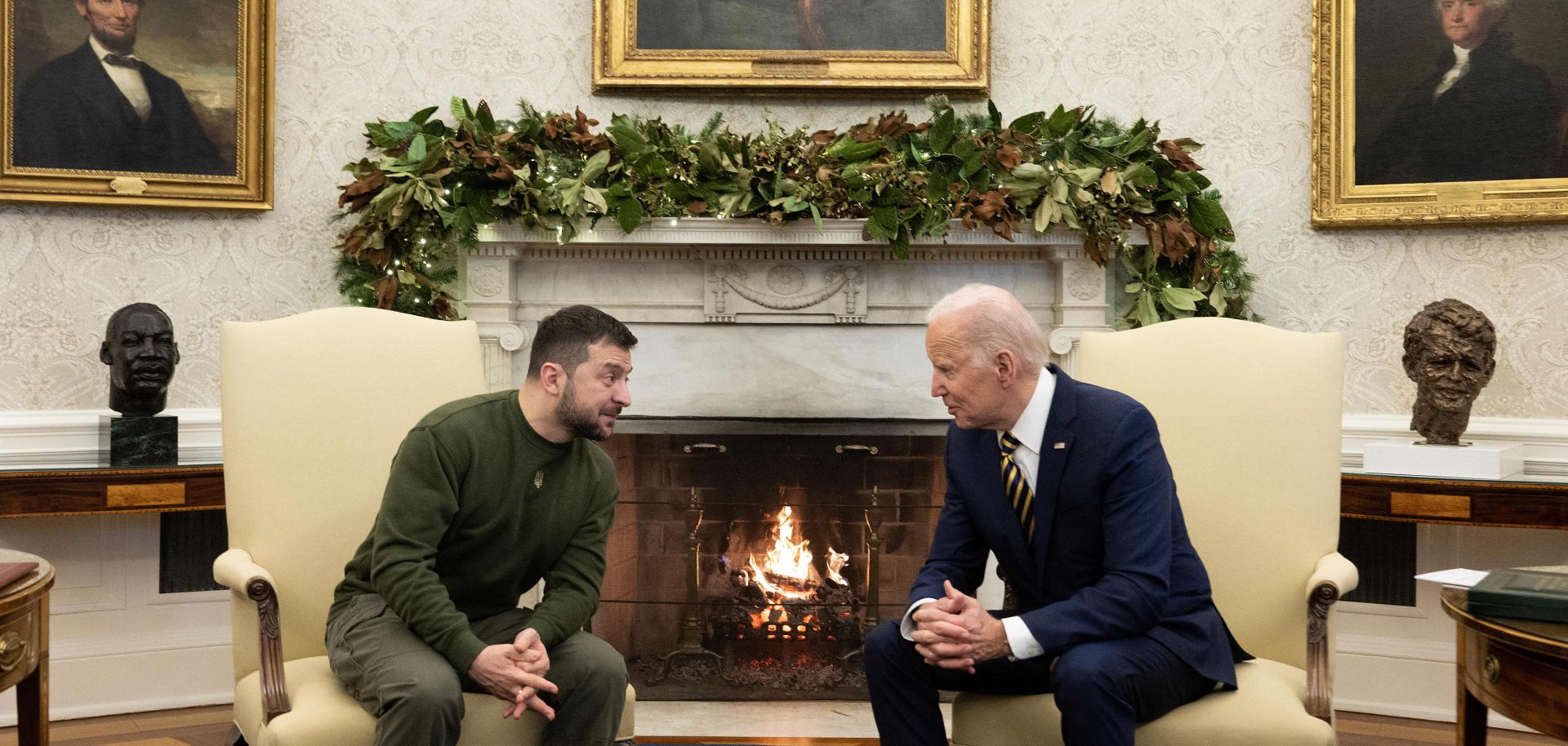
Ukrainian President Volodymyr Zelensky meets with U.S. President Joe Biden in the Oval Office of the White House, in Washington, D.C. on Dec. 21, 2022.
Ukrainian President Volodymyr Zelensky's visit to the United States appears unlikely to convince the White House to provide Kyiv with the weapons it needs to retake more of its territory from Russia. On Dec. 21, Zelensky made his first foreign visit since Russia invaded his country on Feb. 24 — arriving in Washington for talks with U.S. President Joe Biden and top U.S. officials, followed by an address to a joint meeting of the U.S. Congress. The visit coincided with the announcement of a new U.S. package of $1.85 billion in additional security assistance for Ukraine that includes one Patriot anti-air defense system (details on the model and munitions for which were not disclosed). The visit comes at a pivotal moment, with Ukrainian forces making gains on the battlefield in recent months. But Ukraine lacks the long-range strike capability and other offensive equipment it needs to maintain its momentum against increasingly entrenched Russian forces. At a press conference with Zelensky, President Biden shot down the idea of providing Ukraine material ''fundamentally different'' from that which is already going there, saying this would ''have the prospect of breaking up'' NATO and the European Union's support for Ukraine. The remark reasserted the West's policy of refusing to provide Ukraine long-range weaponry, such as the Army Tactical Missile System (which is a surface-to-surface missile) or other longer-range munitions Ukrainian forces would need to more effectively degrade Russian logistics farther from the current front line. Therefore, while the trip will likely help drum up support among U.S. lawmakers and citizens for continuing to help Ukraine, Zelensky's visit did not secure longer-range strike capabilities that Kyiv will need to maintain offensive momentum this spring — buying Russia time to train, rearm, and build fortifications for its troops in eastern Ukraine, and likely putting on the war on a path whereby Kyiv will have little chance to retake the territories Russia seized this year.
- The $1.85 billion U.S. package authorizes $1 billion of additional security assistance to Ukraine, delivering equipment that is drawn directly from Department of Defense stocks. The other $850 million in assistance will come from the Ukraine Security Assistance Initiative (USAI), allowing Ukraine to purchase equipment and earmark production directly from U.S. defense contractors.
- The U.S. decision to provide the Patriot defense system is the result of Russia's campaign on Ukraine's civilian infrastructure. The decision is notable due to the system's ability to help defend Ukraine amid Russia's ongoing airstrikes against the war-torn country's critical infrastructure (like its energy grid). The delivery of the Patriot system is also notable because it marks a shift in U.S. policy, as in the months immediately following Russia's invasion, the United States had repeatedly rejected the idea — often saying the system would require U.S. personnel to be stationed in Ukraine, which would pose an unacceptable risk for NATO.
The visit comes as Russia is signaling its intention to maintain the war effort in the long term, while highlighting its cooperation with China. Moscow conducted two previously unannounced events on the day of Zelensky's visit in what appeared to be an effort to signal Russia's intention to maintain its negotiating position and continue the war — no matter how long it takes and at what cost for Russia. Russian President Vladimir Putin and Russian Defense Minister Sergei Shoigu gave public remarks before an expanded meeting of the Russian Defense Ministry's Collegium. During the meeting, Putin said that there were ''no funding restrictions'' on the Russian military and that ''the corresponding results will be achieved,'' while Shoigu vaguely noted that Russia's goal for 2023 was to continue the ''special operation [in Ukraine] until its completion.'' Also on Dec. 21, former Russian President Dmitry Medvedev — who's a close confidant of Putin and currently serves as the deputy head of Russia's Security Council — met Chinese President Xi Jinping on an unannounced visit to Beijing, where he delivered a ''message'' from Putin, the contents of which were undisclosed beyond hailing the countries' ''unprecedented'' cooperation. Together, the two events emphasized the Kremlin's commitment to its current course, reassuring China that Russia will remain a long-term reliable partner for Beijing against the West no matter how the war evolves.
- During the Dec. 21 event, Shoigu proposed and Putin accepted a controversial measure to adjust the age range for conscription in Russian military service from 18-27 to 21-30. The details of the proposal are unclear, other than it will be phased in starting next year. But its purpose appears to be making more of Russia's population subject to conscription, while also excluding teenage conscripts from being called to fight in Ukraine (which is unpopular in Russia).
- Medvedev was accompanied by Secretary of the United Russia party Andrei Turchak and the head of the United Russia faction in the State Duma, Vladimir Vasiliev. Their inclusion in the China trip was likely intended to reassure Beijing of the guiding role the United Russia party will play in managing Russia's politics in the long term, and that under the party's leadership, Russia would continue its policy of confrontation with the West (even after Putin is no longer president) — thereby demonstrating to Beijing the inviolability of their close ties.
Kyiv's failure to shift the U.S. position on advanced and long-range strike weapon deliveries will likely force Ukraine to adopt a more cautious and defensive strategy on the battlefield, making further Ukrainian territorial gains (and peace talks with Russia) unlikely over the next year. Even if it does not get the weapons it is requesting from the West, Kyiv is unlikely to agree to any sort of a cease-fire that involves giving up Ukrainian territory to Russia, as this would be politically unacceptable for Zelensky. With little prospect of rapidly regaining its territory without long-range capabilities, Kyiv's strategy will effectively involve waiting for Russia's social, economic and political conditions to deteriorate to the point where Moscow is eventually forced to withdraw from Ukraine. But this strategy is dubious because it could take many years for Russia's domestic situation to reach that point. It also depends on events in Russia evolving in a certain way, as well as continued Western support for Ukraine (which could eventually weaken amid the mounting global economic fallout from the war).
- The United States could hypothetically reverse its decision not to provide Ukraine advanced and long-range strike weapons in the future, as it did with Patriot. However, such a move is unlikely unless Moscow significantly escalates the war (by, for example, launching a renewed offensive toward Kyiv) because, as Biden indicated, it could cause increased tensions within NATO. Such a strategic reversal could also be politically costly for the Biden administration, as deciding against providing Ukraine with advanced weapon systems now only to later authorize it would pose the same escalation risks, while also giving Russia additional time to reconstitute its forces.
- Following Zelensky's trip to Washington, Ukraine may shift the focus of its requests for additional Western aid to other offensive weaponry Kyiv needs, such as modern main battle tanks, armored personnel carriers, and NATO fixed-wing aircraft (which Zelensky assured Congress the Ukrainian military was perfectly capable of operating). But there is for now little sign that the West's stance on providing Kyiv with such systems will change anytime soon.
