
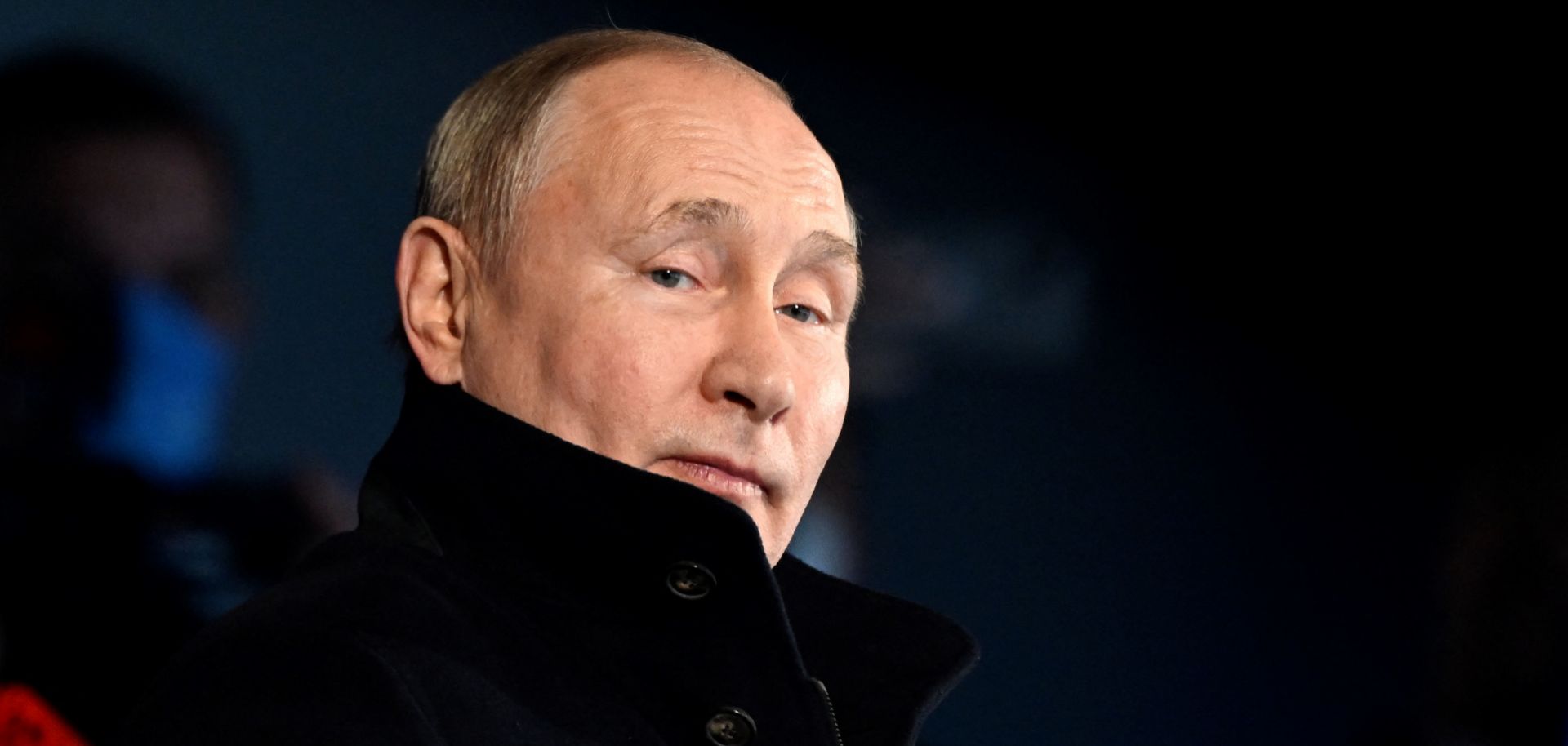
Russian President Vladimir Putin looks on during the opening ceremony of the Beijing Winter Olympics in February 2022.
Barring major setbacks on the battlefield in Ukraine, Russian President Vladimir Putin’s hold on power will likely remain secure. But the high price and questionable strategic benefit of his ongoing war create several avenues by which threats to the Kremlin will likely grow — especially ahead of the 2024 presidential election. In the weeks following the start of Russia’s February invasion of Ukraine (and in particular following Russian forces’ retreat from Kyiv and northern Ukraine), speculation swirled in Western media that Putin could be in political danger. The speculation included, for example, that a coup could depose the Russian president following the failure of Moscow’s “special military operation” to accomplish its original goal of regime change in Kyiv. Such speculation again appeared in the aftermath of Russia’s latest retreats in Ukraine, including its recent withdrawal from the major southern city of Kherson. The loss of Kherson has left the Kremlin with little more ground it can lose in Ukraine and still reasonably claim its invasion has been worth the cost. But for now, Putin’s regime remains in little immediate danger, as the Kremlin's preemptive repressions have enabled the Russian elite, security services and general populace to still believe that time is on Russia’s side in the war — and that if Russian forces can endure, Moscow will eventually be able to declare victory.
Russia’s large-scale campaign of repression to insulate Putin’s regime from popular protest and elite disgruntlement has so far been essential in staving off political unrest and will make political change difficult in Russia going forward. Protests against Putin, the war in Ukraine and Russia’s ongoing mobilization have been minor. This is largely due to the Kremlin’s systematic campaign to dismantle opposition and gain tighter control over the internet (including foreign tech giants), which predates the Ukraine war. With one of the most bloated domestic security spending budgets in the world, the Russian government has spent considerable resources developing its repression apparatus in recent years. And it used that apparatus to step up its campaign against dissenting and critical voices in the months leading up to the February Ukraine invasion, as evidenced by Russia declaring opposition leader Alexei Navalny’s organization as extremist in June 2021 and ramping up the use of coercive measures against Western tech giants since Russia’s initial incursion into Ukraine in 2014. Without these steps, the Kremlin would have been far less able to maintain political conformity in the aftermath of the invasion. Most importantly, the success of Russia’s domestic crackdown on dissent will continue to fuel inflated security budgets for increasing government control over the internet and the subsequent brain drain from the country. This will enable Putin’s government to continue relying on these long-tested and finely-tuned tactics to counter the inevitable rise in public disenchantment in the years ahead. The same anti-opposition campaign has also intimidated economic elites and businessmen into submission, for fear that their assets will be taken and their security threatened should the Russian security services detect their opposition to the war and believe it is causing them to pursue business activities detrimental to the interests of the Russian government.
- Russia has historically been a global leader in police officers and domestic security personnel per capita among major countries. The government’s focus on domestic security spending is now set to rise even further, by more than 50% to 4.42 trillion rubles in Russia’s 2023 annual budget compared with 2022.
What to Watch For
In light of these drivers and constraints, the following are potential signposts of growing political risks to President Putin and the Kremlin:
Ukraine retakes the rest of the Kherson and Zaporizhzhya regions (the so-called Crimea “land corridor”). The primary signpost for a growing threat to Putin’s rule is failing to defend the remaining territory that Russia still holds in Ukraine. Such a Ukrainian achievement remains improbable because of Ukraine’s lack of sufficient modern equipment and ammunition to overcome Russia’s increasingly entrenched forces. But should Ukrainian forces defy the odds by cutting off Russia’s “land corridor” to Crimea and pushing Russian forces to evacuate the area, the Kremlin would find it increasingly hard to claim the invasion has been a success, regardless of the narratives being peddled by Russia’s propaganda machine. Russian elites and the general public would likely then begin to speak out against the decision to invade and deride the war as not worth the economic and human costs for Russia.
Russia continues mobilization measures and/or renews widespread mobilization. Mobilization is by far the biggest contributing factor to the war’s declining popularity in Russia because it has touched many Russians whose lives were otherwise unaffected by the distant war. Contrary to claims by Russian officials, Russia’s military mobilization is continuing (albeit not in an active draft phase amid fall conscription activities), and is largely bottlenecked by a shortage of modern equipment. If the Kremlin forces more drafted or conscripted soldiers into combat (regardless of publicly announcing any renewed formal mobilization measures), this would increase the threat to Putin and the war because mobilization is the most unpopular element of the war and because it would suggest the Kremlin failed to plan the invasion properly or is receiving incorrect information from the Russian military.
Opinion polls show that support for Putin and the war is rapidly declining. Support for the war and Putin has largely trended downward in the months since the February invasion. A credible survey conducted in November showed that 55% of Russians supported peace talks with Ukraine — a notable jump from the only 32% of Russians who wanted such negotiations in July. That said, public support for Putin and his war has only been declining by a handful of percentage points each month, which isn’t fast enough to pose an immediate threat to Putin. But an acceleration of that decline could prompt anti-war Russians to believe a critical mass of opponents of the war has finally been achieved to realistically convince at least some of Russia’s largely apathetic and apolitical citizenry to more actively oppose the Ukraine conflict and Putin’s ruling party. This could, in turn, push Russian elites to begin quietly aligning with alternative power centers (of which there are few) in an effort to protect themselves. To limit the production and spread of information showing that public support for the war is trending downward, Russian authorities will likely move to further limit the number of open surveys being conducted on Russians’ attitudes to the conflict next year.
Russian ultranationalists and other far-right political forces increasingly question the Kremlin and claim the war’s failures necessitate a change of course or leadership. Even if Russia does not lose major additional occupied territories in Ukraine, a loss of support from the ideologically radicalized and increasingly armed Russian ultranationalists and its informal movement leaders (such as Alexander Dugin or Evgeniy Prigozhin) could threaten the Kremlin in several ways. The Kremlin has raised the far-right’s perceived influence among Russian elites and the general populace by repeatedly taking actions long advocated by its leaders and various pro-war telegram channels. Those far-right channels and leaders are increasingly influential among Russians supportive of the war, causing many to view this movement as an alternative power center to the Kremlin. If Putin is unable to assuage this constituency, hard-line forces within the government could increasingly feel emboldened to oppose the Kremlin’s pursuit of the war amid Putin’s reluctance to escalate. Sympathetic elements at the top of Russia’s security services, for example — including those who even initially lobbied for an invasion of Ukraine — could align with these far-right forces to replace Putin, although this remains extremely unlikely for now.
Fractures in the elite are increasingly visible as public figures become increasingly willing to question the war. The majority of the Russian elite oppose further escalation that could threaten their privileged status by destabilizing Russia, and believe that Russia can win the war with time amid the ongoing destruction of Ukraine’s civilian infrastructure. All parties in Russia’s parliament have supported the invasion. But some public figures — including lawmakers in the federal Duma and some regional parliaments — have made comments questioning the war’s rationale, its vague and constantly changing objectives, and the effectiveness of the Kremlin's strategy. Should lawmakers and other public figures (like leaders of state-owned and private companies, prominent academics and think tank scholars) begin to more regularly question official narratives, this would start to normalize skepticism about the war among not only Russian elites but average Russian citizens, posing the risk of further undermining public support for the war.
Putin fires or denounces high-ranking members of his inner circle in an attempt to make them scapegoats or distract public attention from the war. On Oct. 8, Russia appointed a new military commander to lead its war in Ukraine — General Sergei Surovikin. It appears the Kremlin tapped Surovikin to serve as a scapegoat for Russia’s subsequent retreat from Kherson (which came just a month later) and any additional setbacks on the battlefield. But Surovikin is a relatively obscure military official with little-to-no clout among Russian elites, and also does not have a close relationship with Putin. Putin remains unlikely to offer up allies from his inner circle — such as defense minister Sergei Shoigu or other top security officials, like Alexander Bortnikov (the chief of the main Russian intelligence agency FSB) or Nikolay Patrushev (the secretary of the Kremlin's Security Council) — as scapegoats for any failed war efforts in Ukraine, because it would not assuage public disappointment and would imply admitting that something had gone wrong at the top ranks of Putin’s regime. Moreover, a purge within Putin’s inner circle would turn the president into a source of danger rather than protection for the rest of his close collaborators, making it more likely they would conspire against him. Therefore, Putin sacking high-ranking officials — including non-security personnel like ministers — could be a sign of increasing desperation in the Kremlin.
Grassroots civil society groups become increasingly popular and active, even if not immediately through street protests. The Kremlin’s constant crackdowns on political dissent has made Russians extremely skeptical that taking to the streets can achieve political change. Therefore, grassroots organizations opposed to the war are unlikely to focus on staging protests, which would draw immediate and heavy-handed scrutiny from Russian security services. An anti-war movement is instead more likely to emerge from some of the groups that are currently focused on supporting Russian troops fighting in Ukraine (by, for example, providing equipment or securing the living conditions of service members or their family members back home), as Russian volunteers become disenchanted upon realizing the hardship the war has caused and their inability to fundamentally alter the conflict’s outcome. As elite groups in Russia’s government and security services become increasingly skeptical of data regarding support for the country’s current political course, sentiments among volunteer groups and other grassroots NGOs will become an important proxy indicator for public opinion turning against the Kremlin, and could push elites to begin quietly aligning with power centers with perceived influence over those grassroots groups.
A deep global recession and the subsequent large fall in crude oil prices or enforcement of a lower, crippling G-7 Russian oil cap price. On Dec. 2, the Group of 7 (G-7) unveiled its long-awaited price cap on seaborne Russian oil. The cap is set at $60 per barrel, with an adjustment mechanism that will review the price level every two months and keep it at least 5% below international oil prices (which are currently hovering around $80 per barrel). Russia can endure the cap as long as it remains set near or above the current $60 level, and is thus unlikely to face severe economic difficulties in the foreseeable future that would pose an immediate threat to Putin. Russia’s budget deficit is forecast to remain small in the coming years and with a tolerable oil price cap, the government will remain able to bring in sufficient revenue from oil sales to run little-to-no current account deficit. The new price cap is therefore likely incapable of exhausting its reserves in the near future. And even if those reserves were to run out, the Russian government could print money and internally finance its debt while continuing to receive a steady stream of hard currency from commodity sales and theoretically balancing its budget with further cuts. But should global oil prices plummet to around $30 per barrel, or should the G-7 price cap fall to a similar level, Russia’s economic health would deteriorate. Amid the loss of oil revenue, Russia’s state budget would begin running a massive deficit that would force Moscow to enact harsh and unpopular austerity measures, further slowing economic growth and deterring investment in Russia (even from friendly countries). Such a dramatic worsening of Russia’s economic environment would exacerbate anti-Putin and anti-war sentiments in the country.
Major political instability arises on Russia’s periphery, especially in Belarus or Kazakhstan. There is, for now, little sign that the regimes in Belarus or Kazakhstan are in imminent danger of succumbing to the kind of mass unrest that erupted in those countries in August 2020 and January 2022, respectively. But a sudden political crisis (for example due to the unexpected deaths of those countries’ nearly 70-year-old leaders), could force the Kremlin to act rapidly to ensure Russian interests are preserved amid likely chaotic succession processes. In a worst-case scenario, Russia could be forced to become militarily involved to secure regimes willing to maintain current relations with Russia, as the loss of pro-Russian leadership in either country would thoroughly discredit the Kremlin and create new geopolitical uncertainty in Russia’s immediate periphery. But the cost of rapidly moving in to prop up pro-Russian leaders with force would also be highly risky and involve Russia diverting crucial military assets and budgetary resources away from the war in Ukraine. Either way, such political upheaval in Belarus and/or Kazakhstan would thus pose a serious threat to the Kremlin.
Looking Toward 2024
These signposts will become increasingly relevant in the lead-up to Russia’s 2024 presidential election. The above signs of political, social and economic instability have either not yet been observed, or have been observed in insufficient quantity to constitute a trend. A failure to observe the further development of these signs likely means that the threat to the Kremlin remains low and stable. And most remain unlikely to appear unless Russian forces suffer greater setbacks on the battlefield. But Russians will increasingly question the strategic competence and necessity of the costly invasion as they prepare for the next presidential election (which is currently scheduled for March 2024 but could be postponed due to the war). Putin is likely to seek reelection because any scenario involving his departure and the subsequent power transfer would come at extreme risk that he is unlikely to accept amid the ongoing war. But while another term would prolong Putin’s hold on power, it would also create a continued risk of Russians becoming all the more fatigued with his regime and policies, merely kicking the possibly chaotic succession process down the road.
