
The logos of the U.S.-based social media platforms WhatsApp, Instagram and Facebook (left to right) are seen on a smartphone screen in Moscow, Russia, on Oct. 5, 2021.
With parliamentary elections now behind it, the Russian government will maintain its pressure campaign against Big Tech, threatening companies to coerce them into compliance while diluting their influence with domestic analogs in the coming years. Last year, the Kremlin launched a crackdown on political dissent to prevent the September elections for the Russian State Duma from resulting in opposition victories or mass protests. As the crackdown sought to narrow permitted political speech and information accessible in Russia, one of the focal points of the campaign became U.S.-based “Big Tech” companies like Google, Apple, Facebook, Twitter and Amazon, as well as other smaller tech companies. Russian independent media and political activists rely on these platforms to spread their message and demand more democratic governance in Russia, which the regime views as a threat. Moscow envisions sufficiently pliable domestic entities — such as Russia’s large tech conglomerates like Yandex, VK, and Sber — enjoying an environment similar to that of China or the United States, where domestically based tech and social media companies enjoy near-monopolies in their respective markets. The Kremlin would therefore like to weaken foreign tech companies and allow their Russian counterparts to enjoy less domestic competition and focus additional resources on expanding intentionally as tools of Russian influence. The digital component of the crackdown came to a head on the eve of last month’s election, when Apple and Google relented and deleted Russian opposition leader Alexei Navalny’s app from their marketplaces after lawmakers threatened the companies’ employees in Russia with criminal prosecution.
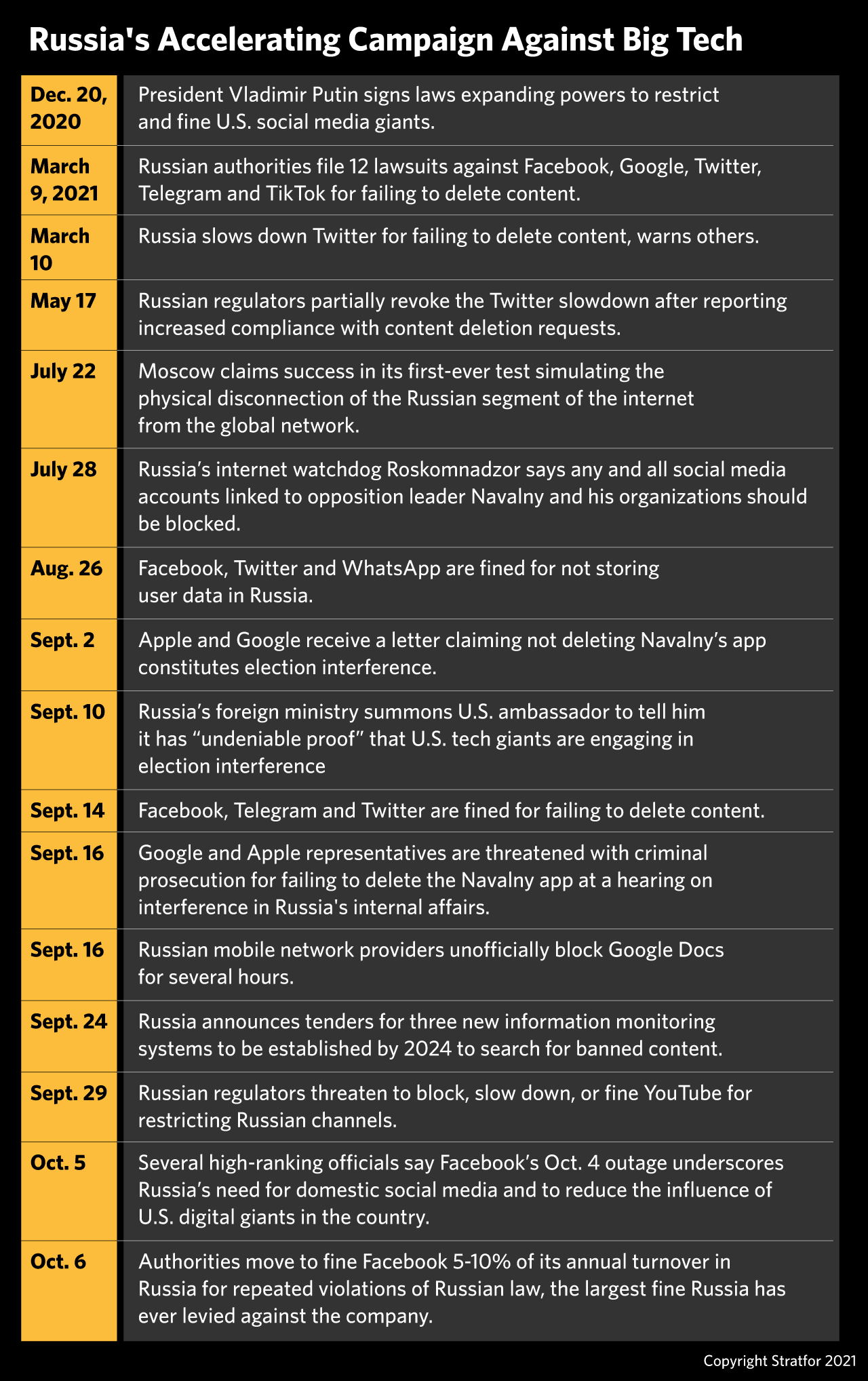
- In March, Russian authorities slowed Twitter’s speed in response to its alleged failure to remove banned content and threatened others with similar measures or blockage for failure to comply. Regulators partially lifted the slowdown in May to signal to companies that they would be reworded for increased compliance with Russian demands.
- As organizations connected to Navalny were declared extremist and the September parliamentary elections grew nearer, the pace of regulatory actions and threats against the companies accelerated, with additional fines for failing to delete content and store data in Russia and claims that not deleting content was tantamount to election interference.
- The Kremlin’s targeting of U.S.-based digital giants is also motivated by its divergent visions for cybersecurity governance compared with the United States. Russia’s latest national security strategy recognizes a wider range of threats than ever before, including concerns over the “Westernization” of the country’s political, ideological and cultural development. To increase its leverage in the U.S. cyber talks, the Russian government has drawn a dubious equivalence between its failure to go after ransomware groups targeting the United States and the U.S. government’s failure to halt tech giants’ from allegedly interfering in Russia’s domestic affairs.
The Next Phase of Russia’s Tech Crackdown
Scenario #1 (Most Likely)
In our baseline scenario, the Kremlin is likely to implement a steady pressure campaign that avoids blocking the services of major tech companies but tries to coerce them into compliance while supporting the development of analogous domestic services to reduce their market share and influence. This approach would seek to avoid the domestic backlash that would accompany blocking popular U.S.-based resources, while still accomplishing the Kremlin’s goals. For several years, Moscow has been unable to rein in U.S. companies for two main reasons. The first is that it lacked the technical capability to block content in a targeted manner, as demonstrated by the failed blockage of Telegram starting in April 2018 before relenting in June 2020. This restraint fundamentally changed over the past year, as the slowdown of Twitter and blockage of Navalny’s Google-hosted app displayed a significant improvement in authorities’ abilities to block unwanted content using Deep Packet Inspection (DPI) technologies installed as part of Russia’s 2019 so-called Sovereign Internet law, intended to increase the government’s control over the country's internet infrastructure and even isolate it in case of an emergency. Authorities will continue using this improvement in DPI blockage and slowdown capabilities to coerce companies into increased compliance. However, the second restraint on Moscow — the lack of large-scale domestic analogs for several of their services — will dissuade the Kremlin from outright blocking them at least through 2024, and probably longer, as millions of Russians and businesses continue to rely on the platforms for critical communication and Russian analogs will not be considered sufficiently functional and popular to replace them.
Some of the signposts that would confirm this scenario include:
- Russia’s internet regulator Roskomnadzor regularly reminds companies of their noncompliance with increasing fines and continued threats of legal action, using powers acquired this year to fine noncompliant companies based on their yearly turnover in Russia, as regulators did on Oct. 6 over Facebook’s violations of Russian law.
- Roskomnadzor continues to issue threats to slow down or block sites for their actions against Russian disinformation, as seen on Sept. 29 when the Russian internet censor threatened to ban YouTube if it did not reinstate two German-language, Russia-backed channels that were blocked for violating YouTube’s COVID-19 disinformation rules.
- Reports suggest that, while controversy over political censorship requests persist, U.S. companies are generally increasing compliance with content deletion and other legal requirements, a trend Moscow will seek to encourage that gives authorities less reason to block them.
- Slowdowns similar to that experienced by Twitter this year continue, but only as a last resort to keep Russian regulators’ threats credible and on a selective basis, as Russian analogs are still not ready to adequately replace most services and would be unpopular.
- Outright blockages occur in only isolated cases against smaller companies to keep Russia’s threats of such action on other companies for noncompliance credible.
- Despite reports that it’s planning to do so, Moscow does not take concrete action to further control and isolate the Russian internet by, for example, creating a mandatory accreditation system for all hosting providers and approved IP addresses of all users to reduce anonymity.
Scenario #2 (Less Likely)
A less likely scenario is a variation of the base case with a significant acceleration and crescendo prior to Russia’s 2024 presidential election. The Kremlin could grant regulators the green light to impose the harshest penalties against the companies to force them into compliance or enact widespread slowdowns and blockages to stave off election-related instability. Regardless of whether President Vladimir Putin decides to seek another six-year term or designates a successor, widespread disenchantment with Russia’s political system is likely to only increase in the coming years and manifest around the time of the 2024 presidential election. Accordingly, Russian authorities could decide to deepen the measures to tighten control over the internet and the activities of foriegn tech companies to stave off mass protests. While domestic analogs to most critical services are unlikely to be fully prepared, Moscow could conclude that a crackdown on Big Tech is absolutely necessary and that domestic analogs have made sufficient progress in recent years to be subject to a “trial by fire.” Indeed, draft budget proposals indicate that Russia is seeking to enhance the security and law enforcement capabilities of its internet infrastructure by 2024. Tenders for new information monitoring systems suggest that authorities' abilities to detect law violations will be substantially higher by that year, giving the government more grounds to enact restrictive measures on companies.
Some of the signposts that would confirm this scenario include:
- The Russian government periodically enacts brief, unofficial slowdowns of the traffic of U.S. services without putting them into the official blocked sites registers, as it did with Google Docs on the eve of last month’s election — building the perception among Russians that even if these companies’ services are not officially blocked, they should not consider their availability reliable in the long run and therefore begin switching to domestic analogs.
- Moscow begins more vigorously blocking VPNs that are not registered with Russian authorities, along with registered ones that fail to block content at the request of Russian authorities in a timely manner.
- Reports suggest that the companies are not sufficiently increasing their compliance and refusing to comply with politicized requests from Russian regulators to delete the content of the opposition on national security grounds, leading to renewed accusations of interference in Russia’s internal affairs from the highest levels of government.
- Moscow passes additional laws regulating the digital giants that are essentially a casus belli that lawmakers know the companies will refuse to comply with, creating grounds to block them. U.S. tech giants could, for example, be required to label themselves as “repeated violators of Russian law” on their resources, which they are unlikely to comply with and would then be blocked for.
- Chinese analogs for things like cloud services, phones and online marketplaces are popularized in Russia as a stop-gap measure until Russian services become sufficient and popular enough to replace Western tech giants, as Moscow perceives Chinese companies to be more responsive to the demands of Russian regulators. A shift to Chinese services would take years, but preliminary steps have already been taken and there is still time for significant acceleration in these efforts prior to 2024.
- Amid continued claims of successful tests simulating the disconnection of the Russian segment of the internet from the global network, Russian security forces move forward with concrete plans to further increase the state’s control over digital infrastructure to deanonymize all domestic internet traffic, with reports suggesting the government is prepared to slow all unregistered foreign internet traffic.
Scenario #3 (Unlikely)
In an improbable scenario, brinkmanship and miscalculation by Moscow could push major social media or tech companies to halt or scale down their operations in Russia, and/or push the Kremlin to block a company it’s largely unprepared to replace before 2024. But Russian authorities would still exercise discernment in any blockages regardless. Because Moscow has few incentives to offer the foreign tech companies other than the continued allowance of their operations in Russia, Moscow’s primary tactic is to enact punishments on them in a game of chicken that involves an inherent risk of miscalculation by either side. Particularly in this scenario, and to a lesser extent in the previous two, significant variance in the Kremlin’s approach to the companies may develop. The Kremlin will be more reluctant to adopt significant actions toward Google, Apple, or Microsoft because their services are harder to replace and more likely to prompt backlash if blocked. Conversely, Facebook’s products and Twitter are more likely to face harsher punitive measures for non-compliance, as they do not have representative offices in Russia and Moscow believes domestic replacements to their services are more available. Additionally, there are numerous smaller U.S.-based companies that have been under pressure from Russian authorities for some time, including Booking.com, Pinterest, Tumblr, Snapchat and Slack (among others). These tech firms could befall the same fate as Linkedin, which has been blocked entirely from the country since 2016 for not storing data on Russian users in Russia — grounds that could be selectively applied to essentially any other tech or social media company at Moscow’s will.
The main signposts that would confirm this scenario include:
- In the face of Russian threats to slow traffic, a major U.S. tech decides to escalate instead of backing down by making some of its services unavailable in Russia. Moscow would take great offense to any attempts to turn the tables and, in retaliation, would likely block the company outright, even if domestic analogs lack the capacity to replace it effectively in the short term.
- In another version of this scenario, the Kremlin, with few levers to respond effectively to yet another unpredictable escalation in tensions with the United States, could react by slowing down or blocking a single major U.S. company, even though domestic analogs for its services are not entirely prepared.
More U.S.-Russia Tensions in Tow
Regardless of which of these scenarios materializes, Russia’s continued campaign against U.S. tech and social media companies will likely complicate bilateral relations in the coming years. Both the administration of U.S. President Joe Biden, along with lawmakers in Congress, will likely face increased political pressure to get more involved in establishing expectations and regulations regarding the extent to which large U.S. tech companies are permitted to facilitate authoritarianism abroad by caving to demands to censor the political speech of opposition forces. While the U.S. government has largely declined to comment on Russia’s actions against Big Tech, seeking to avoid politicizing the companies’ conduct and provoke harsher Russian actions, the continuation of Moscow’s digital crackdown will force the U.S. government to eventually respond publicly and raise the issue in bilateral talks with Russia. Despite calculating that having U.S. companies largely obedient to the demands of Russian authorities is preferable to having none of the Big Tech companies present in Russia at all, the U.S. government’s restraint on the issue is likely to be eroded, as pressures on the companies build from both the Russian and U.S. politicians increase. The decline of Big Tech’s significant presence in Russia inevitably will entail the waning of an instrument of U.S. soft power influence over Russia.
