
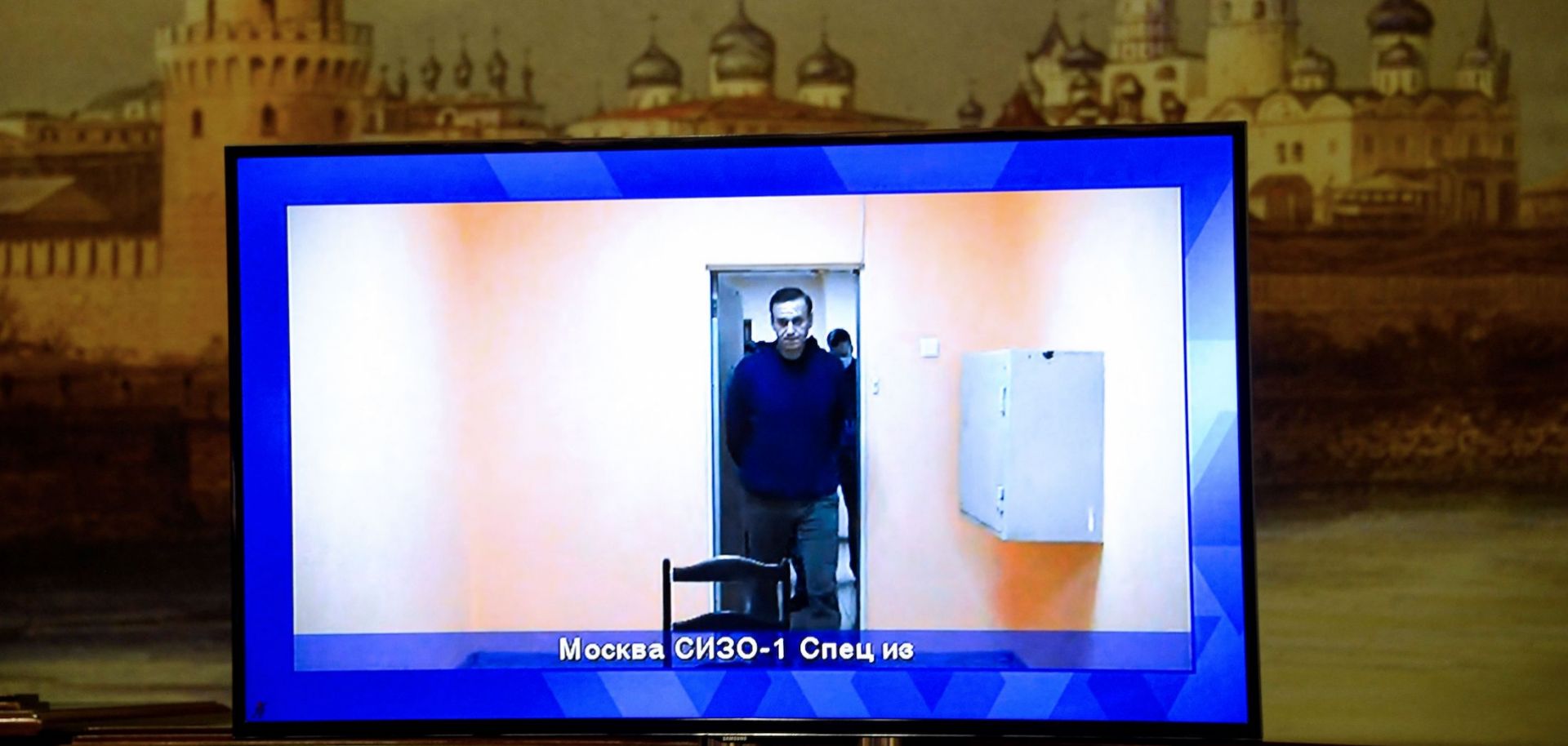
Opposition leader Alexei Navalny on Jan. 28, 2021, appears on a screen set up at a hall of the Moscow Regional Court.
Navalny's "Smart Voting" initiative is unlikely to significantly impact September's parliamentary election after the app of the prominent Russian dissident Alexei Navalny was blocked. This indicates a further atrophying of his political movement, but not a softening in the Kremlin's campaign against Western social media. On Aug. 23, Russian telecoms companies blocked "Navalny," a mobile app created by Navalny's inner circle to coordinate opposition votes. GlobalCheck, a group that monitors the accessibility of domains in Russia, fixed the functionality of the app as low as 25% nationally, meaning that only a quarter of the population could access it. Hours later, Navalny's chief deputy, Leonid Volkov, claimed that technical adjustments had allowed the accessibility of the app to climb back up to around 70% across the country. Additional data released by Global Check, however, suggested the accessibility was likely no higher than 50% as of Aug. 24.
- Navalny's team had promoted the app as the preferred conduit for participating in his "Smart Voting" initiative after Russian authorities blocked all his websites and even called on Western tech giants to take down the social media accounts affiliated with his movement.
- The Smart Voting initiative, unveiled in 2018, is a tactical voting scheme where Navalny's team advises registered supporters who to vote for — that is, the candidate that Navalny's team has determined has the best chance against the ruling United Russia party in their district. Smart Voting has been his movement's greatest political project in the years since its launch, and was testament to his movement's ability to maintain a tangible effect on elections even as candidates directly affiliated with his movement were largely banned from seeking office.
- Navalny's team is reluctant to send participating voters notification of who they should vote for too long before the vote, as doing so would give authorities too long to prepare countermeasures against the endorsed candidates. Previously, they notified voters three to five days before an election.
The Kremlin will continue to use this technique ahead of the September elections, dealing a major blow to Navalny's movement and accelerating the reconfiguration of the Russian opposition. Successful disruption of the app, even if the Kremlin cannot completely stop its functioning, suggests that the app and the main Smart Voting website — now essentially the last functioning website in Russia of Navalny's movement — will continue to be targeted before Russia's Sept. 17 parliamentary election in order to reduce the number of Russians able to receive Smart Voting instructions in a safe and confidential manner. Experts believe that the domains the Navalny app uses, intended to service a phone app, are for now being blocked just by mobile operators and not yet internet service providers, meaning that there is additional space for the government to improve the effectiveness of its blockage of them. Unlike blocking mobile operators, blocking ISPs could also cut off other applications or websites that use the same digital infrastructure. Both the app's and the main Smart Voting website's domains are likely to be blocked by both ISPs and mobile operators closer to the election, when the authorities will be less concerned about the collateral damage to other services. Between the disruption of these two resources, the Smart Voting initiative will struggle to meaningfully impact the vote, leaving Putin's United Russia party largely unchallenged in parliamentary elections by a disjointed opposition and able to retain its parliamentary majority. The likely failure of Smart Voting will be a major blow to Navalny's credibility, as disappointed supporters and the broader opposition cease to view his movement as a unifying force for creating political change in Russia through elections. Many will be convinced that further interaction with Navalny's structures is no longer worth the risk. Realignments in the Russian opposition that began after Navalny's arrest last year will intensify as a result.
- Navalny's popularity has declined in the months following his arrest and especially following the announcement in June of the government's decision to designate his organizations as extremist. That ruling sparked weeks of discussion regarding how and to what extent average Navalny supporters would face recriminations.
- Since then, Navalny's supporters and the entire Russian opposition have watched Russian law enforcement closely for clues as to exactly when and how widely so-called extremism provisions will be enforced. The first hint of the government's plans came when hundreds of supporters in Moscow were contacted by police and asked to denounce Navalny, admit to and rescind previous support for him, or even identify themselves as victims of Navalny's team for mishandling their personal information, evidence of yet another major criminal case against him and his organizations.
Despite the likelihood of ultimate failure, Navalny's continued use of Western tech giants as a shield ahead of the election means that the Kremlin's yearslong campaign to tighten the reins on foreign social media firms is likely to intensify rather than abate in the coming weeks. With both his Smart Voting website and app blocked, Navalny's team will have few ways to coordinate opposition votes and will likely use Western social media platforms. Contacting supporters directly via email or phone now carries great risk of supporters being identified and targeted by the government after the failure of an appeal Aug. 5 meant that his organizations' extremism designation entered force. Unable to send Russians their Smart Voting instructions in a confidential manner via the app and with their websites inaccessible, Navalny's team will likely have to rely entirely on Western social media outlets to notify Russians of the candidates they should vote for per Smart Voting — putting those platforms directly in the crosshairs of Russian authorities, as they are the only place left where instructions from Navalny's organizations remain accessible to Russians. On July 29, Russian internet watchdog Roskomnadzor said any social media accounts linked to Navalny's "extremist organizations" should be blocked, and on Aug. 20 Russia formally asked Apple's App Store and Google's Google Play to delete the Navalny app from their marketplaces; neither company has complied or commented. As Russian authorities' efforts to block Navalny's app are incomplete and fluctuating in effectiveness, and with elections looming, the Kremlin still has an incentive to keep up the immediate threat of a battle with Apple and Google prior to the election. Russia's campaign against Western social media will continue, part of its yearslong push to catch up on internet control. Thus even if the immediate threat to Western social media falls somewhat after the vote, the Navalny movement's confinement to Western social media means Russian authorities' unceasing fight against his organization and remaining opposition will leave Western social media in the Kremlin's crosshairs going forward.
- The main reason Russian authorities have not yet started blocking the main website for Navalny's Smart Voting initiative is because it is hosted on appspot.com, a Google cloud computing platform for hosting web applications — even though Smart Voting's main website is not an app. Thus, Navalny has effectively been using Google's systems as a kind of shield. Russia cannot block the site using regular means by blocking the domain, which is also used for Navalny's app on Google Play, as the domain also hosts other apps and other services related to Google.
- Russia's internet censorship agency, Roskomnadzor, is blocking Navalny's app using deep packet inspection techniques that filter through the content using those domains to block only the necessary IP addresses of the undesirable content, minimizing collateral disruptions of other services. Russian lawmakers fortified this capability by requiring telecom companies to install necessary technologies at great expense as part of the 2016 "Yarovaya" and 2019 "Sovereign Internet" laws.
- In 2018, Russian authorities tried to ban the messaging app Telegram, but as the app used constantly changing domains provided by Amazon's AWS, Russia could not do so without disrupting numerous other sites and services in Russia. As its deep packet inspection tools were still insufficiently installed, authorities quietly lifted the ban in 2020 after the app's Russian founder, Pavel Durov, agreed to cooperate in combating terrorism and extremism on the platform.
- Russia's slowdown of Twitter beginning in March 2021, however, shows that Russian regulators learned from the Telegram debacle, and their deep packet inspection capabilities are steadily improving, a trend that is likely to continue.
- On Aug. 26, a Russian court fined Facebook, Twitter and WhatsApp for failing to store data on Russian users in Russia, and Google was hit with its first fine for the same offense in July 2021. Noncompliance with the data storage law served as the formal justification for the blockage of LinkedIn in Russia in 2016, making the fine a signal to the companies that they could face greater punishment for noncompliance with Russian law as Moscow seeks to pressure the platforms into removing content it finds unacceptable. Both companies were fined for the same offense in 2020, but Facebook paid its fine while Twitter did not. This likely contributed to the slowing down of Twitter's traffic, though neither company has a representative office in Russia.
