
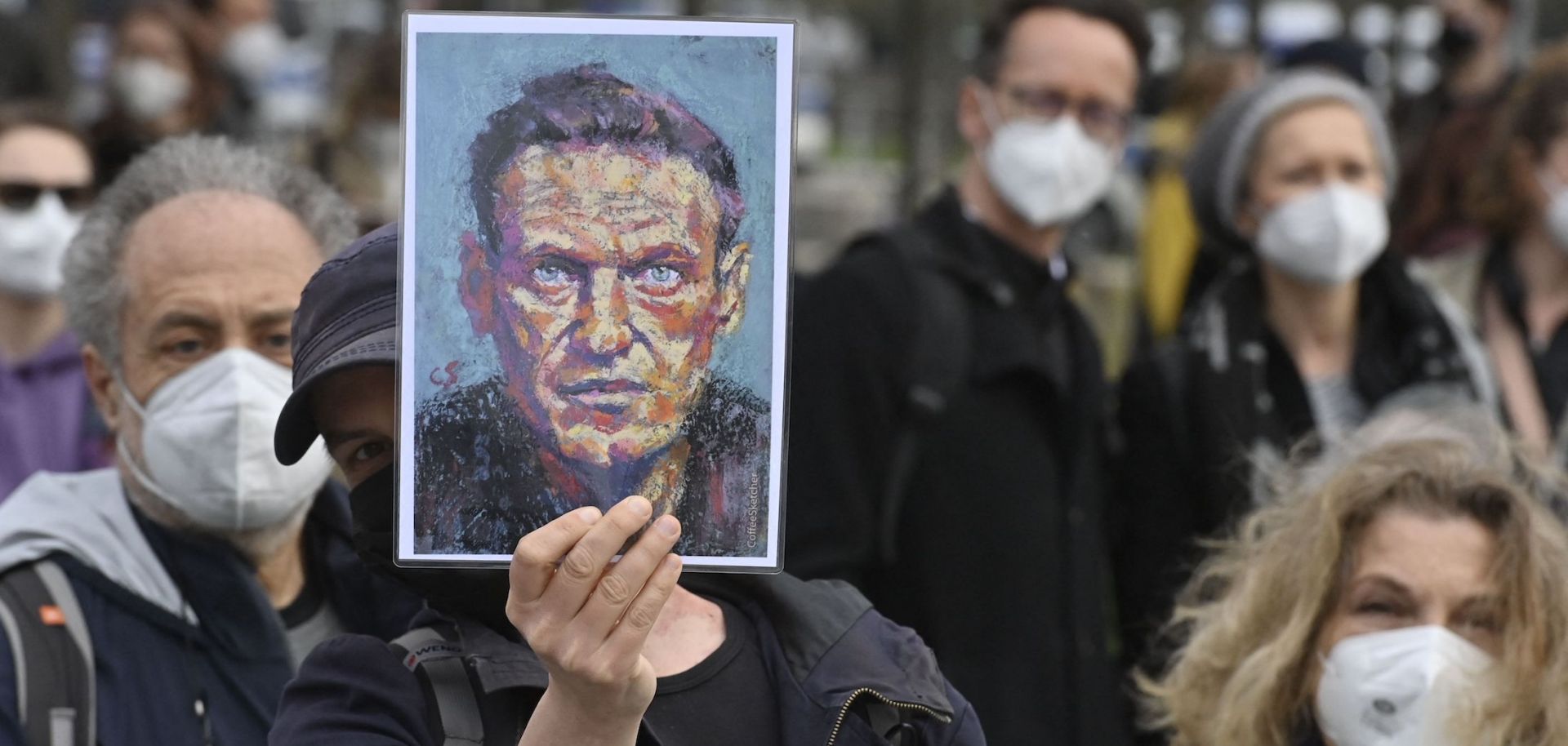
A demonstrator displays a portrait of Russian opposition leader Alexei Navalny during a protest on April 21, 2021.
Despite attracting global attention and domestic support, the Russian political movement led by jailed opposition leader Alexei Navalny faces severe challenges that will probably leave it unable to meaningfully contest legislative elections later this year. On April 23, Navalny announced on social media that he was ending his prison hunger strike on the advice of his doctors, saying he had “achieved enough” in drawing attention to his case and deteriorating health condition. Several days earlier, Russian authorities also allowed civilian doctors not affiliated with the prison service to examine Navalny for the first time since his lawyers publicly raised concerns about his worsening health in late March. But Navalny is by no means out of the woods regarding his health, which has been deteriorating since he was jailed in February — due possibly to the lingering effects of being poisoned with a nerve agent during a Russian assassination attempt in August 2020.
- Russian authorities continue to deny Navalny’s key demand of being granted access to his personal doctors.
- There is also no indication that prison officials will ease their harsh treatment of Navalny, which he, his allies and multiple international groups have called akin to “torture.”
The turnout at recent protests suggests that Navalny's allies in Russia may have reached a limit in mobilizing additional grassroots support. On April 21, tens of thousands of Russians protested across the country in support of Navalny and in defiance of authorities’ warnings to not participate. But the demonstrations were smaller in number and less geographically diverse than two previous rounds in late January, even if Navalny expressed “pride and hope” in an online post after learning of the mass protests.
- Navalny’s allies were forced to call the protests before hitting their goal of having 500,000 supporters sign an online pledge to take part, suggesting a ceiling to their influence.
- In addition, protesters’ email addresses and personal information were leaked after Russian security services allegedly recruited an employee of Navalny’s Anti-Corruption Foundation (FBK) to hack the sign-up database and steal the information.
There are also signs that Navalny’s foreign supporters have few clear avenues of influence beyond rhetoric. Since Navalny began his hunger strike on March 31, many countries and organizations — including the United States, France, Germany, United Kingdom, and European Union (EU) — have expressed concern over his prison treatment and health, with U.S. National Security Adviser Jake Sullivan promising unnamed “consequences” and the French foreign minister explicitly threatening new sanctions if Navalny were to die in prison. But further penalties on Russia over Navalny’s health and prison treatment face challenges and are unlikely to be meaningful even if they materialize.
- The European Union and the United States already imposed Navalny-related sanctions in March. Since then, Washington has imposed additional penalties over its other grievances with Moscow. This suggests there are few remaining avenues for action absent major escalation, which U.S. President Joe Biden and his European counterparts have said they seek to avoid.
- On April 26, the Austrian chancellor and German foreign minister rejected calls for harsher sanctions, illustrating divisions among EU members that make further coordinated action unlikely.
Apart from these immediate stumbling blocks, Navalny’s movement faces potentially insurmountable hurdles to its future activities, including hopes of challenging the ruling United Russia party in September’s parliamentary elections. On April 26, Russian authorities suspended the activities of Navalny’s nationwide network of political offices while a Moscow court reviewed a request that would effectively ban their operations by labeling the entities “extremist” organizations. The targeted entities include Navalny’s nearly 40 campaign offices, as well as the FBK and the Citizens’ Rights Protection Organization — both of which are already subject to onerous requirements after being deemed “foreign agents” in 2019 and 2020, respectively. Regardless of the widely expected “extremist” designation, Navalny’s movement also faces various other ongoing legal challenges amid the Russian government’s broadening crackdown on dissent.
- An “extremist” designation would enable any staff member to be criminally charged with up to a decade in prison, depending on the employee’s position. The label would also make anyone who finances (such as through donations) or volunteers for the movement liable to face up to eight years in prison. Anyone convicted would lose access to their bank accounts and face severe limits on their monthly spending as well. In addition, Navalny’s movement would be forced to cease holding public events and posting materials online, and any use of its symbols and logos would be outlawed and punishable by a fine or 15 days in jail.
- Navalny's campaign offices in Moscow and St. Petersburg have already announced that they are halting their activities, saying “they can no longer work in the same format” out of concern for their employees’ and supporters’ safety.
- Earlier this month, a Russian court also jailed an FBK cameraman for two years on charges of inciting extremism online. Multiple top Navalny aides, many of whom are under house arrest, face various legal charges for their activities as well.
