
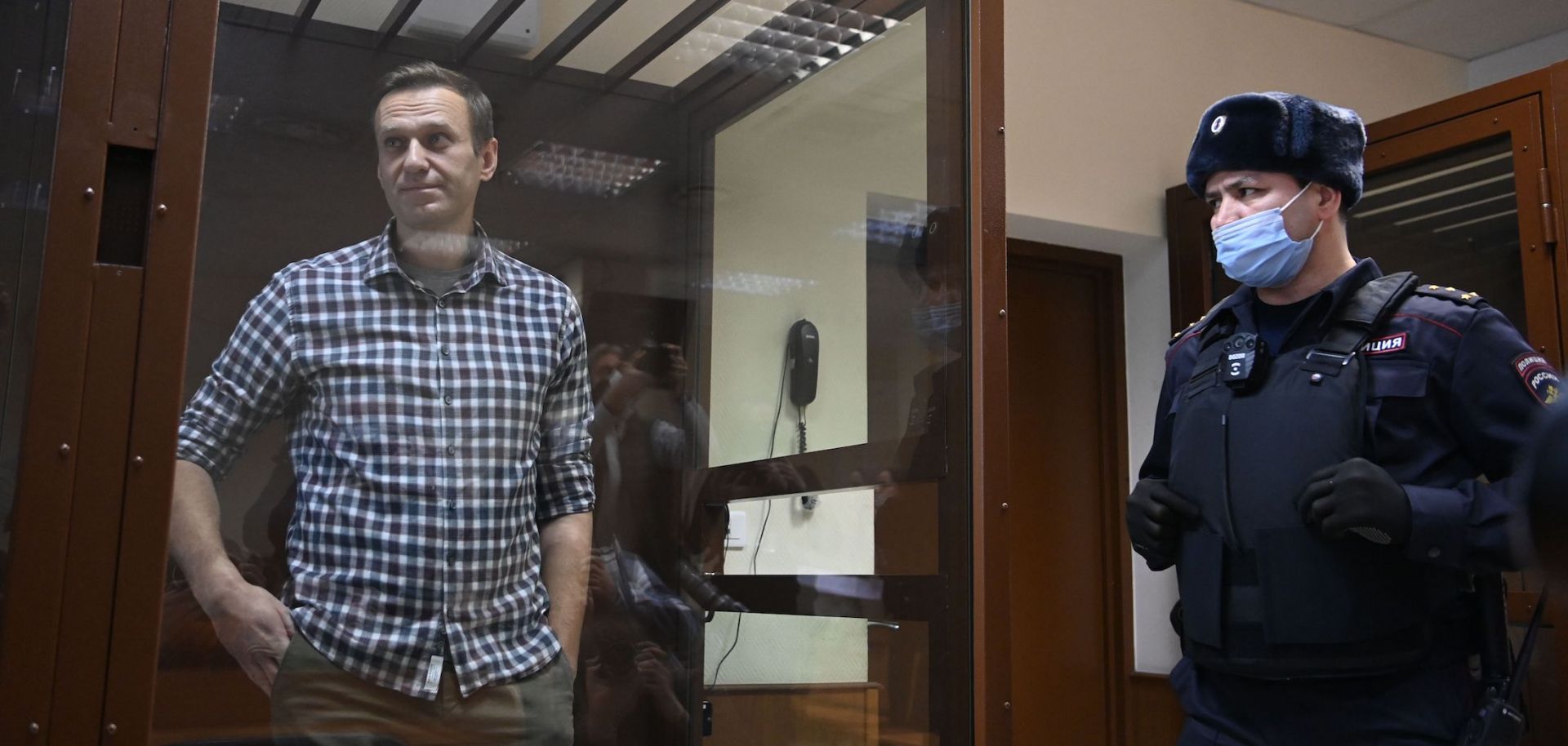
Russian opposition leader Alexei Navalny during a court hearing Feb. 20, 2021, in Moscow.
Were the imprisoned Russian opposition leader Alexei Navalny — whose health is deteriorating — to die, the Kremlin would likely face near-term domestic unrest and additional Western sanctions, but Navalny's death would not change the outcome of September's parliamentary elections or weaken President Vladimir Putin's grip on power. On March 24, Navalny's lawyers for the first time publicly raised concerns about severe pain in his back and right leg after they were denied access to him. Navalny previously asked his lawyers not to publicize his health status, which reportedly began to worsen earlier in March and could continue to deteriorate. Navalny wrote on social media on March 31 that he will begin a hunger strike to protest his prison conditions, two days after he wrote in a separate online post that he risks being sent to "torture like" solitary confinement for what he portrayed as frivolous prison rule violations.
- On March 25, one of Navalny's lawyers tweeted that "a deliberate strategy is underway to undermine his health." Navalny, who has been denied access to an independent medical evaluation, has complained of sleep deprivation and of being given only two tablets of ibuprofen a day to treat his increasing pain. Outside medical experts have theorized that he may be suffering lingering effects from being poisoned with a nerve agent in August 2020 in an assassination attempt widely blamed on Russian security services.
- Russia's federal prison service (FSIN) has denied its officers are specifically targeting Navalny, and on March 25 described his condition as "stable and satisfactory." The Kremlin says it has no influence over Navalny's fate and has referred questions to the FSIN, while some pro-government commentators have accused Navalny of feigning ill health.
Navalny's death would likely catalyze renewed mass protests and new Western penalties that would temporarily challenge the Kremlin. In late January and early February, Navalny's allies organized two large-scale anti-government demonstrations over his poisoning and subsequent jailing after he returned to Russia following a five-month convalescence in Germany. Western governments also imposed asset freezes and travel bans on multiple Russian government officials, and at least some have threatened further penalties.
- On March 23, Navalny's allies announced they would coordinate future mass rallies once 500,000 Russians signed an online petition pledging their participation. As of April 1, approximately 370,000 had done so; Navalny's death would likely push the signatories over 500,000 and motivate his allies to organize protests shortly thereafter.
- Independent of his deteriorating health, the United States and United Kingdom reportedly are considering more significant Navalny-linked sanctions, and at a minimum would impose new asset freezes and travel bans on Russians linked to his potential death. They would seek to coordinate with the European Union, but divisions among its members would challenge the bloc from implementing the more aggressive penalties reportedly under U.S. and U.K. consideration, such as sanctioning Russian business elites or restricting trading in Russian sovereign debt.
- Washington almost certainly would step up efforts to sanction entities involved in trying to finish the controversial Nord Stream 2 natural gas pipeline linking Russia and Germany. Navalny's death may even give the government in Berlin, which continues to back the project despite significant domestic and foreign pressure, an excuse to at least temporarily pause construction, perhaps under the political cover of completing a review.
Despite forcing the Kremlin to confront near-term obstacles, Navalny's possible death would not meaningfully help opposition politicians in September's parliamentary elections or undermine Putin's broader control. Even after it became clear that he had been poisoned, there was little immediate public outcry after Navalny came close to dying last year, and polling shows most Russians distrust Navalny and approve of Putin. These points suggest that Navalny's death would be unlikely to have a long-term impact, even if it triggers near-term unrest amid his allies' calls for action. Similar high-profile deaths — most notably that of whistleblower Sergei Magnitsky while in prison in 2009 and the assassination of political opposition leader Boris Nemtsov in 2015 — drew domestic protests and Western sanctions, but did not provoke sustained increases in support for anti-government political parties or meaningfully harm Putin's position.
- If Navalny dies, his death risks further splitting the already diffuse Russian political opposition, rather than uniting it, as rival parties try to win over Navalny's supporters, who are mainly young people. Anti-government parties have struggled to coalesce as the Kremlin has brought in new quasi-opposition parties to compete with truly anti-Kremlin lawmakers, blunting the effectiveness of Navalny's "smart voting" strategy to vote for the opposition party most likely to defeat the ruling United Russia party.
- Russian authorities almost certainly will use their wide array of repressive tactics — including many recently expanded powers to control social media companies, online content more broadly and so-called "foreign agents" — to maintain their crackdown on dissent in advance of parliamentary elections. If anything, Navalny's death could trigger a wider clampdown, as the Kremlin would likely want to show it is in complete control to sustain the fear and political apathy it has developed in Russian voters.
- Even if Navalny's death galvanized the West to overcome disagreements and find new ways to strongly penalize Moscow beyond token sanctions on officials — reminiscent of more sweeping punishments on Russian financial interests and elites after it annexed Crimea in 2014 — such moves are unlikely to seriously threaten Putin's power. If anything, as evidenced in the intervening seven years, the West's more severe Crimea sanctions, despite some short-term pain, have allowed Putin to characterize Russia as under siege and in need of a strong leader to confront supposed Western belligerence.
