
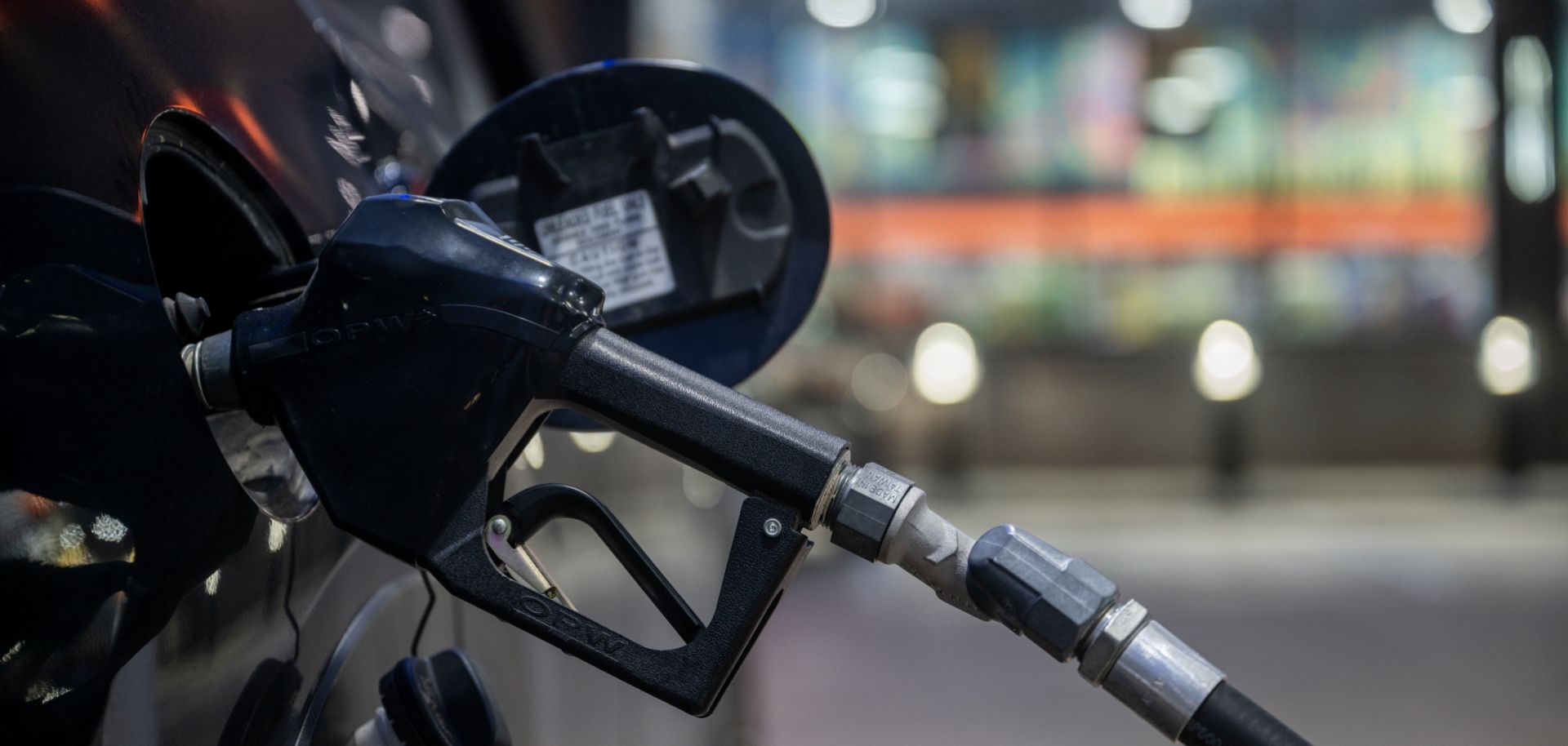
A photo illustration shows a car being filled up at a Chevron gas station in Houston, Texas, on Dec. 5, 2022.
The West's price cap on seaborne Russian oil and OPEC+'s decision to rollover production levels will likely have a marginal impact on oil markets in the coming months, but the developments reflect profound shifts that are reorienting the global hydrocarbon market away from the West. On Dec. 2, the European Union reached an agreement to set the West's price cap on Russian crude oil transported at sea using Western insurance at $60 per barrel, with an adjustment mechanism that will review the price level every two months and keep it at least 5% below international oil prices. Two days later, OPEC+ (the alliance of OPEC and non-OPEC oil producers, including Russia) agreed to roll over their production strategy and maintain a 2 million barrel per day (bpd) cut in quotas OPEC+ agreed to in October. The two announcements were largely expected and have only had a limited impact on oil prices, with the cost of European light crude benchmark Brent increasing by as much as 2.6% — up to $87.99 per barrel – on Dec. 5 after markets opened, though the price fell later in the day.
- The price cap, which went into effect on Dec. 5, aims to reduce Russia's oil revenue to punish it for the war in Ukraine, while also incentivizing Moscow to continue exporting crude oil exports in the hopes of mitigating the impact on global energy prices. The cap works by barring European financial institutions that insure oil tankers (which dominate the insurance market) from providing liability coverage to tankers shipping Russian crude oil that has been sold above the price level. A similar price cap on Russian petroleum products will go into effect on Feb. 5, 2023.
- In October, OPEC+ agreed to reduce production by 2 million bpd through the end of 2023, barring a change in policy. The bloc also agreed to change the cadence of its policymaking ministerial meetings from once every month to once every six months, at OPEC's twice-a-year scheduled meetings — effectively moving the cadence back to pre-pandemic levels of frequency. OPEC+'s next scheduled meeting is on June 4, 2023.
For now, the cap is unlikely to significantly impact the global oil market, though it will have an impact on some Russian oil shipments. But that could change if prices rise and prompt the Kremlin to cut exports. The Ukraine crisis and subsequent deterioration of energy trade with Europe have most directly affected exports of Russia's key crude oil grade, Urals, which has historically been transported via pipelines to Europe and oil ports in Western Russia. Urals had already been trading near the price cap — or below the cap — due to the large discount between the Russian crude grade and international prices, meaning the cap will only have a limited effect on the cost of Urals exports. Still, Russia has repeatedly said it will not sell oil to countries and companies abiding by the cap and has prepared a presidential decree to implement the policy. This threat likely extends to customers buying Russian crude at the currently prevailing rate, but using Western insurance and collecting the necessary compliance documentation for the price cap (despite the price level itself not being binding). The latter requirement for documentation will likely result in a modest decline in Russian Urals exports, but if the revenue being generated from those exports ultimately stays the same, the Kremlin may not be compelled to enforce such a regulation unless the price cap becomes binding. Even though the price cap is not binding for Russian Urals at current prices, Russia's ESPO crude grade — which constitutes about 1 million bpd of Russian crude and is transported via Russia's Far East Kozmino oil export terminal — has been trading at around a $5 to $10 discount to international benchmarks, putting it around $70 to $80 per barrel. Given this current rate, Russia is far more likely to enforce its demand for ESPO buyers not to use the price cap. But compared with Russia's western ports along the Baltic and Black seas, Russia's eastern Kozmino port is geographically closer to China and India. Exporting oil to those two massive Asian markets thus does not require as large or as many tankers, which will mitigate the impact of the fewer vessels that will now be willing to ship Russian oil outside the cap. Indeed, Russia's three main crude oil customers — China, India and Turkey — will likely abide by Moscow's rules and maintain high volumes of imports, regardless of whether they are buying ESPO or Urals grades. India and Turkey have already approved the use of Russian insurance. And while China has yet to publicly announce it, Beijing is expected to either approve the use of Russian insurance or find domestic alternatives. Beyond these large oil consumers, it is unclear how many of Russia's smaller clients will have the same ability to use alternatives.
- Prior to the price cap being set, Urals had been trading at a discount of about $24-$27 per barrel to Brent, which translates to about $60 to $65 per barrel at Brent's current price. On top of the price, freight and other costs associated with transporting Urals from export infrastructure in Western Europe to China and India (Russia's main Asian consumers) are currently around $20 to $25 per barrel due to the limited number of high-capacity crude tankers willing to ship Russian crude and do so without Western liability coverage.
- Russia's seaborne crude exports have been averaging about 3 million bpd in recent months. China has been importing around 900,000 to 1 million of those barrels each day, with India importing around 800,000 to 850,000 barrels and Turkey importing 300,000 to 350,000 barrels. Estimates have varied on how much oil the price cap could take off the market, but continued demand from Turkey, China and India should limit the impact. Still, if prices rise, the global oil market could lose as much as 1 to 1.5 million bpd.
- The modest impact of the price cap is largely due to the fact that the global oil market is currently more concerned with demand issues, stemming from a potential global recession and China's ongoing COVID-19 lockdowns. The oil market's health could change in 2023 if economic conditions in the West improve, and if China eases its economically disruptive ''zero-COVID'' restrictions. At that point, Russia may restrict oil exports further as the gap between the price cap and international prices rises, resulting in even more upward pressure on prices.
The price cap and Russia's alliance with OPEC will cement the growing divergence between the West and many of the world's largest oil producers, which will ultimately weaken the United States and Europe's ability to influence global energy trade via sanctions and diplomatic pressure. OPEC's decision to cooperate with Russia and maintain production cuts agreed to in October reflects how relations between OPEC's de facto leader, Saudi Arabia, and the West have deteriorated in recent years. Previously, with a looming oil market supply shock, Saudi leaders probably would have worked with the West in order to maintain stable global supplies. But this time around, Riyadh (and by extension OPEC) publicly aligned itself with Russia in cutting production. This suggests that in the coming months and years, the kingdom will increasingly give less weight to U.S. views in shaping OPEC decisions and policies. Moreover, Russia's shift to export more of its oil to Asian countries has long been a key goal of the Kremlin and will not slow, even if the price cap is suspended in the event of a cease-fire in Ukraine or end of the war. As such, Russia will become more economically connected with major Asian oil and gas consumers, just as Saudi Arabia and other Middle Eastern oil producers are doing— particularly as Western economies more hastily transition away from hydrocarbons than their Asian counterparts. This will solidify the long-term remapping of global energy trade, as major oil producers (like Russia and Arab Gulf states) become more economically — and, in turn, politically — intertwined with non-Western oil consumers (like China and India). From a geopolitical perspective, the end result will be less alignment on a broad array of issues between the West and countries like Saudi Arabia (and Iraq). This will mean less coordination between the West and major oil producers when it comes to managing the energy market and any subsequent economic challenges — marking a dramatic shift from the close U.S.-Saudi cooperation that has existed for much of the past 40 years. In addition, there will also be less cooperation on sanctions policies, which will force the United States and Europe to expand the legal scope of sanctions to ensure their enforcement (and, in turn, their effectiveness). This will see Western leaders enact more measures akin to the price cap on Russian oil, as well as more direct sanctions akin to those imposed on Venezuela and Iran.
- Historically, Western sanctions on oil producers have effectively deterred non-Western companies and countries from significant trade. But the recent price cap — along with the broader alignment between non-Western oil producers and consumers — is creating alternative mechanisms, like Russia-India insurance cooperation and a build-out of a tanker fleet less exposed to Europe. These mechanisms ultimately blunt the effectiveness of the West's sanctions regime on energy exports (and more broadly to other products) by helping countries sanctioned by the West (like India, North Korea and Venezuela) mitigate the impact of those retaliatory measures.
