
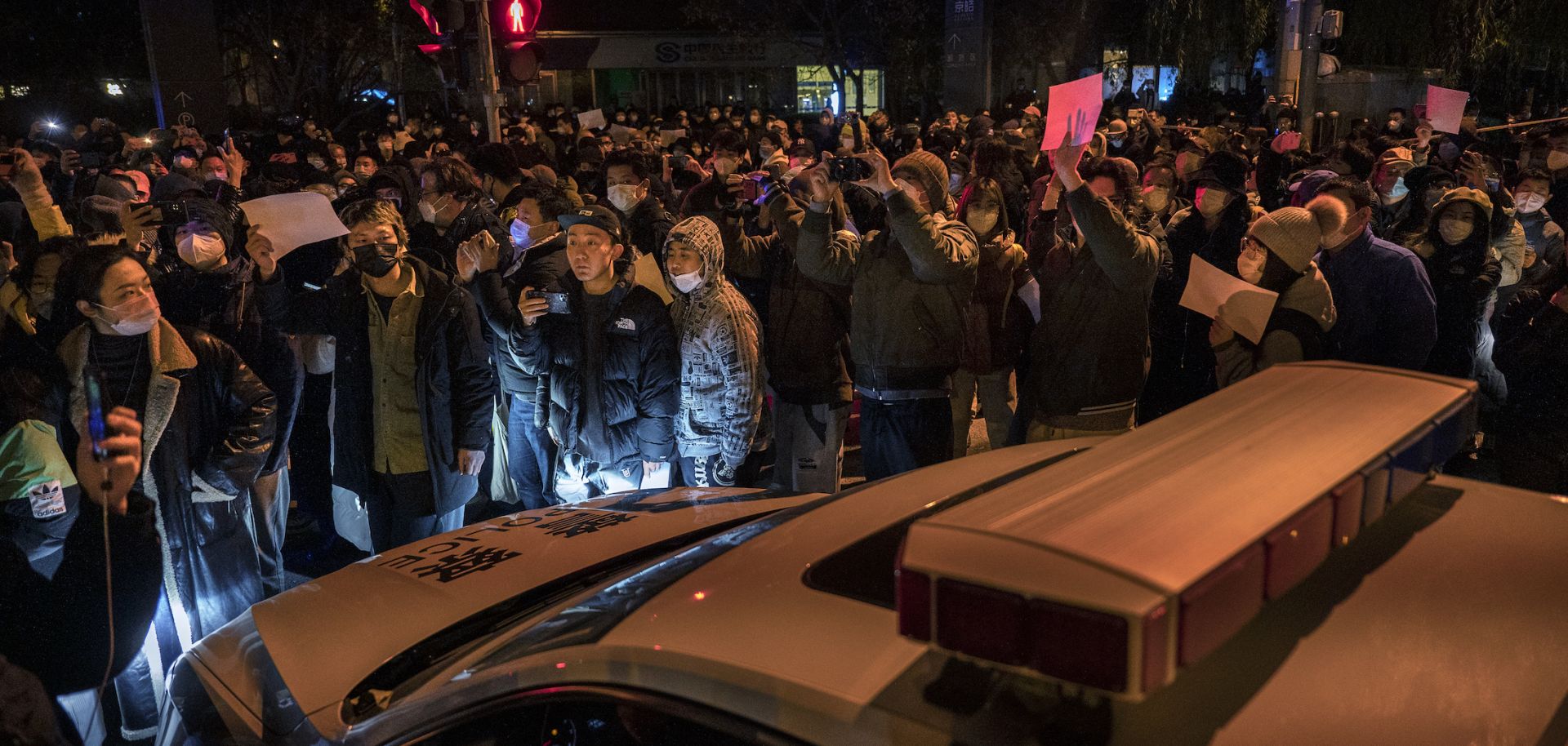
Protesters march by a police cruiser during a protest against China's strict "zero-COVID" measures on Nov. 27, 2022, in Beijing.
Recent protests in China do not yet pose a threat to the Communist Party regime, but Beijing's reaction will include requiring enforcement of existing COVID-19 restrictions, mass arrests of protesters without a military crackdown, and knee-jerk reactions to foreign pressure, suggesting no significant easing of China's "zero-COVID" restrictions and, subsequently, its economic woes. Protests erupted in cities across China from Nov. 25-27, though they have largely abated as of Nov. 28, according to videos posted on China's Weibo and U.S. platform Twitter. These occurred after local authorities said Nov. 25 that at least 10 residents died in an apartment fire in Urumqi, the capital of Xinjiang province. Citizens across China blamed these deaths on the inability of fire and rescue services to access the building due to COVID-19 restrictions. Protests began in Urumqi and were followed by protests in several other Chinese cities — including Shanghai, Beijing, Wuhan, Guangzhou, Chengdu, Lanzhou and Xi'an — from Nov. 26-27, both near busy public streets and on university campuses. Many of the protests included hundreds of people, some included thousands, and all seemed to focus on getting the government to ease or stop its "zero-COVID" policy, with some crowds calling for democracy and freedom of expression, and a few protests (including one in Shanghai with hundreds of participants) calling for the Chinese Communist Party and Xi Jinping to step down. In the most extreme case so far, protesters in Urumqi broke through the gate of the headquarters of the Urumqi Municipal Government and entered the building, according to videos on Twitter, but it is unclear how they proceeded thereafter.
- China's zero-COVID policy — or "dynamic clearing" as Beijing calls it — involves closely tracking COVID-19 cases with mass testing and stopping transmission as soon as possible via mandatory isolation of individuals in central facilities and, in some cases, lockdowns of districts or entire cities. It also involves more controversial methods like welding apartment complex doors shut and "silent lockdowns," whereby officials implement a de facto lockdown without announcing it.
- Protesters are exhibiting common tactics to protect themselves from the authorities, including appearing in large numbers, waving the Chinese flag, and memorializing the fire victims with candlelight vigils and by staging protests at relevant places like Urumqi Road in Shanghai. These tactics impede authorities' arrest efforts, given the sheer mass of participants, and justify their protests with nationalism and memorializing the dead, a sacrosanct cultural practice in China that the authorities are loath to impede.
- Protesters in various cities also repeated the protest slogans of a man arrested in October — "We don't want nucleic acid tests, we want food. We don't want lockdowns, we want freedom" — for posting a protest banner on a bridge Oct. 13 in Beijing leading up to the 20th Party Congress, China's seminal, quinquennial political event.
At this time, the most likely response from Beijing seems to be a combination of reinforcing existing limits on COVID-19 restrictions and cracking down on protesters via widespread arrests while avoiding killings or military mobilization. Given the large protests over the weekend and rapidly rising COVID-19 cases (which may prompt new local restrictions), much will depend on how Beijing chooses to handle "zero COVID" and the protests in the coming days. Beijing's most likely response will be a combination of promises to better enforce recently eased COVID-19 restrictions from Nov. 11 (e.g., mandating that cities end lockdowns if case spread has ceased), but without significantly altering the existing policy. They will also conduct heavy arrests and interrogations of protesters to deter would-be protesters from joining their ranks. This may even involve televised confessions on state media, with protesters claiming to have been paid by foreign forces to stoke unrest in China (one of Beijing's common narratives to explain away genuine civil unrest). If the protests continue to grow in number, makeup (e.g., beyond the youth), and geographic spread, it is possible, though unlikely, that Beijing will consider real policy concessions on zero-COVID (e.g., reducing quarantine times or greater restrictions on mass testing); city officials in Urumqi promised to ease COVID-19 restrictions soon in discussions with protesters Nov. 25. But given how unprepared China's health system is for a rapid uptick in cases and Xi's predilection for punishment over conciliation on policy issues, major concessions seem unlikely. Thus, if better implementation of existing measures and heavy arrests are unable to curb the protests until the government can legitimately ease COVID-19 measures — perhaps in six months when nationwide hospitalization capacity and booster shot uptake among the elderly are improved — the risk will grow of a violent crackdown by the People's Armed Police and the military. Meanwhile, local officials will be in a holding pattern of pandemic management, balancing the use of COVID-19 restrictions with not angering citizens, as nationwide COVID-19 cases continue to rise rapidly, hitting their fifth record day in a row of more than 40,000 cases on Nov. 28.
- If the protests die down naturally, failing to resume over the coming weeks (especially on the weekends, when protest activity tends to surge), Beijing will do little to adjust its zero-COVID policy in the short term, besides mandating better implementation of the eased policies announced on Nov. 11. But the floodgates have already been opened on public protest since the Urumqi fire. So this lack of policy change would be at best a delaying tactic for Beijing if not accompanied by a strong crackdown, with more protests likely as Beijing's weak response emboldens citizens.
- Beijing is already waging a campaign of arrests and investigations into protest participants, using police to patrol former protest sites and other domestic security forces to track down protesters using social media records and facial recognition video footage, interrogating them and surveilling them closely for the remainder of their lives. If the government does this without killing anyone, it would disperse the current protests but only further deepen people's anger at the government, thus leaving the threat of more protests if the government makes no major concessions on zero-COVID restrictions.
- Police presence has been heavy at protests, though they are generally showing restraint from violence, likely because the protests are heavily videotaped and protesters outnumber police. But in some cases, the police are making violent arrests and in rare cases (like in Chengdu) charging into crowds to break up protests.
- If the government unleashed a deadly attack on protesters — which seems unlikely for now given the short tenure of the protests — they could successfully quiet the masses, buying it time to guide China in an orderly fashion through its current COVID-19 wave, but once again making China a pariah state (as happened briefly after the Tiananmen Square massacre of 1989).
The government will continue its attempts to ease the impact of zero-COVID restrictions on the economy and citizens' daily lives, but given Beijing's hesitance to make significant policy concessions, China's economic prospects are unlikely to change drastically in response to the protests alone. If Beijing is able to successfully enforce its 20 policies on a more tailored COVID-19 response from Nov. 11, this will limit the business impacts of arbitrarily extended lockdowns, quarantines for secondary contacts and unannounced lockdowns impeding supply chains. But this would still leave China's eight-day quarantine times intact, and a new wave of lockdowns — especially as China's rising caseload continues to break daily records — remains a very real possibility. Thus, the protests are likely to add to China's economic woes — giving Beijing one more policy issue to juggle alongside COVID-19, real estate, dropping demand for exports, and unemployment — even as it helps root out the excesses of local governments' COVID-19 responses, which will eliminate some of the guesswork for companies planning for logistics and personnel disruptions in lockdown-affected areas. A potential unprecedented wave of COVID-19 cases — e.g., 1 million cases per day — in the next couple of months could, however, overwhelm China's hospital system and prompt new lockdowns, worsening China's economic prospects and pushing Beijing to lean more heavily on crackdowns to squash any new protests.
These protests will herald a period of extreme political sensitivity in China to both external and internal threats, with Beijing responding strongly to foreign criticism and tracking down protesters systematically. In the coming weeks, Beijing will be sensitive to any outside commentary, sanctions and other legislative action against China, and may target Western companies with informal coercive measures (e.g., arbitrary fines, red tape, etc.) as a means of punishing their governments. Once these protests clear, Beijing will double down on its pro-Beijing, Marxist ideological indoctrination campaigns on college campuses in an effort to prevent future unrest by the youth, further isolating Chinese academic connections with the rest of the world as ideological unity and political loyalty trump all else. As during previous bouts of unrest in China, there will also be a period of prolonged, quiet crackdowns after the protests clear. This will mean greater censorship on social media platforms and more enforcement of data security, cybersecurity and privacy regulations as the government attempts to seal up any leaks in its surveillance of key data flows that may deter future protests. On the world stage, these protests may embolden pro-democracy advocates in the legislatures of the United States and Western Europe to pass bills sanctioning Beijing for its treatment of protesters and journalists and for imposing greater tech restrictions on China (especially against companies involved in the kinds of surveillance or data processing used by the police). These Western actions and Beijing's responses to them would counteract China's recent efforts at a diplomatic thaw with the West following the G-20. This could slow progress on improving trade ties with the likes of Germany and Australia.
- Police in Shanghai dragged to the ground and arrested BBC journalist Edward Lawrence on Nov. 27, detaining him for several hours before releasing him. This development has already mobilized British politicians to condemn China, and may trigger more Western legislative action against China for its treatment of citizens and foreign journalists.
At this point, the protests do not pose a serious threat to the Chinese government because of the overwhelming resource gap between the protesters and the state and the centralization of political power under Xi. While many protesters are calling for democracy and the downfall of the Party and Xi, the probability of a revolution that results in the collapse of the government is unlikely because of the heavy centralization of power under Xi, which has significantly reduced the threat of rival political factions taking advantage of Xi's handling of the affair to threaten his leadership. The government's firm control over the world's largest surveillance infrastructure and the military also makes the hard power balance such that an armed revolution against the government is unlikely, especially given China's tight restrictions on weapon ownership by citizens. Furthermore, China's public security forces are well-funded (better than the military) and are constantly planning contingencies for putting down mass unrest and armed rebellions, and so the resource and planning advantage is heavily on the side of the state. Because criticism of Beijing's zero-COVID policy is the main concern driving protests, the demonstrations are likely to die down if this main concern is mitigated with better implementation of existing policies (alongside the heavy arrests Beijing is already wielding). Still, Beijing is likely to look for scapegoats within the Party and fire local officials in Urumqi, Shanghai and elsewhere for both spurring the protests and failing to manage them. Political scapegoating, mass arrests and even violence against the protesters will become more likely if these protests persist in the coming weeks and Beijing feels it has to make a choice between admitting its own governance failures (highly unlikely given its reliance on performance legitimacy, given China's absence of elections) and using brute force to impose its will on the Chinese people.
