
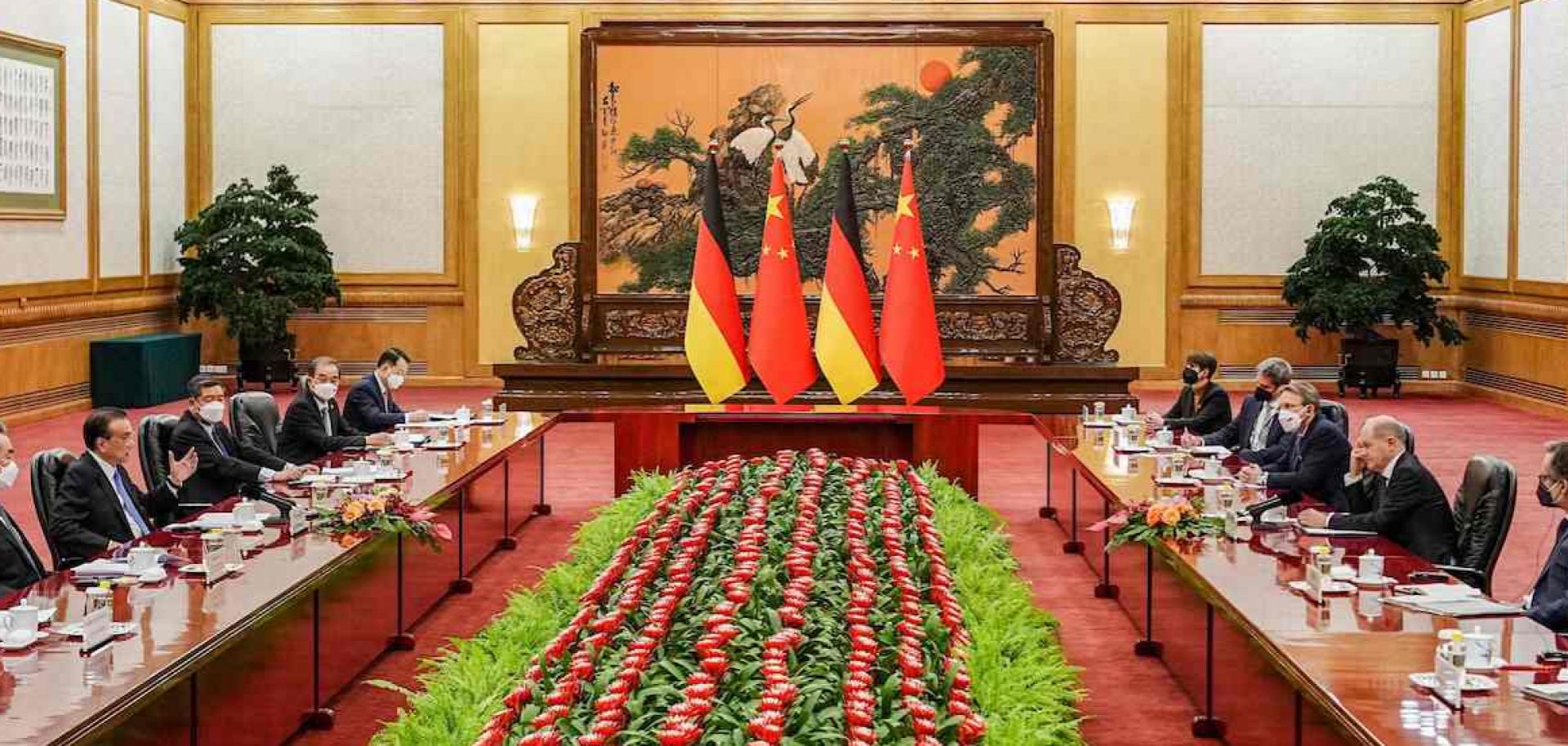
Visiting German Chancellor Olaf Scholz and members of his delegation (right side of table) attend a meeting with Chinese Premier Li Keqiang at the Great Hall of the People in Beijing on Nov. 4, 2022.
German Chancellor Olaf Scholz's recent trip to China indicates that Berlin will continue to maintain trade ties with Beijing while also working to gradually reduce critical dependencies, despite mounting external and domestic pressure for a more aggressive decoupling. Scholz visited China on Nov. 3-4 accompanied by a large business delegation, the first Western leader to do so since Chinese President Xi Jinping secured an unprecedented third term in October. The two leaders condemned the threat of nuclear weapons in Ukraine and discussed the mutual need to ensure the stability of food and energy supply chains. Finally, as Scholz was flying back to Berlin on Nov. 4, the German Chancellery posted a tweet that noted the ''reliability and trust'' between Germany and China as the basis for a ''political partnership'' between the two countries. As he was flying back to Berlin on Nov. 4, Scholz tweeted that ''reliability and trust [formed] the basis of diplomatic relations and political partnerships'' and that it was ''a good thing that [he and Xi] met in person and held talks.''
- Top executives from some of Germany's largest firms — including BASF, Volkswagen, BMW, Deutsche Bank and BioNTech — joined Scholz on his trip.
- In Beijing, Scholz also raised concerns about the Xi administration's use of trade for political coercion and push for near-total control over the Chinese economy, as well as problems of market access and IP theft for European companies operating in China.
- In a Nov. 3 op-ed penned to the German newspaper Frankfurter Allgemeine Zeitung, Scholz defended his decision to travel to China amid growing criticism from Berlin, Washington, Brussels, Paris and several other European capitals. He rejected the idea that Germany should ''decouple'' from China, arguing that the country remained ''an important economic and trading partner for Germany and Europe'' and that he was traveling to Beijing ''precisely because 'business as usual [was] no longer an option in [today's] circumstances.'' In response to the backlash over this trip, Scholz also noted that he had coordinated ''closely'' with EU and U.S. partners ahead of the visit, adding that a ''German policy on China can only be successful when it is embedded in European policy on China.''
A strategic rethinking of relations with China is underway in both Germany and the European Union, with Berlin being urged to reduce strategic economic dependencies on China. For decades, Europe had viewed China primarily as a commercial opportunity as opposed to a potential competitor or systemic rival. But in recent years, EU countries have started to reconsider their strategic approach to Beijing amid growing security concerns related to expanding ties with an increasingly assertive and autocratic regime. Germany, meanwhile, is also reviewing its China strategy. Berlin's new position, which is set to be made public sometime next year, is expected to focus on weakening Germany's economic reliance on China and diversifying supply chains, all the while preserving business ties with Beijing. China remains Germany's largest trading partner and a key investment destination for large German companies, which have even recently hiked investment into the country against the trend of most other European firms that have largely frozen or reduced their commitments in the past few years. However, the value of Germany's foreign investment in China is also highly concentrated in a relatively small number of large multinational companies, particularly in the automotive industry. While the impact wouldn't be as critical as Germany's decision to reduce its reliance on Russian natural gas following Russia's invasion of Ukraine earlier this year, this means that Germany's export-driven economy would be hit hard if a major geopolitical crisis (such as a Chinese invasion of Taiwan) forced Berlin to quickly reduce trade ties with Beijing. Moreover, Germany still has critical supply vulnerabilities rooted in its overreliance on China, which mostly consist of high imports of Chinese rare earth minerals, essential components for solar and wind technologies, as well as certain chemical goods and electrical equipment.
- China was Germany's largest trading partner for the sixth consecutive year in 2021, accounting for 9.5% of its trade in goods. According to a study conducted by the German Economic Institute, German businesses' direct investment in China totaled a record 10 billion euros in the first half of 2022.
- A 2021 study from Germany's Kiel Institute for the World Economy estimates that a decoupling in trade with China would cost Germany about 1.4% of GDP (or roughly 48.4 billion euros) in real income, and 1% of GDP for the European Union as a whole. In a study published earlier this year, the Cologne Institute for Economic Research (IW) estimated that exports to China accounted for 2.7% of Germany's total economic added value and 2.4% of employment.
- Germany's automotive industry has significantly expanded its foreign investment in China in recent years. China represented 29% of the sector's total foreign investment in 2019, which typically accounts for more than 70% of German investment and over a third of European investment in the country.
- EU foreign ministers discussed revising the bloc's strategy toward China at an Oct. 20-21 summit in Luxembourg. Ahead of the meeting, EU ministers received a letter on Oct. 17 from the European External Action Service (the bloc's agency for foreign relations) advising them to take a tougher stance on China and to see the country as an all-out-competitor with only limited areas of potential cooperation.
Germany will continue to seek commercial ties with China while simultaneously working to further diversify its exports and reduce supply chain dependencies. Scholz's words before and after his two-day trip to Beijing show how Berlin has indeed acknowledged the status quo has changed under President Xi's iron-fisted rule and that Germany needs to reduce its economic dependencies. At the same time, the trip confirmed that Germany's approach to Beijing is still driven by a perception of China as primarily a trading partner and key market for some of the country's most prosperous and strategic industries. The combination of these realities will compel Germany to continue to seek commercial ties with China as long as they remain viable and profitable by exporting cars, machinery and other goods to a vast market that still harbors the potential for further growth. At the same time, Berlin will also seek to reduce dependencies in industrial supply chains.
- German Foreign Minister Annalena Baerbock has recently reiterated her demand for a more assertive ''new China strategy,'' arguing that ''China is our partner on global issues'' but also a ''competitor and increasingly a systemic rival,'' adding that ''we will base our China policy on this strategic understanding and also align our cooperation with other regions in the world.''
- In an interview with the newspaper German Welt am Sonntag published on Nov. 4, German Finance Minister Christian Lindner said Germany ''must recognize that China is not only a place to do business, but also a systemic rival.''
- Scholz is also facing backlash after signing off on a deal allowing Chinese state-owned shipping giant Cosco to buy a 24.9% stake in one of Hamburg's port three terminals in October. EU and U.S. leaders have both criticized the deal, along with several members of Scholz's own cabinet. Still, the decision to allow a smaller stake than the originally planned 35% is a compromise between Scholz and his coalition partners — further illustrating the Chancellor's balancing act in his approach to China, which seeks to maintain business ties while limiting strategic dependencies.
- There are signs Berlin is becoming increasingly wary of granting China access to strategic assets. On Nov. 9, for example, the German government blocked the sale of Elmos Semiconductor's wafer facility to a Swedish subsidiary of China's Sai MicroElectronics due to security concerns. The government is also reportedly planning to block a prospective Chinese takeover of the German semiconductor firm ERS Electronic in Bavaria for similar reasons.
- After analyzing direct and indirect value-added linkages along Germany's supply chain, the Institute for Economic Research at the University of Munich recently concluded that China played an important but ''by no means dominant role'' for Germany as a supplier or destination market. The study, which was published in June, found that China accounted for 7% of all foreign value added to the production of final goods in Germany, whereas the European Union represented 44% and the United States 10%. But analysis conducted at the product level also showed that the German economy remained dependent on China for several critical industrial goods and raw materials.
While expanding trade ties with China will not represent a systemic threat to the German economy, it will leave German companies with a large presence in the Chinese market exposed to growing operational, reputational and financial risks. Berlin will likely accelerate and coordinate action with fellow EU countries and other key allies — including Japan, Australia, and the United States — to build alternative supply chains in critical sectors by expanding economic cooperation with other countries, including in China's neighborhood. Ultimately, however, the onus will be on German companies. While they'll be allowed to keep trading with China, German firms will face increasing pressure to reduce critical dependencies, increase export diversification to other markets, and put in place contingency plans to ensure continuity of operations should a geopolitical crisis with China (i.e. an invasion of Taiwan) require a sudden decoupling. Failing to do so may come at the cost of ready and cheap access to capital, either in the form of government guarantees (which Berlin offers to German companies in emerging markets to protect their investments from political risk), or lower creditworthiness and company valuations on the financial markets due to perceived high levels of geopolitical risk.
- In May, Germany's economy ministry refused to extend Volkswagen's investment guarantees for China, citing human rights violations in Xinjiang. The ministry is now working on plans to cap the number of such guarantees for China, according to the Financial Times.
- According to a recent survey conducted by the Institute for Economic Research at the University of Munich, nearly half the German manufacturers that receive significant inputs from China plan to reduce their Chinese imports, mostly citing ''to decrease dependencies and increase diversification, increased freight costs and disruptions in transportation, as well as political uncertainty'' as the main reasons.
- Scholz allegedly rejected a proposal by French President Emmanuel Macron to hold a joint meeting with Xi, highlighting a lack of concrete alignment on China between the European Union's two largest economies. However, both Scholz and Macron have critiqued the United States' increasingly confrontational stance on China, advocating instead for a more nuanced approach that still sees Beijing as a trade partner, with a focus on diversifying (and not decoupling) from China.
