
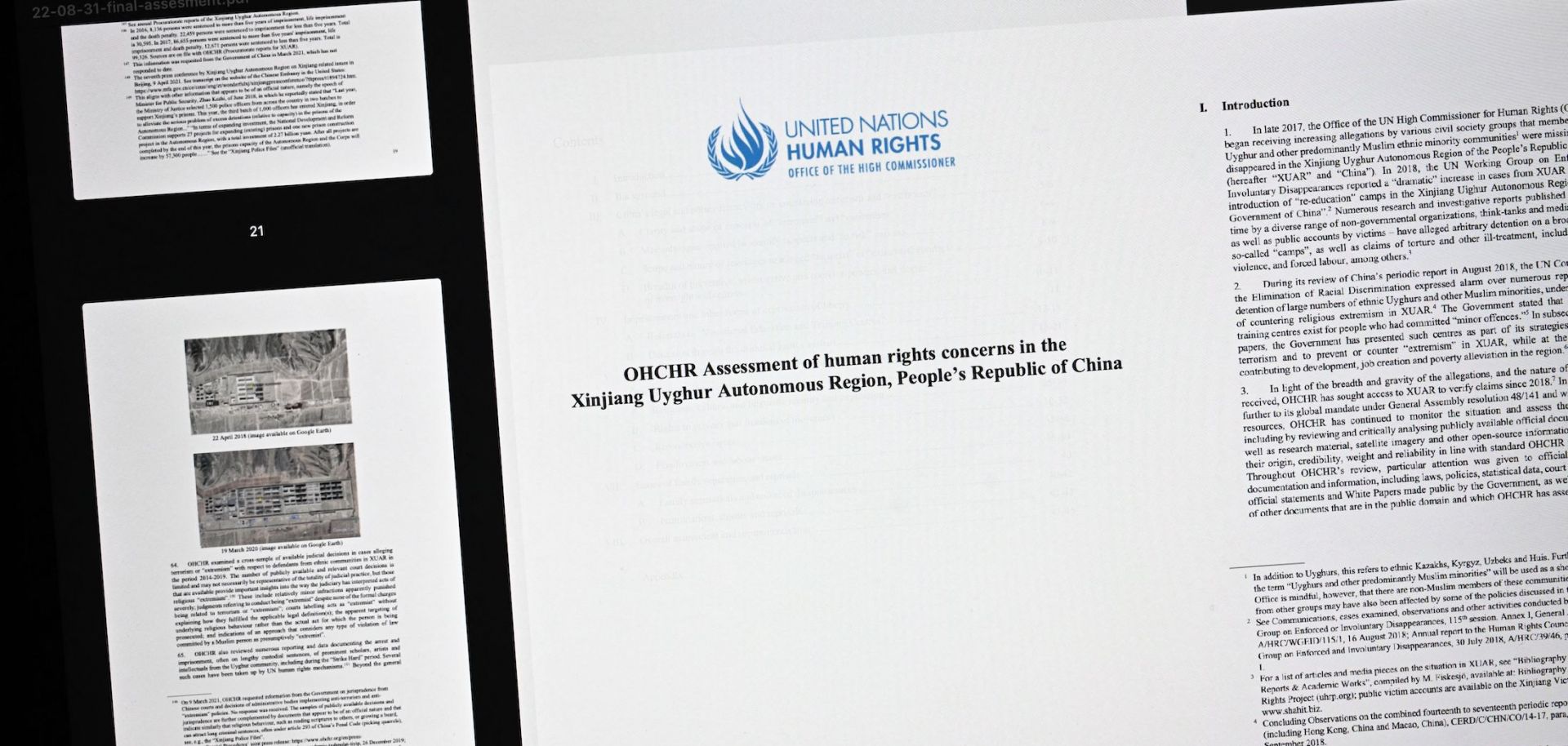
Pages of the long-delayed U.N. report on human rights abuses in China's Xinjiang region are seen on a computer screen on Sept. 1, 2022.
The release of a long-awaited U.N. report detailing human rights abuses in China's Xinjiang region may prompt renewed scrutiny and punitive measures from other countries and lead to Chinese countermeasures, compounding reputational risks for businesses and exposure to retaliatory legislation both inside and outside of China. On Aug. 31, the U.N. Office of the High Commissioner for Human Rights (OHCHR) released a much-delayed 46-page report on the Chinese government's human rights abuses against Uyghurs and other minority peoples in the country's western Xinjiang region from 2017-2019. The report concludes that China has committed crimes against humanity in Xinjiang, including arbitrary imprisonment and torture of detainees; systemic repression of Uyghur and other minority groups' religions, cultures and languages; violations of privacy rights and freedom of movement; violations of reproductive rights; forced labor; family separations; and undue reprisals.
- The findings of the Xinjiang investigation, which was launched in 2018, were released in the final minutes of former U.N. High Commissioner for Human Rights Michelle Bachelet's four-year term — narrowly making Bachelet's self-imposed Aug. 31 deadline.
- Though the report concludes that a litany of crimes against humanity was committed during the period under investigation, it falls short of alleging genocide — a designation some Western governments have used to describe China's activities in Xinjiang.
- The Chinese 131-page rebuttal, released with the report, calls the claims ''distortions and lies'' while defending security initiatives in Xinjiang as legitimate anti-terrorism and -extremism measures.
The timing of the report's release reflects an apparent struggle for influence within both the U.N. human rights office and the United Nations at large to dictate procedures. The fact that the Xinjiang report took years to compile and was delayed several times — only to be released within the literal last minutes of former U.N. High Commissioner for Human Rights Michelle Bachelet's term — is likely indicative of the many constraints Bachelet's office faced in publishing the document, due largely to its reliance on extensive input from the Chinese government, as well as an intense pressure campaign from China and its allies in the United Nations. Indeed, China has shown consistent interest in forestalling human rights investigations and altering institutional norms to fulfill that purpose, to avoid international criticism and potential punitive measures. In 2020, for example, China blocked a U.N. resolution denouncing human rights abuses against Rohingya Muslims in Myanmar.
- The OHCHR began investigating allegations of crimes against humanity in Xinjiang in September 2018. The commission first attempted an unrestricted visit to the region to collect facts that same year, but was repeatedly denied entry by Chinese authorities.
- In September 2021, the OHCHR announced that the Xinjiang report was being finalized. But the release of its findings was repeatedly delayed over the past year, fueling allegations of collusion between the Chinese government and the OHCHR.
- This past February, the U.N. human rights office confirmed it would not publish the Xinjiang report before the Beijing Winter Olympics after leaked documents showed the OHCHR's willingness to accommodate China at the time.
- In May, Bachelet finally made her official visit to Xinjiang. The trip, however, was highly controlled — prompting other human rights organizations to voice concerns that Chinese coercion would heavily tone down the report's findings.
- In August, Bachelet confirmed she received a letter from China signed by 40 countries asking that the report be withheld. The signatories were not divulged, but China has received consistent backing on this issue in the United Nations from reliable partners such as Russia, Iran, Saudi Arabia, Egypt, Pakistan, Venezuela, Cuba and Myanmar, among others.
- Bachelet's office insisted she intended to release the Xinjiang report prior to the end of her term on Aug. 31. As the deadline drew nearer, speculation grew that the release would again be delayed. But in the eleventh hour, Bachelet's office published the findings of its years-long investigation.
The report legitimizes criticism that had previously come almost solely from China's geopolitical rivals. Its findings may provide the impetus for new punitive measures and Chinese countermeasures, which could lead to dual reputational and sanctions risks for foreign enterprises. With the weight of the United Nations behind it, the report could prompt renewed legislative action and sanctions against China from countries in the West, where the atrocities highlighted in the document have already elicited a windfall of negative media attention. The possibility of new Western sanctions may, in turn, further increase reputational and compliance risks for foreign companies reliant on Chinese suppliers. Given Chinese lawmakers' history of punishing foreign firms for the actions of their home countries and the increasing nationalist zeal among Chinese consumers, Western companies doing business in China may similarly face retaliation from Beijing via counter-sanction measures, as well as from Chinese consumers via boycotts. Amid this pressure, enterprises doing business in Xinjiang (or are seen to be doing business by exporting supplies, like cotton, from the region) may ultimately be forced to move their operations elsewhere and/or find new suppliers — creating disruptions that would inevitably reverberate worldwide, given China's deep entrenchment in the interconnected web of global supply chains.
- In March 2021, Swedish clothing company H&M faced a months-long media smear campaign and e-commerce blackout — either preemptively out of nationalist furor or at the direction of the government — after the retailer obliquely suggested online that human rights abuses were being committed in Xinjiang.
- In June 2021, China's top legislative body enacted the Anti-Foreign Sanctions Law (AFSL), which allows the government to retaliate against individuals, their families and organizations that cooperate in the imposition of sanctions targeting Beijing. Beijing has so far only used the AFSL against non-business entities; companies with operations in China are thus much more likely to face the kinds of retaliation leveled at H&M in response to any new sanctions or punitive measures imposed following the U.N. report on human rights abuses in Xinjiang. But the letter of the law suggests China could still leverage AFSL to ban the activities of or fine foreign companies in China.
