
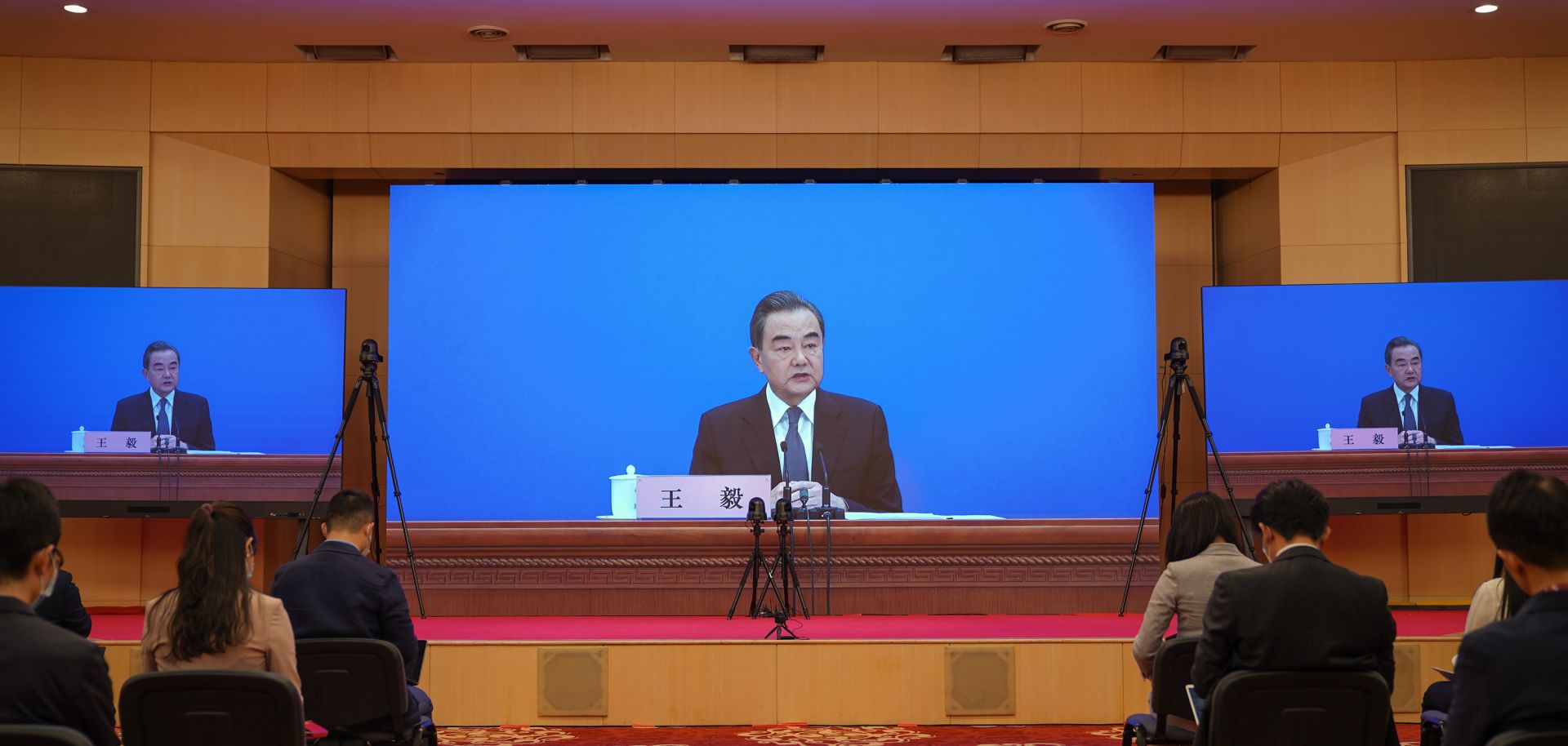
Chinese Foreign Minister Wang Yi answers questions during a video press conference on May 24, 2020, in Beijing, China.
The growing global backlash against China's involvement in both the COVID-19 pandemic and Hong Kong's political crisis is fueling a new brand of "wolf warrior" diplomacy in Beijing, aptly named after a nationalistic Chinese action movie. This more aggressive stance abroad exposes a sense of vulnerability in Beijing, and poses two potential risks for the regime — the first is that the tactic backfires overseas, and the second, and perhaps more problematic, is that Beijing loses control of the nationalistic narrative.
China's Wolf Warriors
Chinese diplomats and officials have become much more vocal in recent months amid increasing pressure regarding the origins and management of the COVID-19 pandemic, as well as renewed attention on China's Hong Kong policies. Just a few recent cases include:
- China's ambassador to Australia, Cheng Jingye, threatened trade action in response to Australia's calls for an international investigation into Beijing's involvement in the COVID-19 crisis. China's Global Times also ran editorials calling Australia "gum stuck to the bottom of China's shoe" and "a giant kangaroo that serves as a dog of the [United States]."
- China's ambassador to Germany, Wu Ken, warned that if Berlin blocked Chinese telecommunications giant Huawei from taking part in Germany's 5G rollout, it would face economic consequences.
- Chinese Foreign Ministry spokesman Zhao Lijian warned Canada that it must release Huawei CFO Meng Wanzhou to "avoid any continuous harm to China-Canada relations," following a Canadian court ruling that would allow extradition proceedings to continue against Meng. Zhao has also played an active role in the wolf warrior diplomacy overall, notably asserting that COVID-19 may have been brought to China by the U.S. military on Twitter.
- China's ambassador in France, Lu Shaye, criticized Western democracies for their poor handling of COVID-19 and implied France had simply left those in its nursing homes to die in one of a series of comments that led Paris to summon Lu.
- In an interview with the state-owned China Global Television Network, China's ambassador to the United Kingdom, Liu Xiaoming, defended China's wolf warrior diplomats and lauded their role in countering "fake news about China" and telling people "the true stories of China."
The Origins
The front-line diplomats and the Foreign Ministry officials are backed by Chinese media, particularly the Global Times, and by Chinese individuals using social media to counter any perceived denigration of China. It is a notable shift in China's international posture, though similar brief cycles have been seen in the past, most notably in the lead up to the 2008 Summer Olympics in Beijing. But China has also engaged in aggressive diplomacy backed by nationalist fervor in localized cases, as evidenced by its antagonistic response to Japan's 2012 decision to "purchase" the disputed group of islands in the East China Sea, known as the Senkaku islands in Japan and the Diaoyu islands in China.
In each of these cases, rising Chinese nationalism was a response to perceived external pressure, but also a reflection of limited Chinese options. The surge of nationalism surrounding the Olympics was in part spurred by China's inability to counter Western accusations of human rights violations in Tibet and Xinjiang at the time, and China's unwillingness to ease up its policies in those regions for fear of fostering support for independence movements. The spat over the Senkaku/Diaoyu islands, meanwhile, reflected China's inability to secure the territory that has long been under Japenese control, and its recognition that it could not alter Tokyo's decision.
It's thus no surprise that the current rise of China's wolf warrior diplomacy comes at a time when Beijing is particularly embattled, with its international support slipping amid the COVID-19 pandemic and rising calls, even well beyond the United States, to rethink China's economic and political expansion. Trade tensions with the United States were not significantly quelled following the January signing of the two countries' "phase one" trade deal. And the U.S. Congress has also proposed or passed several new bills targeting Chinese human rights and economic policies.
Even the European Union, which had initially sought a relatively neutral or even conciliatory line amid rising U.S.-China tensions, has begun to turn on Beijing. The EU High Representative for Foreign Affairs and Security Policy Josep Borrell has raised concerns over China several times in recent weeks, warning Europe that Beijing exploits internal differences. Borrell has also stated that the European Union will not give in to Chinese censorship again after a line about the origins of COVID-19 was removed in an EU letter published in a Chinese newspaper.
The Risks
Borrell's comments — and the rising responses from Australia, Canada, Germany and others — highlight how China's wolf warrior diplomacy may well backfire on Beijing. While the policy provides a nationalistic sense of pride inside China, externally it is contributing to rising anti-China sentiments, which reinforces government decisions to stand up to Chinese economic or political threats and challenges. As a domestic tool, it may serve some purpose in creating a sense of embattlement at a time when China is also struggling with the economic fallout from the COVID-19 crisis. But beyond China's borders, it is facilitating an alignment of views toward China that were formerly split.
The very success of the domestic component of the policy, however, is also a double-edged sword for Beijing. The 2012 spat with Japan over the Senkaku/Diaoyu islands fueled riots in China, with Chinese citizens burning Japanese brand vehicles and smashing Japanese stores. Ultimately, Beijing had to rein in these domestic acts to avoid losing control, as well as better manage its international and economic priorities. The current nationalist surge risks getting even further beyond Beijing's control, given the global nature, current strong government support through social media and the more personal nature of the COVID-19 crisis compared with most other distant foreign issues.
Already Beijing has started to scale back some of the most egregious posts on domestic social media sites. The Chinese government recently shut down several WeChat channels, including one that reportedly asserted the vast number of dead COVID-19 victims in the United States were being used in hamburgers and other meat products. But while shutting down such wild channels is relatively easy, maintaining a nationalist fervor that ensures domestic unity while avoiding extremes will prove more difficult. And China has a long memory of domestic social movements, actively or tacitly backed by the central government, quickly getting out of hand.
It is perhaps notable that Leng Feng, the protagonist of the Wolf Warrior movies from which China's more assertive diplomacy takes its name, has a habit of not following orders and acting on his own account, even as he remains fiercely patriotic. This can be a difficult combination to control. Several conflicts in the South China Sea have been triggered by overzealous Chinese fishermen acting outside direct government sanction, but confident that the government would back them up anyway — thus forcing Beijing's hand in the international arena. Indeed, it was Tokyo's nationalist governor who forced Japan's hand to "buy" the Senkaku/Diaoyu islands that then spurred its major break with China. Patriotism and nationalism can be positive and unifying forces, but they can also rapidly gain their own momentum, shift in unpredictable ways, and leave Beijing playing catch-up.
