
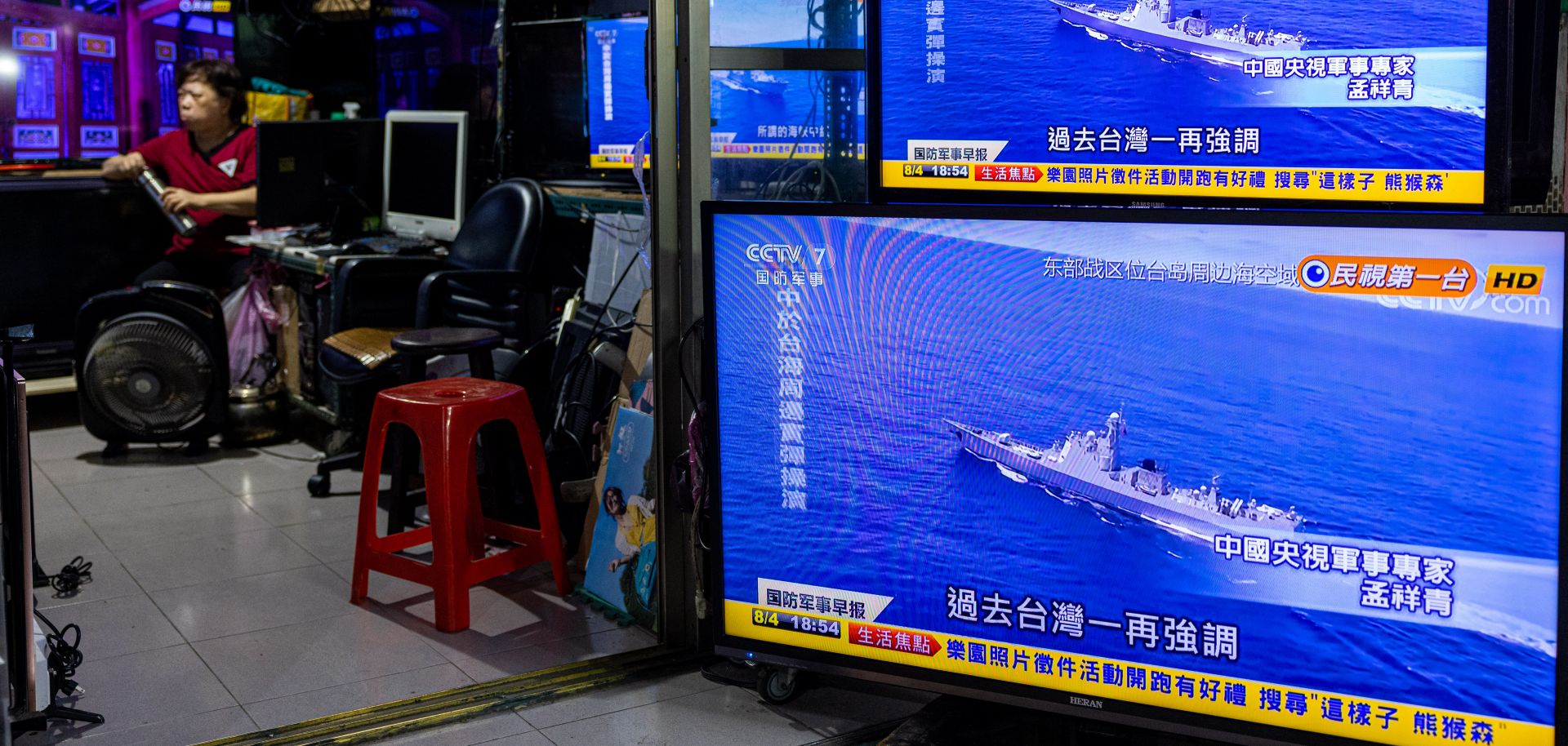
A television at an electrical repair store in Taipei shows a news broadcast about China conducting military drills near Taiwan on Aug. 4, 2022.
China's military drills in response to U.S. House Speaker Nancy Pelosi's visit to Taiwan will not trigger an immediate military escalation, though they underscore Beijing's options for political, military and economic retaliation against the United States, Taiwan and other rivals, as well as the limitations of regional stabilization efforts. Pelosi met with Taiwanese President Tsai Ing-wen in Taipei on Aug. 3 after arriving on the island a day earlier. In response, China's defense ministry announced live-fire drills for Aug. 4-7 in six areas in the waters surrounding Taiwan. Then on Aug. 4, Taiwan's Maritime and Port Bureau claimed that China had added a seventh area and extended the maritime drill through to 10 am local time on Aug. 8. The drills have so far involved Chinese naval and aerial incursions across the Taiwan Strait median line (a de facto dividing line between the two countries) and missile tests in the designated areas. Amid the first day of these drills on Aug. 4, Japan's defense ministry reported that at least four missiles had flown directly over Taiwan's capital city of Taipei before landing in the waters east of Taiwan, and five missiles had landed within Japan's claimed exclusive economic zone, though all were still within predetermined drill areas.
- The live-fire drills are targeting waters north of Taiwan (near the port cities of Taipei and Keelung), as well as in the Taiwan Strait west of the island and in the sea east of the island. To Taiwan's south, exercises are also being held off the coasts of Kaohsiung and Anping, as well as in an area further out in the Luzon Strait.
- The last time China conducted live-fire drills of this scale was in 1995-1996, but they were farther from Taiwan's shores and concentrated primarily on the areas west of Taiwan, not further afield in the seas east of Taiwan. The areas designated for the current drills, however, overlap in some places with Taiwan's territorial waters, and thus missile strikes in these waters can qualify as acts of aggression, although Taiwan and foreign powers will be motivated to respond to these drills with restraint.
The drills are primarily intended to both express Beijing's dismay with the U.S. diplomatic trip to Taiwan and convince Taipei that such collaboration with the outside world is not worth bearing Beijing's retaliation. Since the founding of the People's Republic of China in 1949, Beijing has viewed Taiwan as its sovereign territory and pledged to ''reunify'' with Taiwan by whatever means necessary, including the use of force. When foreign dignitaries counter this narrative by visiting Taiwan and de facto supporting the island's sovereignty, Beijing has often responded with sanctions, trade restrictions, shows of military force, and freezes on diplomatic channels. As with previous military drills, Beijing intends to deter the Taiwanese government and people from moving toward de jure independence and closer defense relations with the United States.
More broadly, China's latest drills are meant to remind its rivals of the military and economic costs of supporting Taiwan. For Beijing, these drills can help deter Asian and Western businesses from supporting Taiwan's sovereignty by showing the wide-scale disruption China can cause to global shipping in the Taiwan Strait in response to developments involving the island. The expansion of the geographic area and duration of drills, moreover, signals China's ability to impose a de facto embargo on Taiwan's main ports in future, and thereby decimate global maritime traffic. Indeed, China's state news and military coverage of the drills has directly confirmed this intent by stating the drills would provide training for implementing a ''maritime blockade'', ''air-to-air interception'', and the ''sealing and control'' of Taiwan and the surrounding waters. China is also attempting to deter foreign involvement in Taiwanese affairs by showing Japan and the United States the military costs of intervening in a future Chinese invasion of Taiwan.
The opinions of Chinese nationalists, concerns over Xi Jinping's legacy, and the symbolism of the 95th anniversary of the People's Liberation Army (coincidentally on Aug. 1) likely informed Beijing's decision to respond as strongly as it did with the military drills. Prior to Pelosi's visit, Chinese leaders had communicated through backchannels to the White House that Beijing might impose a no-fly zone to stop Pelosi from entering Taiwanese airspace. This ultimately did not happen, as she arrived safely in Taipei on Aug. 2 after being escorted by U.S. Air Force planes. Thus, the drills are partially aimed at shoring up the Chinese government's legitimacy with nationalist citizens, who criticized their military for failing to prevent Pelosi from visiting the island, by showing that China can still defend its interests in Taiwan. In addition, the drills will help bolster the military bona fides of President Xi Jinping himself before he and other top leaders deliberate on the composition of China's next Politburo (the Chinese Communist Party's top decision-making body) ahead of the 20th Party Congress, which will be held sometime this Fall.
In addition, the drills have tactical benefits for China's wartime readiness by enabling its military to practice ''short of war'' coercion methods, as well as some of the preliminary steps necessary for a future Taiwan invasion (including embargos, coordinated missile strikes, and anti-access and aerial denial campaigns). From a logistical standpoint, China's military is not prepared to invade Taiwan — which would be one of the largest and most complex amphibious landing operations in world history — and simultaneously counter the likely large-scale conflict with the United States that would ensue. Recent U.S. military estimates go so far as to suggest China will not be militarily ready to launch an invasion of Taiwan before 2027. But the current drills do give China's military experience with mass mobilization of forces (as seen in social media videos of Chinese, self-propelled howitzers and missile platforms driving on the highways and beaches of Xiamen), as well as joint operations between the PLA Air Force, Navy, Rocket Forces, and Strategic Support Forces (in charge of logistics, cyber operations and propaganda). These experiences are critical in preparing for a future Taiwan invasion, which would require all of China's military branches to respond with force coordination and resource mobilization on a scale that the People's Republic of China hasn't had to muster since its founding in 1949. Nonetheless, the current drills fall short of a proper dress rehearsal for an invasion, which would also require practicing other, more intricate aspects (like the mass mobilization, training, and equipping of civilian resources) that such an ambitious operation would require.
- To occupy Taiwan, China would need to deploy millions of troops, ensure they land safely on Taiwan's shores, and then have those troops establish a beachhead with secure supply lines back to the mainland. The sheer amount of manpower, vehicles and logistical capabilities this would require would be a herculean effort even without U.S. intervention. But with an invasion likely to draw in the United States, China must also ensure its military is armed and ready to fend off the most powerful military in the world.
Despite these tactical benefits, the risks of these drills are great for China, with Taiwanese politics and Western stances toward China looking set to skew further out of Beijing's favor. Though the commercial disruptions from four days of drills will be fairly limited, China's drills will reinvigorate the sense in Western and some Asian governments of how large a threat China is to regional stability, potentially prompting even more U.S. and European policies aimed at decoupling from China. For Taiwanese politics, these drills could also backfire on China by driving the island's less China-friendly ruling party to win more seats in November local elections. More immediately, though, the risk of an accidental collision between Chinese and Taiwanese military vehicles at sea or in the air is worth watching, as it could stoke a political crisis on par with the April 2001 EP-3 spy plane incident, during which a Chinese fighter pilot collided with a much-larger U.S. spy plane while trying to ward off the American aircraft. While unlikely to trigger a broader military conflict, such a collision could further deepen Chinese tensions with Taiwan and the United States and prompt even more economic retaliation or a political crisis, as the EP-3 incident did.
- In the lead-up to Taiwan's 1996 presidential election, China tried to use live-fire drills to deter the Taiwanese citizens from voting for Lee Teng-hui. But the drills ended up having the opposite effect by surging support for Lee, helping him to ultimately win the race.
So far, the international response to the drills has largely remained non-escalatory, with minimal military and economic retaliation. In response to the drills, Taiwan has readied its forces across the island. Taipei has also scrambled aircraft and vessels to ward off China's air force and naval assets from passing too far beyond the Taiwan Strait median line. While the Taiwanese government has claimed the military would respond with appropriate measures to any violations of the island's sovereignty, Taipei has so far acted with heavy restraint — using only the minimal force necessary to respond to Chinese provocations. The United States, too, has acted with general calm, sending aircraft carriers to the near seas before and after Pelosi's visit, but not responding directly to any of China's tactical military moves amid the drills. As for businesses, some shipping vessels and South Korean airlines have already diverted or canceled routes, respectively, in the region. The short duration of the drills and the relative ease of altering maritime routes to avoid the areas where they're being conducted (along with the fact that ships can still access Taiwan's ports) will limit disruptions to global supply chains.
- Pelosi's visit comes as the United States and China are trying to both maintain military deterrence in the Western Pacific, as well as protect their interests in Taiwan, without escalating into a greater conflict. Nonetheless, while Washington and Beijing suspect military conflict may eventually materialize amid their strategic competition, both have also sought to avoid unnecessary escalation in the region that could trigger a conflict between the world's two largest superpowers with unpredictable consequences.
But Pelosi's visit and China's reaction nonetheless highlight the risk of short-term political decisions overriding long-term strategies aimed at avoiding conflict. The near-term invasion threat remains remote, though China could still expand military drills or economic retaliation measures (e.g. with additional trade restrictions, goods boycotts, etc.) in the coming days. But Pelosi's visit and China's reaction reveal the danger of short-term political agendas overriding long-term strategic goals to manage tensions. For Taiwan, this strategic goal is to secure de facto sovereignty, even if de jure independence is out of reach. This is similar to the U.S. goal of maintaining Taiwanese sovereignty to hold back China's projection of force deeper into the Pacific that would threaten U.S. military dominance. China's ultimate goal, meanwhile, is to reunite with Taiwan in the long-term, ideally peacefully, though with force if necessary. While cost-benefit analysis and long-term management of growing tensions will continue to drive the broad brushstrokes of Chinese, Taiwanese and U.S. policies, these more pragmatic efforts will continue to be punctuated by political exigencies. Such events will threaten economic and military stability in the short term, and in the process, test the commitment of various governments to their security pledges.
- Pelosi's visit appeared to be her own choice, not a policy decision by the White House, and went against the concerns of the U.S. military. But because of the optics of not wanting to appear weak, Washington eventually gave its support for her visit once it was formally announced.
- A future risk may come from the pro-independence wing of Taiwan's ruling party, which has been known to push for legislation that would formalize Taiwan's sovereignty. Beijing tends to respond strongly to these efforts (for example, with bans on certain Taiwanese exports) despite the desire by both sides to maintain stability and avoid unnecessary provocation.
