
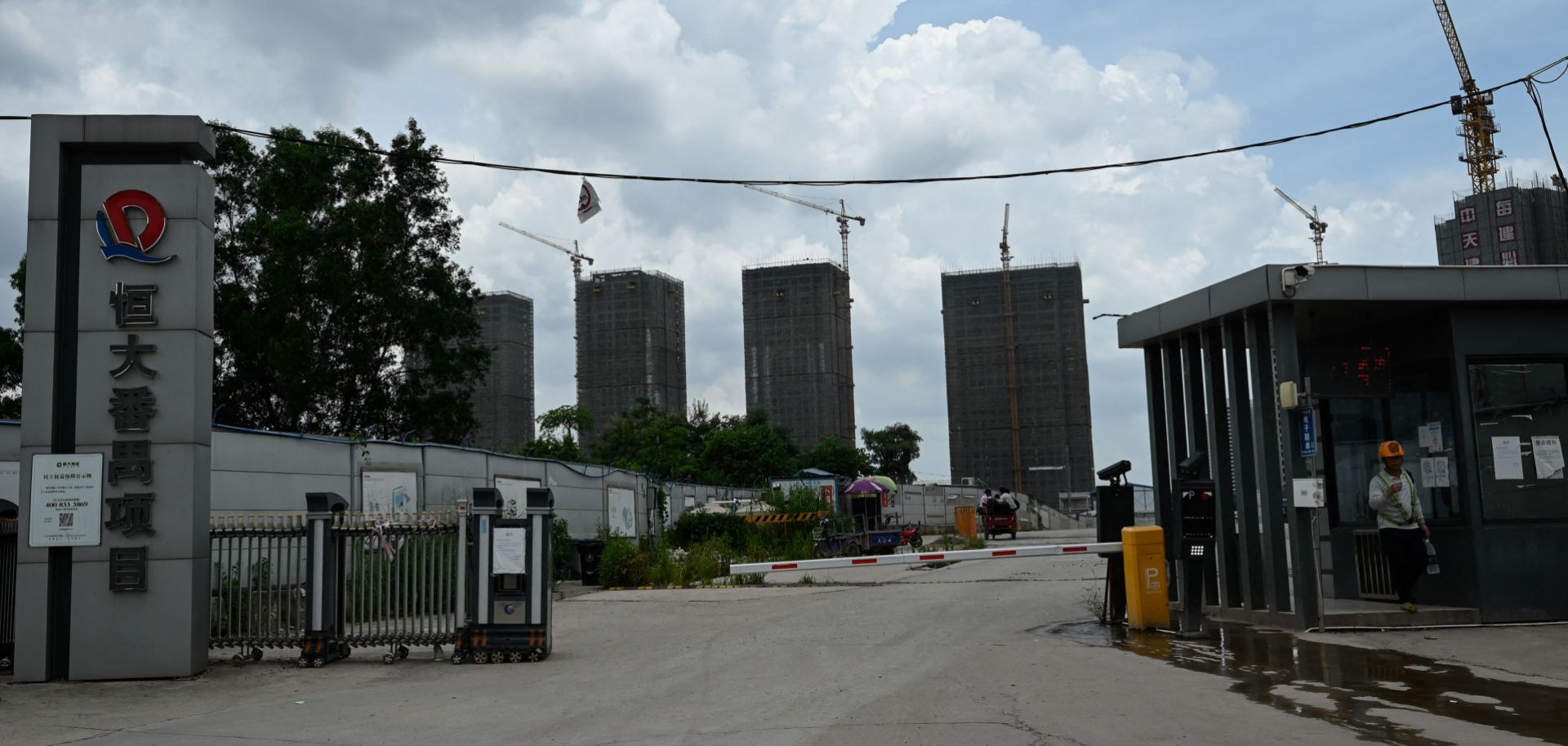
A general view shows Evergrande residential buildings under construction in Guangzhou, in Chinas southern Guangdong province, on July 18, 2022.
China’s lockdowns and other heavy COVID-19 restrictions in hundreds of cities from March to May have raised questions as to how quickly the Chinese economy will recover from its second quarter slump as structural challenges persist into the third quarter. China’s GDP grew just 0.4% year-on-year last quarter; when excluding the first quarter of 2020 (during China’s first outbreak of COVID-19), this marked China’s slowest quarterly growth rate since the government began reporting quarterly data in 1992. A number of events over the last month reflect the persisting risks to consumers, banks and China’s traditional engines of economic growth as the third quarter unfolds.
- In the week leading up to July 19, home buyers from at least 319 housing projects across 112 cities boycotted China’s troubled real estate developers by refusing to pay their mortgages until the developers resume, or in some cases commence, construction. Though the exact number of boycotters is unknown, Chinese housing projects usually consist of blocks of high-rise apartment buildings, with hundreds of units in each block; this means that the ranks of the boycotters could reach into the hundreds of thousands.
- As of July 19, outbreaks of the infectious BA.5 variant of COVID-19 have prompted new rounds of lockdowns in cities like Macau, Beihai and Lanzhou, as well as mass testing and district restrictions in Shanghai, causing panic buying at local supermarkets.
- On July 10, hundreds protested outside a local branch of China’s central bank in the central city of Zhengzhou to demand access to their bank accounts (which have been frozen since April amid an investigation into the misuse of funds by an investor in four local banks) before local authorities violently broke up the protest.
- On July 7, Bloomberg sources revealed that Beijing is considering allowing local governments to prematurely issue $220 billion in special purpose bonds (SPBs) from the 2023 budget in 2022 to help stimulate the economy sooner with infrastructure spending. China has never allowed localities to frontload SPBs to an earlier fiscal year.
These recent events highlight the low consumer and investor confidence in China as the real estate sector trembles and the threat of new lockdowns persists. They also show Beijing deprioritizing its economic derisking campaign — which involves scrutinizing risky lending practices and excess debt in the banking and real estate sectors — in favor of short-term economic growth ahead of a quinquennial milestone for President Xi Jinping in the fall, when he is widely expected to begin an unprecedented third as the leader of China.
- The mortgage protest reveals low confidence among Chinese consumers and investors in the real estate sector, which is the central pillar of China’s economic growth and the top destination for household savings. The sector has been on shaky ground since early 2021 amid Beijing’s scrutiny on housing debt, with S&P Global projecting in July that at least a fifth of Chinese developers could default on up to $88 billion in distressed bonds if China’s economy doesn’t recover by the first quarter of 2023. To put this in perspective, real estate giant Evergrande, which raised fears of a sectoral collapse last year when it missed debt payments, alone had over $300 billion in debt as of September 2021.
- Relatedly, the primary source of local government income, land sales to real estate developers, has dried up this year. Potential new SPB allocations would help local authorities fund infrastructure, which juices GDP growth and employment, but their budget for other expenditures, like social spending and business subsidies, remains scant.
- The bank protest in Zhengzhou underscores the precarious financials of many banks, which are tied up in their own webs of debt (often intertwined with real estate), and the impact this can have on consumers who implicitly trust state-affiliated institutions.
- The latest COVID-19 outbreak in China comes after Xi stated on June 28 during a visit to Wuhan that Beijing would “rather impact a little economic development” than threaten people’s health with COVID-19. Amid their government’s staunch commitment to its “zero COVID” policy, Chinese consumers fear sudden lockdowns and have a reduced appetite for non-essential consumption.
A slowing Chinese economy could significantly weaken the global economy as concerns grow about recession in the West and debt crises in the developing world. Thus, it will be important to watch a number of indicators in the last half of 2022 to determine whether China will recover quickly from its second quarter slowdown. Most immediately, as seen earlier this year, further major production and shipping slowdowns would reverberate throughout the global economy. In turn, amid growing worries about its long-term attractiveness for foreign business activity, a continuation of China’s slowdown would further harm its reputation as a safe haven for global investment since China first recovered from COVID-19 in the spring of 2020. It could also bode poorly for multilateral debt restructuring efforts in developing countries, many of which owe substantial debts to China. This means a Chinese slowdown could portend less generous relief packages and more defaults in the developing world. Finally, some of the indicators for a quicker recovery in 2022 are also indicators of poor long-term health for the Chinese economy, highlighting the tradeoffs in trying to push short-term growth at the expense of future stability. Particularly if these near-term measures do not work, this would raise the risk of China, like many countries in the West, entering a recession (in the worst case) or at least a period of prolonged slow growth that further inflates China’s asset bubbles. Either of these scenarios would only reinforce the negative outlook for the global economy. The following indicators should help gauge these risks:
- A mid-year budget change: The legislature’s next meeting in August could see a mid-year fiscal budget change approved for the first time since 1999, which would help Beijing pay for its “zero COVID” and infrastructure campaigns. This would signify China is prioritizing growth for the remainder of 2022 over fiscal austerity.
- The makeup of investments: China’s fixed asset investment was up 6.1% in June year-over-year, but this was driven by infrastructure and manufacturing and despite a 5.4% drop in real estate development. Should this trend continue, China’s growth recovery would be tenuous, as poor local government funding and languishing real estate could trigger a new crisis in 2023.
- Support for real estate and local governments: Conversely, any sign that Beijing may bail out China’s ailing real estate giants, like Evergrande or Sunac, or ease scrutiny on bank lending to local governments would indicate a broad relaxation of China’s de-risking campaign, restoring faith in a key sector of China’s economy and providing funding relief to local governments. This would support a 2022 recovery, but it would still leave unaddressed the issue of weaning the economy off of cheap growth and perverse incentives for poor investment.
- Consumption: Retail sales in June hit 3.1% growth year-over-year, marking an initial recovery from the contraction in consumption driven by the March-May lockdowns. Should retail sales continue to rise, it would be a sign of recovering consumer confidence and receding fears of new lockdowns among Chinese citizens.
- The trajectory of COVID-19: Should China’s current wave of infections continue to grow, it seems almost certain that Chinese authorities will again resort to lockdowns in dozens of major Chinese cities, risking a repeat of the damage seen in the second quarter. It also suggests that pre-2022 levels of growth (including domestic consumption) won’t resume until Beijing abandons its “zero COVID” policy, which most analysts believe won’t happen until the first quarter of 2023, at the earliest.
- The outcome of the 20th Party Congress: Lastly, China’s 20th Party Congress will be held sometime this fall, during which the party’s politburo will be restaffed. Should President Xi fill this key political body with more loyal yes-men, it would be a sign that China’s economic hard times could persist into 2023 as Beijing doubles down on zero COVID and its many financial and economic derisking campaigns, and as Xi feels more secure with his renewed ruling mandate.
