
National Day celebrations on Oct. 10, 2004, in Taipei, Taiwan.
Editor's Note: This assessment is the second of a four-part series that explores China-Taiwan relations through the lens of the latter's economy, politics, military affairs and regional relations. Part one can be found here.
A more aggressive mainland leadership and more skeptical Taiwanese populace are forcing Taiwan's two main political parties to emphasize national sovereignty, which will amplify cross-strait tensions in advance of Taiwanese elections in 2022 and 2024, setting the stage for a more antagonistic relationship in the long term. Since 2019, Chinese President Xi Jinping has increasingly used public remarks to associate the 1992 Consensus — an ambiguous bilateral agreement on the statehood of Taiwan — with the "one country, two systems" model of governing Hong Kong. This rhetoric has combined with Beijing's 2019 crackdown on Hong Kong protesters and the 2020 National Security Law in Hong Kong to cast doubt on the sustainability of the cross-strait status quo, in which Taiwan functions as a de facto independent country. It has also spurred a marked shift in Taiwanese sentiment against China, which in turn has led Taiwan's conservative Kuomintang and the Democratic Progressive Party to refocus on protecting Taiwan's sovereignty.
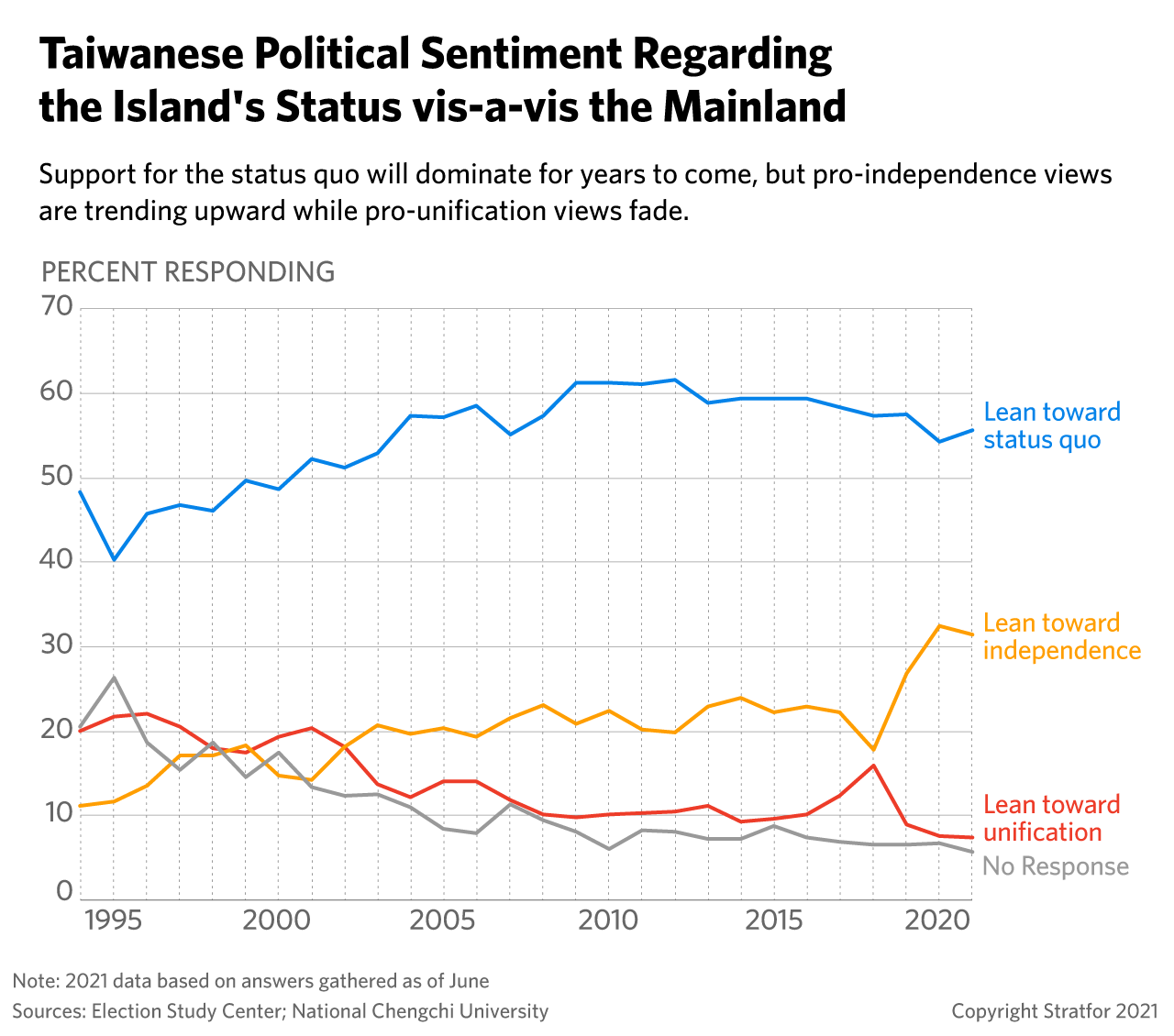
- As of June 2021, data from Taiwan's National Chengchi University showed that 56% of Taiwanese support the status quo in cross-strait relations (no independence, no reunification), while 31% support independence and only 7% want reunification. This compares to the June 2017 distribution of 58% status quo, 22% independence, and 12% reunification.
- Taiwan's Mainland Affairs Council, which plans Taipei's policy toward China, showed the share of Taiwanese perceiving Beijing as hostile toward the Taiwanese people had increased from 46% in June 2017 to 60.5% in March 2021, the second-highest figure after March 2020 (61.5%), when President Tsai Ing-wen was reelected.
In advance of the 2022 local and 2024 presidential elections, Taiwan's two main political parties are seeking to redefine themselves as staunch defenders of sovereignty in a new era of contentious cross-strait relations without sacrificing its economic growth, which is dependent on the mainland. Historically, the KMT has downplayed issues of sovereignty and emphasized cross-strait economic ties in the hope of deterring China's territorial ambitions, while the DPP has highlighted sovereignty issues, been circumspect about making political agreements — like the 1992 Consensus — with China, and sought to diversify Taiwan's economic relations away from China. Now, however, the KMT is reconsidering its stance on sovereignty matters, the DPP is realizing the difficulty of replacing China as a trade partner and both parties must cater to a more China-skeptic electorate set to grow as China's deepening tensions with the United States embolden pro-independence voices in Taiwan.
- KMT chairman Johnny Chiang has defended Taiwan's sovereignty since Xi's 2019 remarks and criticized Beijing's military threats while maintaining support for cross-strait trade. His rival for the Sept. 25 election for KMT chair, Eric Chu, favors restoring "conciliatory" relations with China. Given the electorate's distaste for China, Chiang seems the more likely KMT candidate to gather votes from centrists during the 2022 and 2024 elections.
- President Tsai Ing-wen of the DPP, who favors the status quo, increasingly must soften anti-China legislation from the party's pro-independence faction while still pushing for Taiwan's sovereignty in cross-strait interactions. She is struggling to implement economic decoupling, as her policies have coincided with deepening trade ties with China amid the pandemic. Nonetheless, given the electorate's pro-status quo views, a moderate DPP candidate like Tsai will poll better in 2022 and 2024, assuming the winner can maintain economic growth and defend Taiwan’s ability to represent itself in global forums.
As they prepare to contend with a likely less amicable Taiwanese leadership, Beijing's efforts to influence Taiwan's upcoming elections are likely to be less effective against improved Taiwanese defenses against propaganda, forcing Beijing to rely on overt military threats, diplomatic pressure campaigns and small-scale economic coercion. In November 2018 local elections, China successfully used online influence tactics, like fake campaign groups and social media content farms generating fake coverage, as well as close relationships with Taiwanese news outlets to promote pro-China views and KMT candidates to help the KMT sweep local elections. Ahead of the 2020 presidential and legislative elections, however, Tsai's administration took a number of steps it is likely to replicate in 2022 and 2024 to reduce the impact of Chinese influence efforts and leave Beijing more reliant on other coercive measures likely to generate comparatively more public discontent in Taiwan.
- Taipei cooperated with Facebook to take down Chinese inauthentic online content farms, passed a law to punish entities (including news outlets) that abet foreign campaigns to sway elections and mobilized a volunteer fact-checking group to respond to fake news inquiries on social media. Along with these efforts, the KMT's poorly run campaign and China's handling of the 2019 Hong Kong protests helped Tsai get reelected with 57% of the vote.
- After the 2020 defense campaign against online influence tactics, DPP lawmakers are now looking to strengthen laws on national security, trade secrets, the transparency of foreign political influence, media influence, illegal donations and other foreign political activities in the current legislative session from September to December and the next from February through May, all ahead of the November 2022 local elections.
- Though Beijing will certainly try again to influence Taiwan’s 2022 local and 2024 presidential elections, Taipei’s improved countermeasures will leave China increasingly reliant on other methods to coerce Taiwan, like military flyovers — China launched the most aerial incursions into Taiwanese airspace in 2020 than any year since 1996 — and trade restrictions targeting Taiwan's farmers and other economic sectors dependent on mainland markets. Compared to more covert online influence efforts, these more overt coercive measures will provoke greater Taiwanese frustration with the mainland.
Through 2024 and beyond, Taiwan's more sovereignty-focused politics and Beijing's deeper reliance on overt and belligerent military and economic intimidation over more discreet political influence campaigns will result in a more antagonistic status quo in cross-strait relations. This new normal will push the United States and regional partners to expand their political and security engagement with Taiwan, which will heighten overall tensions and create sporadic flashpoints that disrupt business and political links amid expected Chinese retaliation. Even as all sides seek to limit escalation and have incentives to limit disruptions, a much less likely — but more provocative — U.S. or allied decision to formally recognize Taiwan or make a formal defense pact with the island could push China to seek reunification with the island by force, especially if Beijing perceives room for cross-strait political negotiations as having disappeared or if societal efforts for Taiwanese independence have become the new norm.
- Whether under the KMT or DPP, Taipei will make bolder commitments — mainly rhetoric from the KMT and punitive policies from the DPP — to defend Taiwanese sovereignty. Both parties will continue to recognize the importance of Chinese ties to the economy, but the DPP will become more creative and possibly more intrusive in economic decoupling efforts aimed at businesses, like the amendment proposed in August to ban Taiwanese workers from employment on the mainland.
- Taipei will likely supplement its more defensive political posture toward Beijing with tighter informal military partnerships and a greater focus on attaining recognition in international forums. To do so, Taiwan will try to capitalize on governing accomplishments like its effective COVID-19 management to pitch itself as a responsible international partner.
- As it rebalances to the Indo-Pacific, the United States will likely double down on its support for Taiwan. This will take the form of more diplomatic meetings, like the June meeting between three U.S. senators and Tsai, and perhaps even clearer statements of U.S. defense obligations toward Taiwan as China's threats to Taiwan become bolder. The United States has already pushed the envelope in 2021 on its defense relation with Taiwan, as seen by the agreement on coast guard cooperation signed in March and (more subtly) the July stopover of a U.S. military plane in Taiwan under the auspices of delivering a package to a U.S. diplomat.
- Regional powers like Japan may also more clearly define their political and security relationships with Taiwan, as shown by Japanese Defense Minister Nobuo Kishi's August remarks on the importance of Taiwan's survival for regional stability. But these diplomatic shifts will be limited by the deep economic dependence on China for countries like Japan, South Korea and the Philippines.
- China will become more sensitive to perceived changes in cross-strait relations and in how other countries treat Taiwan, reacting with stronger economic and diplomatic retaliation that causes short-term but severe disruptions for affected companies and/or governments. Recent examples of such retaliation include China's March 1 ban on Taiwanese pineapple imports after a proposal to downplay the prospect of reunification in the Taiwanese Constitution and the Sept. 20 ban on Taiwanese apple imports after the United States considered changing the name of the Taipei Economic and Cultural Representative Office to the "Taiwan Representative Office."
- Should the United States and regional powers deepen their diplomatic relations with Taiwan, Beijing will boost military coercion (e.g. aerial flyovers), cyberattacks and trade restrictions against the island. Much less likely — but much more likely to escalate matters, would be the United States and its allies take clear defense stances about Taiwan, and especially if Taiwanese politicians seek de jure independence or close off cross-strait avenues for political dialogue — China would likely trigger forceful reunification with Taiwan, including either a naval blockade to force Taiwanese political concessions or an outright military invasion of Taiwan's outlying islands or the entire country. These military and diplomatic dynamics will be discussed in the next installations of this series on how Taiwan handles China.
