
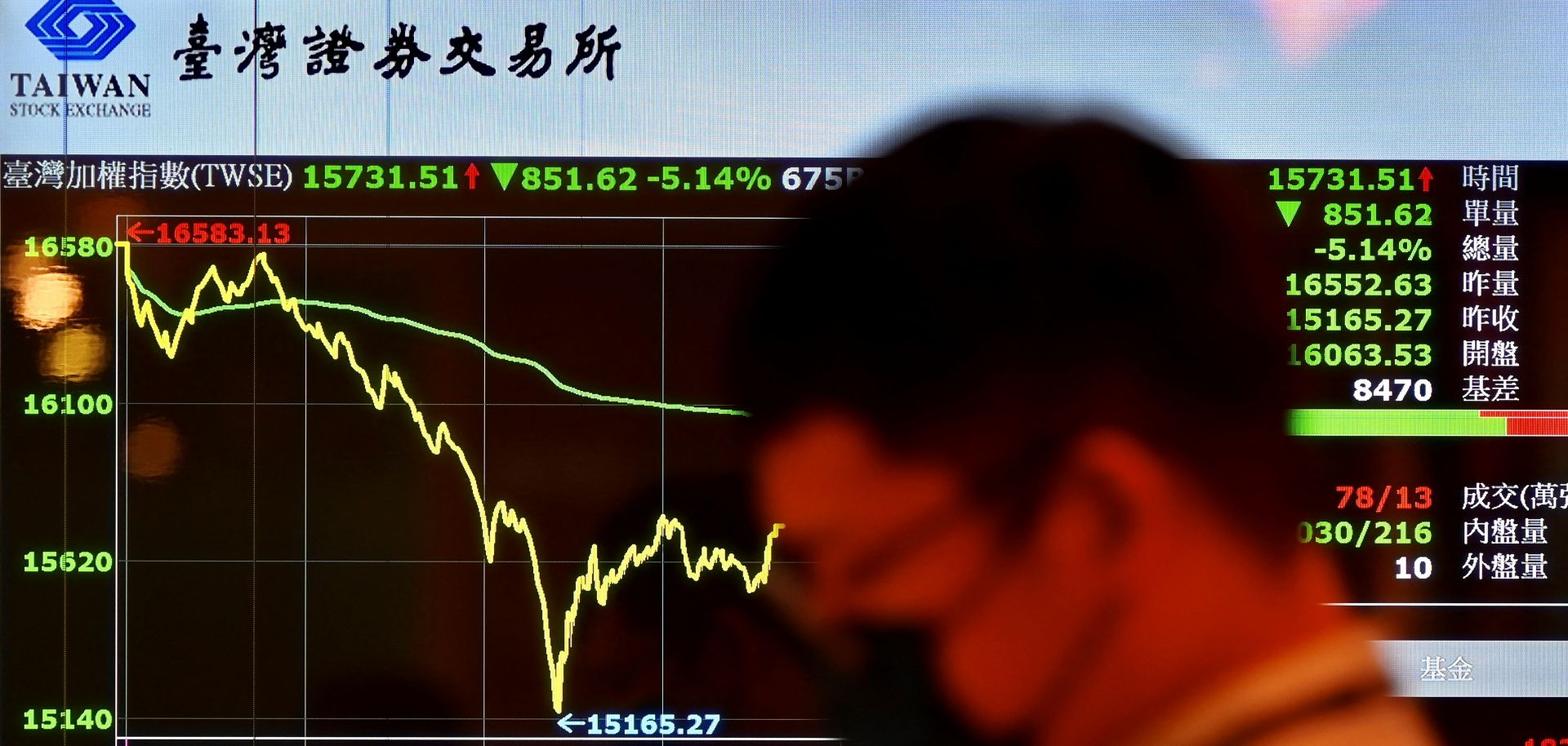
A man walks past a monitor outside the Taiwan Stock Exchange in Taipei on May 12, 2021.
Editor’s Note: This assessment is the first of a four-part series that explores China-Taiwan relations through the lens of the latter's economy, politics, military affairs and regional relations.
Amid shifting political winds in Taiwan and elevated cross-strait tensions, China will continue to weaponize its economic heft against the island’s industries to secure its influence over Taipei — leaving Taiwan on the defense and largely unable to reduce its trade reliance on Beijing over the next five years. This will prompt Taipei to focus on international governance fora and regional military cooperation, as well as diplomatic relations with the United States, Japan and other regional partners as a means of deterring Chinese economic pressure.
- Pro-unification stances among the Taiwanese public are at an all-time low, hovering at around 8% in 2020. Taiwanese support for pro-independence and pro-status-quo views, meanwhile, hit 32% and 54%, respectively, in 2020. In response to these shifting political dynamics, the island’s ruling liberal Democratic Progressive Party (DPP) has begun to entertain more pro-independence policies in recent years. The conservative Kuomintang (KMT) party has also begun to disavow pro-unification viewpoints in a bid to cater to the 64% of citizens who identify only as Taiwanese (and not Chinese).
- In 2020, Beijing flew 49 aerial sorties that crossed the median line between China and Taiwan, the most since 1990. Much to Beijing’s dismay, U.S. diplomats and former officials have met with Taiwanese officials frequently in the last year, including a visit by three U.S. Senators to Taiwan on June 6, where they met with President Tsai Ing-wen.
- Since 1980, China has used a number of economic incentives to influence Taiwan. This has included giving Taiwanese businesses duty-free status, preferential loans and other investment incentives, as well as giving Taiwanese citizens residence permits to work in China. During that same period, China has also leveled punitive measures against Taiwan, including banning DPP-aligned businesses from China, restricting agriculture imports, limiting Chinese tourist flows to Taiwan, and threatening to revoke the cross-strait Economic Cooperation Framework Agreement (a trade agreement on goods flows).
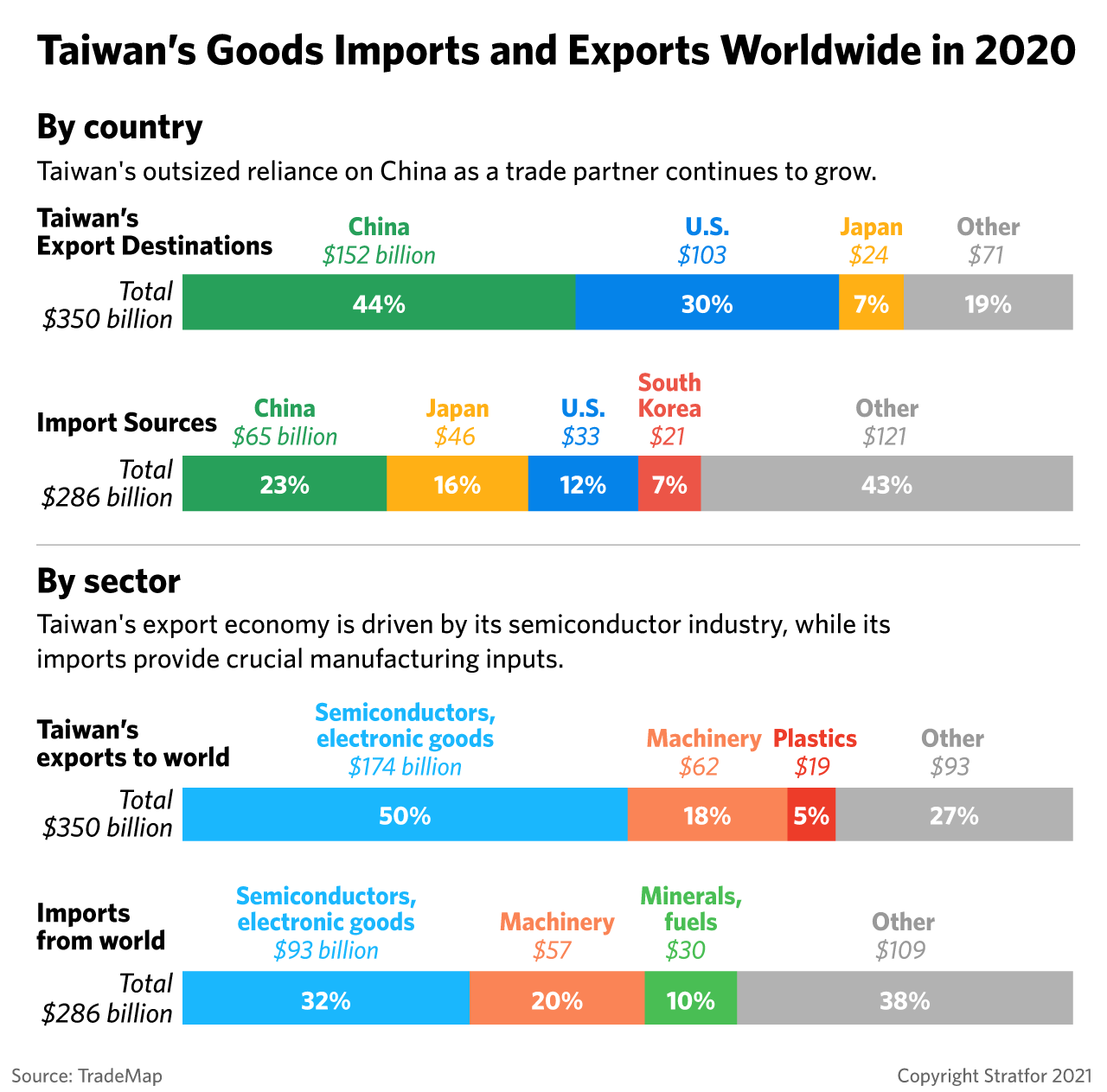
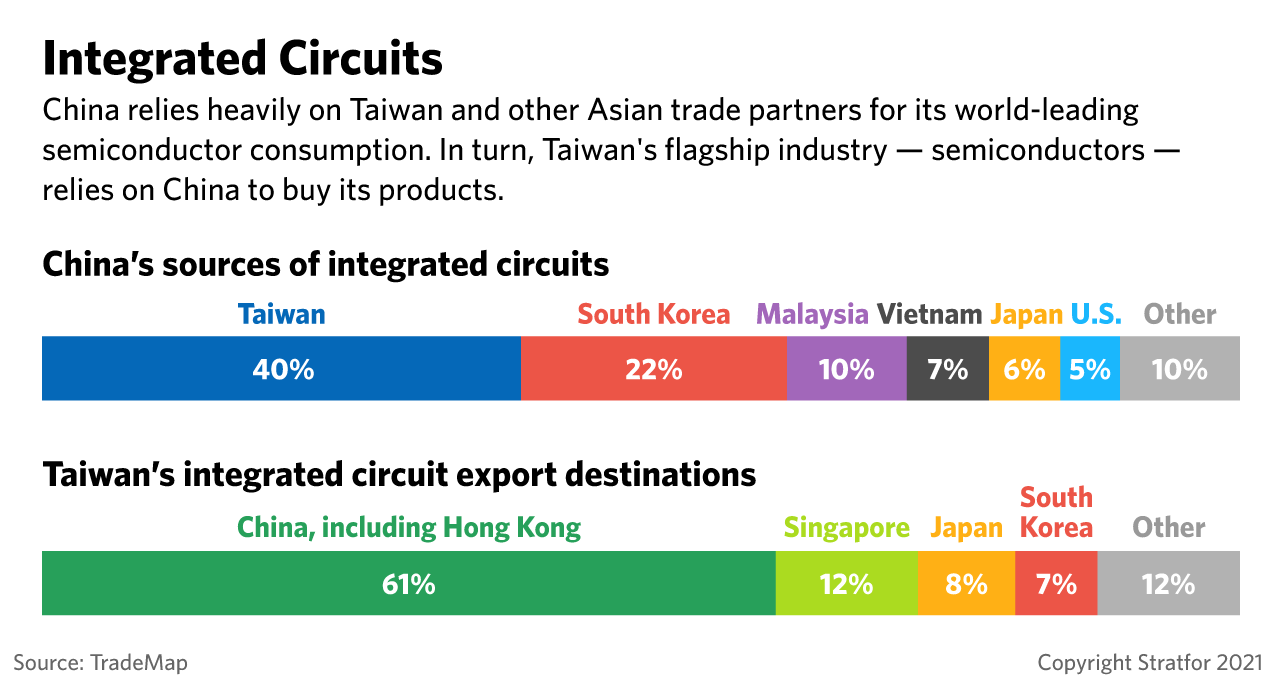
Due to the high trade interdependence between China and Taiwan in semiconductors, Beijing will continue to incentivize chip investments while focusing restrictive measures on smaller, less connected sectors. Taiwan heavily relies on chips for economic growth, with semiconductors and related electronics making up roughly half of Taiwan’s total manufactured goods exports in 2020. China, however, is also reliant on Taiwanese semiconductors, which will leave Beijing relatively incapable of leveraging punitive measures against the Taiwanese chips sectors. But given the large levels of Taiwanese investment that continue to flow into China, Beijing can still attempt to further entangle Taiwanese chip manufacturers by offering incentives for them to invest in China, such as preferential loans, residence permits for Taiwanese factory owners and workers, and inclusion in Chinese special economic zones. Such moves would help preserve Taiwan’s dependence on the Chinese market while preparing Beijing for the future scenario, perhaps ten years down the line, in which China no longer needs Taiwanese chips and can once again use trade restrictions against this sector. For now, however, reliance on Taiwanese chips limits China’s targets for punitive trade measures to smaller, politically influential sectors of Taiwan’s economy.
- Taiwan’s manufacturing sector is heavily exposed to China as a trading partner, especially in integrated circuit (IC) exports, with China purchasing 61% of Taiwanese IC exports in 2020.
- China imported 40% of its ICs from Taiwan in 2020 and also imported 55% of all global ICs that same year. Even if China doubled its integrated circuit (IC) production from 2019-2024, it’s estimated Beijing would still need to import 80% of ICs.
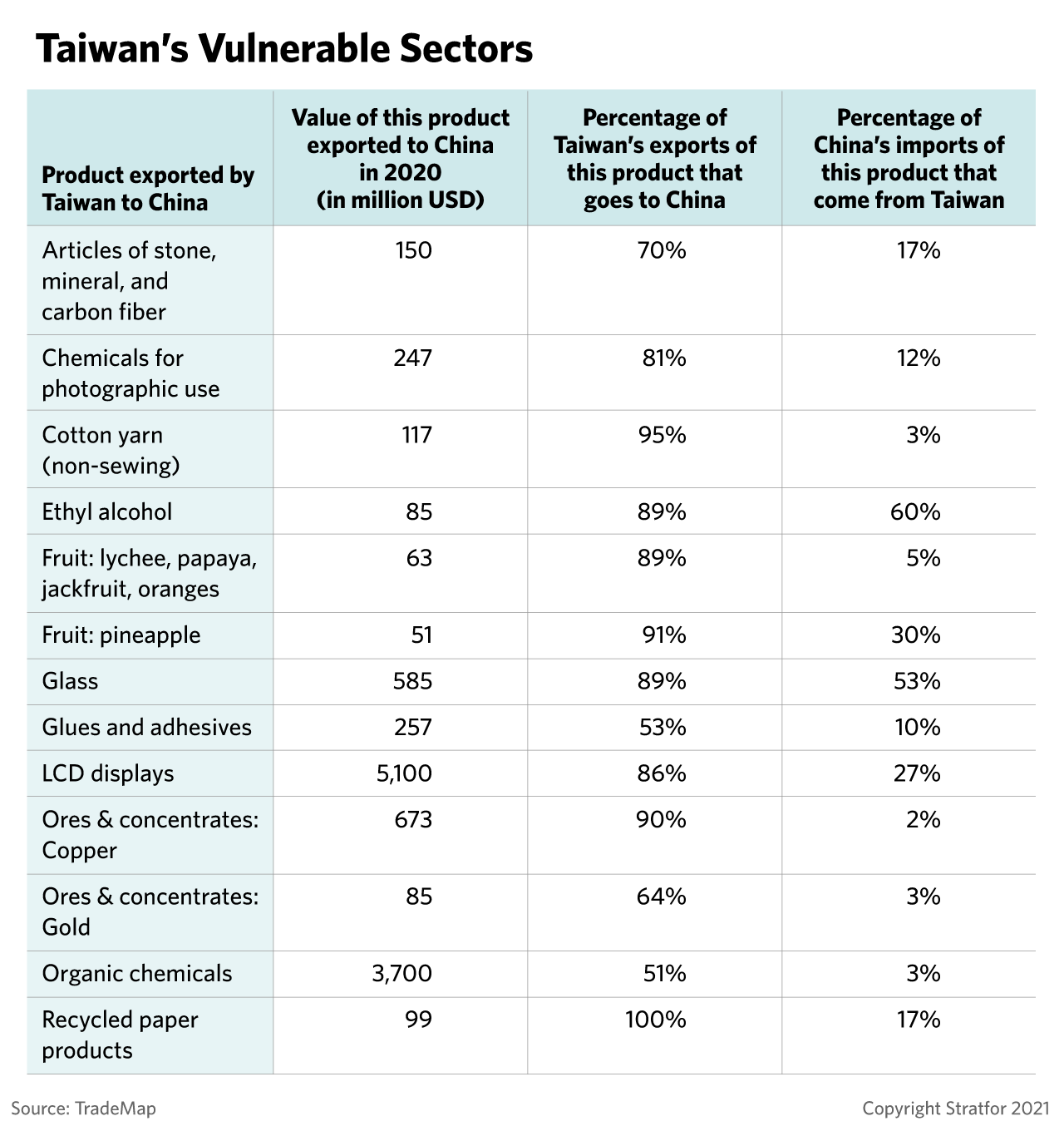
The Taiwanese export sectors most vulnerable to China’s punitive actions and market incentives are agricultural goods and industrial inputs, of which China imports a large proportion of Taiwan’s production. But Beijing remains unlikely to restrict exports of Chinese goods to Taiwan. The ideal Taiwanese export for China to impose trade restrictions against would be one for which China imports a large portion of Taiwan’s output, but also is a key industrial input for China. And if it is a key industrial output, Beijing would ideally have easy access to alternative sources for the targeted good.
- Beijing has a low reliance on organic chemical imports from Taiwan, but their industrial usage and variety would complicate restrictions because Beijing tends to restrict specific products, not whole product categories.
- Gold and copper ores, despite their use as industrial inputs, are more specific products for which Beijing has low reliance on Taiwan, and thus are potential candidates for Beijing’s trade restrictions.
- Fruit is also a vulnerable sector, as Taiwanese producers rely on China as an export market and fruit producers are a loyal constituency of Tsai’s DPP party.
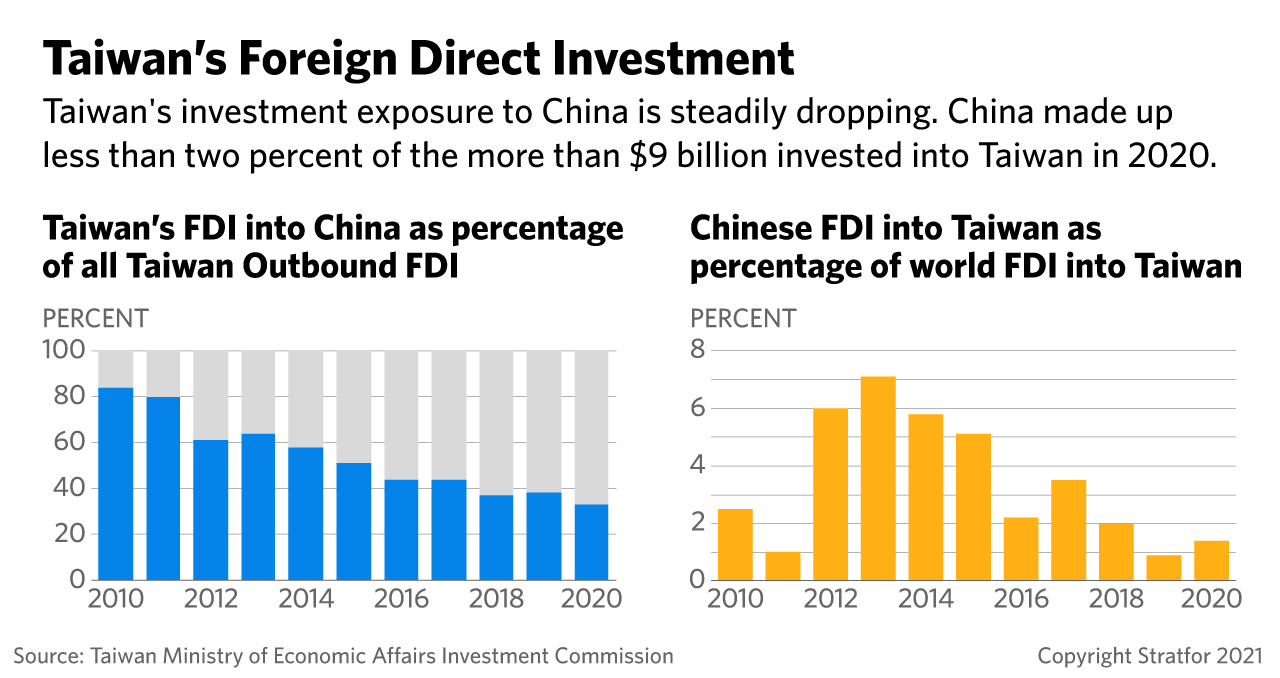
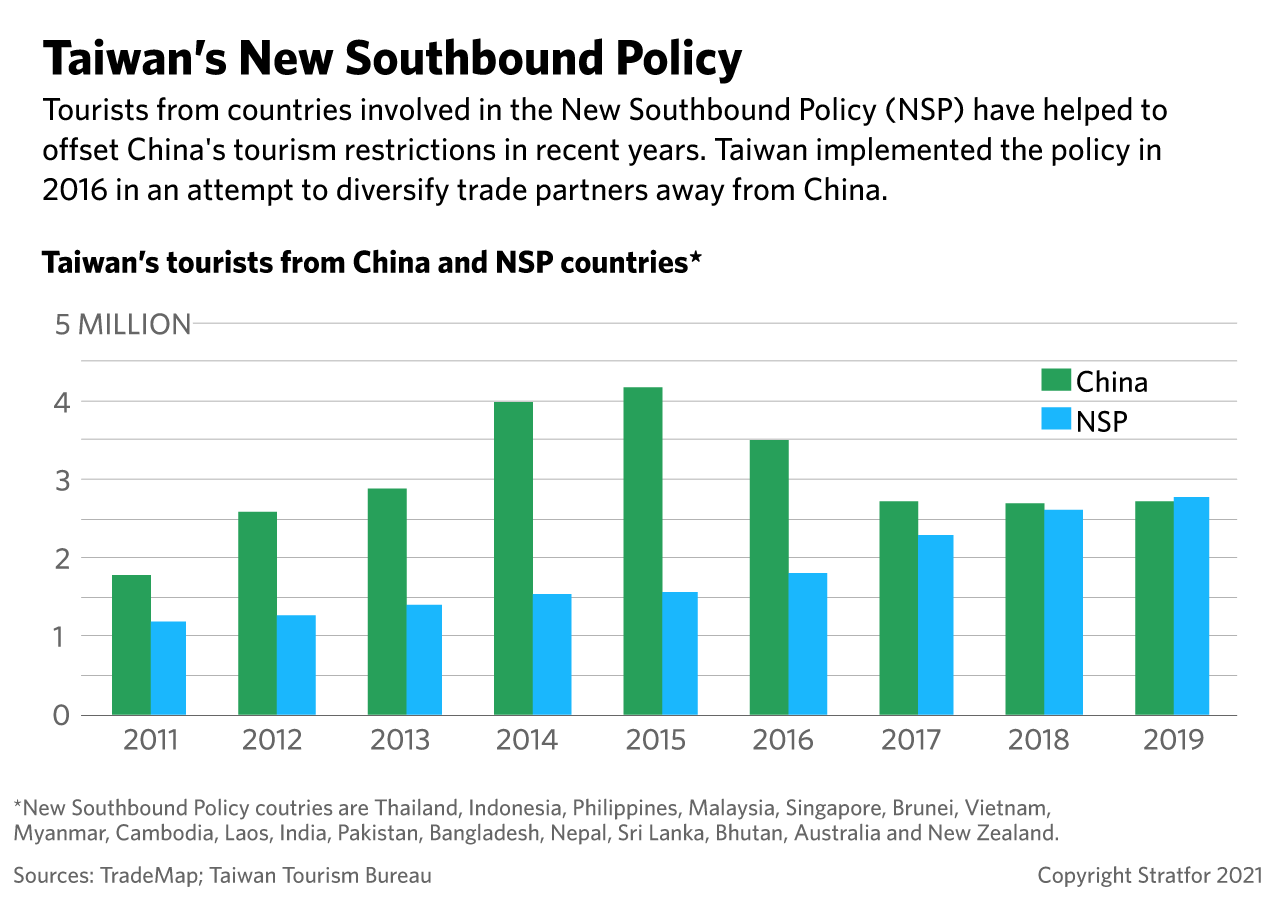
Taipei’s responses to Beijing’s past coercions against small sectors have largely blunted their intended political impacts, but they’ve also shown the limitations of Taiwan’s long-term ability to defend its markets. Taipei’s remedial trade measures are often limited to individual sectors targeted by Beijing or tied to the fate of political leaders, fading away with each new administration. Since 2016, Tsai has enacted a handful of economic policies to reduce Taiwan’s exposure to China, but these have either proven ineffective or required too long of a time horizon to deter Beijing in the next five years. Tsai’s 2016 New Model for Economic Development aims to evolve Taiwan’s economy to high-tech industries by 2046. Taiwan’s reliance on relatively low-valued-added chips fabrication for growth, however, has only increased in the last five years. Similarly, Taiwan’s New Southbound Policy of 2016, aimed at diversifying trade and investment ties in Asia and Oceania, has failed to reverse Taiwan’s growing trade reliance on China.
- In 2005, Chinese President Hu Jintao launched a “fruit offensive” campaign. The initiative was aimed at swaying Taiwan’s fruit producers toward the pro-Beijing KMT by directly negotiating with producers to reduce Chinese tariffs after DPP President Chen Shui-bian was elected for a second term in 2004. To combat this, Taiwan required China to negotiate trade matters directly with Taipei, threatened to remove government fruit subsidies from Taiwanese producers, and pushed through a trade deal with Japan that involved fruit purchases. The tactics largely worked, as Taiwan only exported around 5% of fruit to China from 2005-2008, while exports to Japan increased from 17% to 24% in the same period. The results were short-lived, however, as Chinese fruit imports increased from 5% of total Taiwanese fruit exports to 12% in the three years after Chen left office, while Japan’s share stagnated.
- In 2016, after DPP candidate Tsai Ing-wen won the Taiwanese presidency, China discouraged tourism agencies from sending Chinese tourists to Taiwan. This caused visitors from China (who at the time made up the largest demographic of tourists in Taiwan) to drop 35% from 2015 to 2017. President Tsai’s New Southbound Policy, designed to increase trade and tourism ties with South and Southeast Asia, drew large numbers of new tourists and kept the number of tourists visiting Taiwan growing every year, but annual tourism revenues didn’t reach 2015 levels again until 2019, given that Chinese tourists spend more than nearly any other nationality in Taiwan.
- In February 2021, China banned imports of Taiwanese pineapples, citing pest concerns, after pro-independence lawmakers proposed changes to Taiwan’s constitution to downplay the prospect of eventual reunification with China. To combat the ban and Taiwan’s reliance on Chinese pineapple purchases (China purchased 95% of Taiwan’s pineapples in 2020), Tsai launched a patriotic marketing campaign to encourage pineapple purchases by domestic citizens and foreign partners, even going so far as to gift pineapples to foreign dignitaries. The counter efforts were successful, with Taiwanese pineapple producers seeing enough orders in four days to equal all of China’s pineapple purchases from 2020. In the long term, however, Taiwan will need to find a new permanent market for its pineapples.
Beijing’s outsized influence on the cross-strait economic relationship will limit Taipei to defensive economic policies over the next five years while President Tsai’s DPP will emphasize forming partnerships with global powers to deter Beijing’s attempts to change the bilateral status quo. Taiwan’s persisting trade and investment exposure to China, along with its relatively small economy, will leave Taipei using primarily state-led campaigns to reactively protect individual, vulnerable sectors from China. Should Beijing mount a larger, sector-wide economic coercion campaign, Taipei would struggle to organize private and public economic forces to quickly counteract the economic impacts. That said, Beijing is unlikely to mount such broad campaigns often, as they forfeit China’s plausible deniability for manipulating Taiwan’s economy and increase anti-China sentiment among other trade partners. Beijing is instead likely to continue targeting smaller exports when it believes Taiwan, the United States, or any other country is challenging China’s plans for Taiwan. Given that Taiwan’s strategy for handling China in the economic realm is largely reactive, Taipei will leverage the other realms of political, military, and diplomatic influence to enforce its internal and external narrative of an independent country exposed to China’s authoritarian predations. This strategy will involve other regional and global powers like Japan, Australia, the United States and the European Union to increase the risk that Beijing’s economic coercive measures will impact partner countries and thus counter China’s efforts to isolate Taiwan.
