
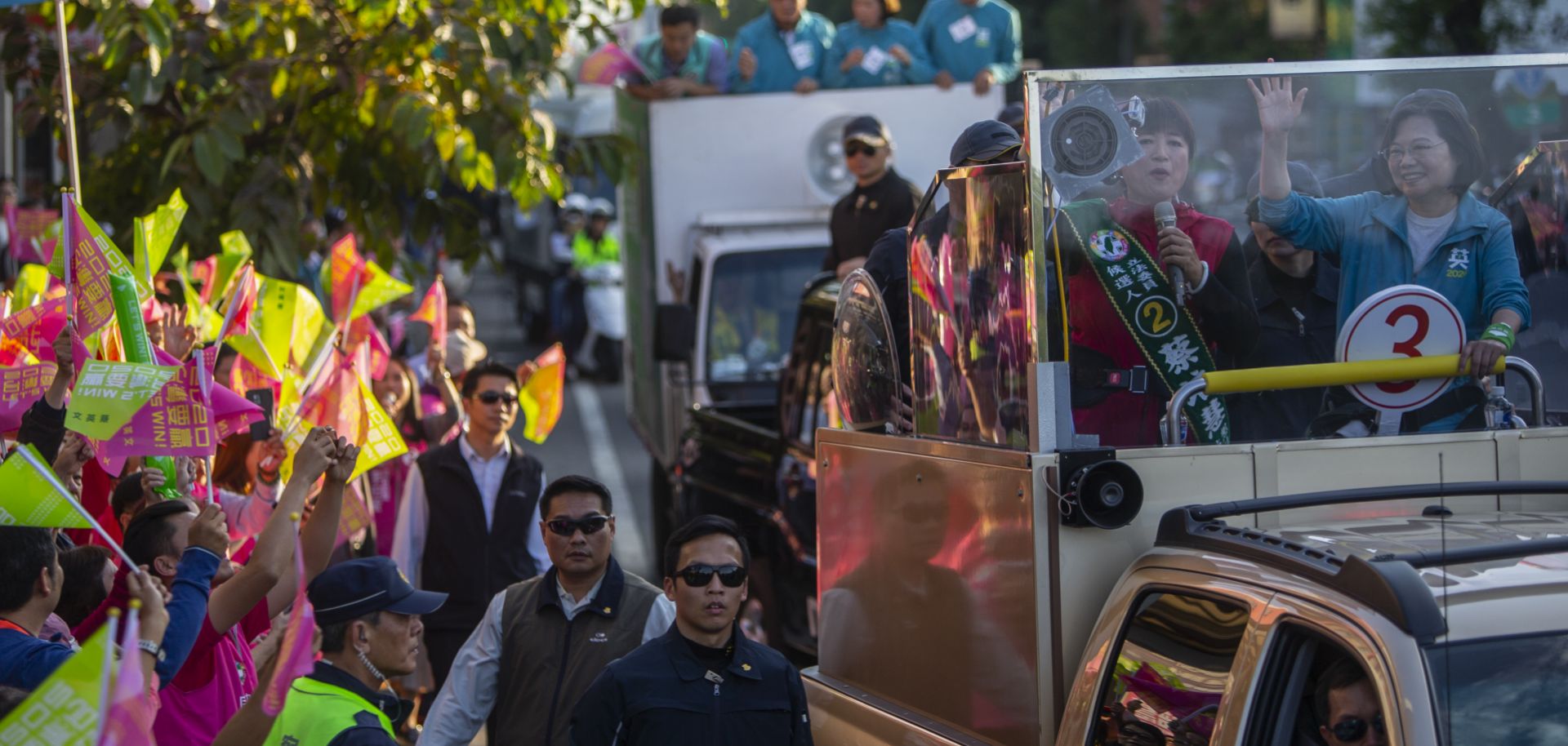
Taiwanese President Tsai Ing-wen of the ruling Democratic Progressive Party waves to supporters during a recent campaign rally ahead of the island's Jan. 11 elections.
Relations between China and Taiwan have nose-dived since the election of the island's independence-leaning president in 2016 and are now poised to plummet even further. President Tsai Ing-wen's strong defense of Taiwan's sovereignty in the face of the ongoing Hong Kong protests has helped pull her back from the brink of political death ahead of the island's Jan. 11 presidential elections. Not only is Tsai widely expected to beat the opposition Kuomintang (KMT) candidate, but the support garnered by the Hong Kong crisis has also greatly improved the prospects of her ruling Democratic Progressive Party (DPP) in concurrent legislative elections.
A victory by Tsai and the DPP would clear the way for Taiwan to continue inching toward independence with the help of the United States, even if doing so means inviting harder-line policies from China. Regardless of the election outcome, however, growing resistance against Beijing's desired "one country, two systems" arrangement — especially among Taiwan's younger generations — will confine the ability of any Taiwanese government to pursue a path toward cooperation with China for the foreseeable future.
Reigniting a Familiar Fight
The prospect of bringing the democratic island under Chinese control has long been a sensitive and highly polarizing political issue in Taiwan. Over the past decade, however, the sovereignty debate has largely taken a backseat to economic concerns, such as Taiwan's stagnated growth, frozen wages and rising youth unemployment. With all eyes on the sluggish economy and her unpopular social policies, Tsai and the DPP were hemorrhaging support at the beginning of 2019. Indeed, Tsai's electoral prospects seemed all but doomed just six months ago, following the DPP's huge losses in 2018 local elections. Even before her opposition challengers had announced their candidacies, she was trailing by 10-30 points in almost every public opinion poll, which almost led to her defeat in the DPP's primaries. But since then, Tsai's political fortunes — and those of the DPP's — have dramatically improved alongside rising public sensitivities over Taiwanese sovereignty precipitated by the Hong Kong crisis.
The pro-democracy protests in Hong Kong over the past half-year (and Beijing's steely response to the crisis) have brought long-simmering issues over Taiwan's sovereignty and security back to the fore. Voters' renewed concerns with China's influence and perceived interference in Tawainese politics has, in turn, greatly strengthened Tsai's campaign narrative, which portrays Beijing as an existential threat to Taiwan's democracy and autonomy.
The Hong Kong protests have also showcased the weaknesses of the opposition KMT, as well as other China-friendlier parties whose credentials rest on maintaining cross-strait relations and the associated economic gains. Several months ago, the KMT seemed all but assured of gaining a majority in Taiwan's 113-seat legislature. But growing nationalist sentiment has since dimmed the party's prospects, paving the way for the DPP to secure a majority come Jan. 11 (whether alone or via a coalition) — an outcome that undoubtedly would help Tsai advance her anti-China strategy and other policy initiatives in her likely four more years in power. In addition, the highly contested nature of this year's legislative elections increases the chances for minor parties to take a bigger role in Taiwan's traditionally two-party politics.
A Prolonged Pro-Independence Push
Specifically, an extended DPP government would almost certainly expand its existing strategies to shore up Taiwan's sovereignty, bolster its defense, curb Beijing's political influence and counter its territorial claims by promoting security ties with the United States and other powers where it can. Over the DPP's past four-year term, these strategies have already placed the roughly 110-mile strait that separates Taiwan from mainland China at the center of Beijing's great power competition with Washington. And the continuation of such efforts under a reelected DPP administration would enable Taipei to align even more closely with U.S. efforts to counter China's regional influence.
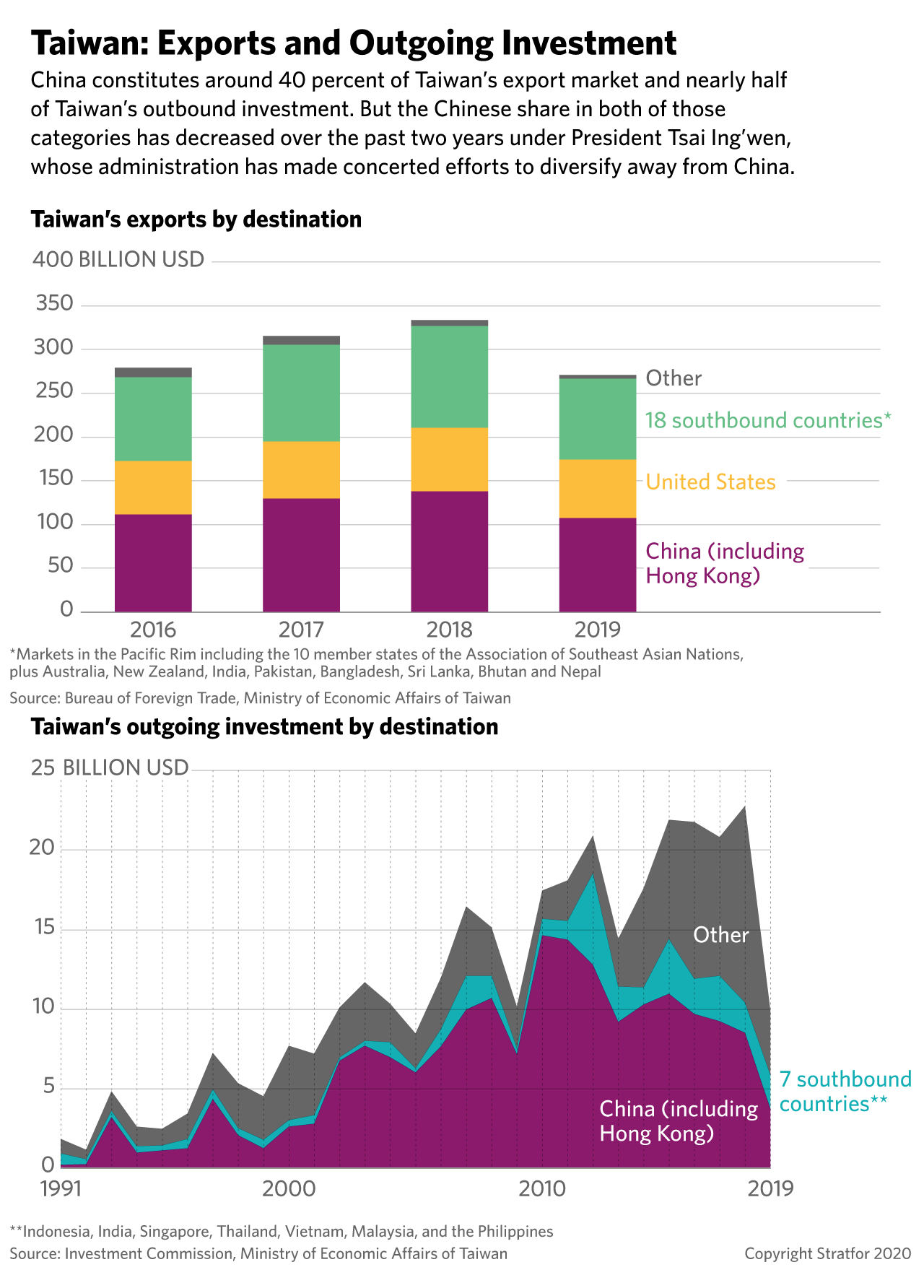
Tsai and the DPP's likely second term is also expected to accelerate the process of decoupling Taiwan's economic ties to the mainland. Taiwanese businesses in the mainland have long been a key source of China's foreign investment and a key pillar that Beijing has relied on to keep the island closer. But China's slowing economy, rising labor costs and an ongoing trade war with the United States have made it a far less attractive destination for an increasing number of the island's businesses. Further aiding the exodus of Taiwanese firms has been the DPP's renewed effort to lessen the island's broader reliance on the mainland economy by introducing incentives aimed at drawing investments back to the island and other emerging markets in Southeast Asia.
That said, the mainland still accounts for roughly 40 percent of total Taiwanese exports, as well as the majority of the island's outbound investments. Thus, the DPP's desired overhaul of Taipei's economic relationship with Beijing will be no easy feat, especially in sectors where the two have highly integrated supply chains, such as electronics and information technology. And indeed, the DPP's past attempts to reduce Taiwan's reliance on China have all largely been fruitless. This latest push, however, has so far shown real signs of impact. Between January and November 2019, Taiwanese investment in China declined by nearly half compared with the same period in 2018. And during the same period, investment into China's information technology manufacturing sector, in particular, dropped by more than 90 percent. In this, the United States has also helped ease this transition by increasingly filling Taiwan's exports where Beijing left off, leading Washington to become Taipei's second-largest trade partner in 2019 behind China.
Another Outcome?
There is, of course, a chance — albeit small — that the opposition KMT could win either the presidency or regain a legislative majority on Jan. 11. If so, a KMT government may seek to reboot economic links with the mainland. But it is unlikely to amend the decreased compatibility between both economies, as well as the growing costs of doing business in the mainland.
In contrast with the DPP, a KMT-led government can also be expected to prioritize more stable relations with mainland China by pledging to uphold its so-called One China policy. Such an approach would help stabilize cross-strait relations, as it would likely entail inviting Beijing to ease its pressure tactics and the poaching of Taipei's diplomatic allies. Caught in the tug-of-war of the U.S.-China rivalry, however, any possible KMT administration will still find it difficult to fend off Washington's push to more aggressively challenge Beijing's influence over the cross-strait balance — and likewise, a more forceful push from China for sovereignty.
But perhaps most importantly is the fact that rising public sensitivities over Taiwanese sovereignty will force any politician in Taipei who advocates for closer ties with China to walk a tight line, lest they are seen as submitting to Beijing's agenda and unification ambitions. Amid the ongoing unrest in Hong Kong, polls show that support for unification in Taiwan has reached an all-time low, and now falls anywhere between 5 and 10 percent. Similar to Hong Kong, the resistance in Taiwan will also be especially strong among the island's younger generations who weren't alive when Taiwan was under authoritarian rule, and thus grew up with little to no connection to the mainland. In a recent survey, nearly 60 percent of Taiwanese citizens between the ages of 20 and 34 said they supported the idea of a fully independent Taiwan. And the crackdown on the pro-democracy protesters in Hong Kong has only cemented the youth's skepticism of China's intentions in Taiwan. As this generation inevitably gains a greater voice in Taiwanese politics, Beijing will face greater resistance to its desire to link and ultimately unify the island by whatever means necessary.
Weighing Beijing's Options
But instead of bringing Taiwan to heel, Beijing's current strategy of suppressing, limiting or neutralizing perceived pro-independence forces has seemed to only solidify the prospects of prolonged anti-China policies under a reelected DPP government. Such a government would likely be split between Tsai's more moderate camps and the party's more radical pro-independence elements. Thus, should Tsai's party win by a large margin on Jan. 11, Beijing may be forced to consider moderating its current hard-line stance in order to insulate the more radical wings in Taipei. The need for foreign investment, as well as the desire to maintain Taiwan's economic reliance, may also compel Beijing to create new incentives to draw in more Taiwanese business to the mainland.
That said, Beijing is still most likely to maintain or even double down on its hard-line policies against Taipei. This, of course, will come at the risk of escalating tensions with the island and could even create a Hong Kong-like confrontation. Thus, regardless of who wins Taiwan's upcoming election, future cross-strait relations will be intertwined closely with the context of China's economic slowdown and intensifying competition with the United States, as well as the rise of Taiwan's nationalistic sentiment.
