
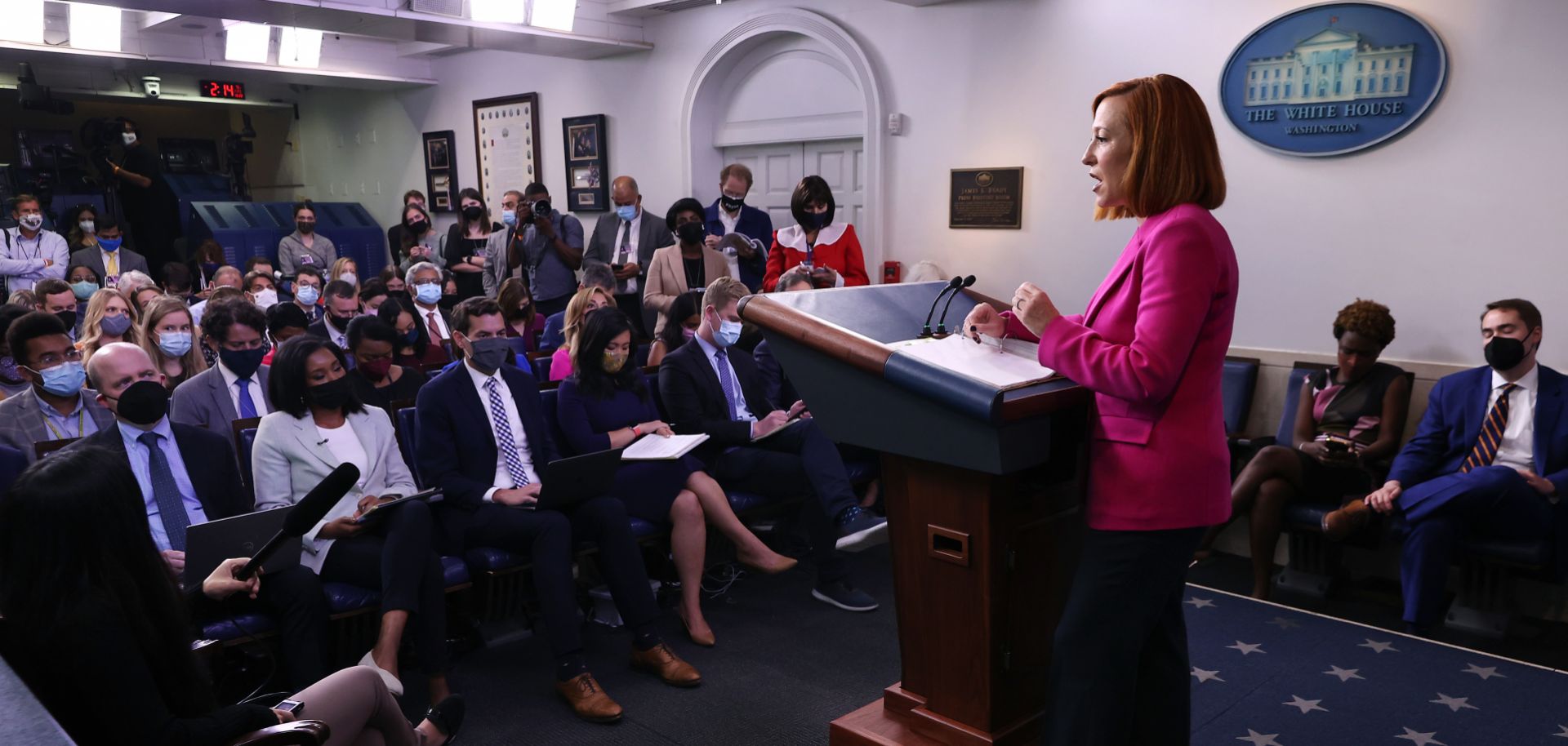
White House Press Secretary Jen Psaki fields questions from reporters about U.S. policy toward Taiwan on Oct. 22, 2021.
Recent confirmation of a U.S. troop presence in Taiwan marks an escalation in U.S.-China and cross-strait tensions, but doesn't significantly change Beijing's calculations regarding whether to take military action against Taiwan. Taiwanese President Tsai Ing-wen confirmed in an interview with CNN on Oct. 27 that U.S. troops were present in Taiwan for a training mission, though Taiwan's defense minister soon clarified that U.S. troops are not garrisoned in Taiwan. In response, China's defense minister said that if U.S. efforts to "contain China" via Taiwan continued, China would "resolutely counter and fight back." Despite these strong words, rumors of U.S. troops in Taiwan have circulated for a year, and given China's wealth of intelligence assets in Taiwan, it is highly likely Beijing already knew about this development. If the U.S. training mission truly crossed a red line, China probably already would have taken military action.
In the short term, China's red lines on Taiwan will remain unchanged; they largely pertain to Taiwan's internal affairs and the formalization of international relationships. Beijing's decision making is often opaque to Western observers, to say the least, but senior officials have been quite clear about the kinds of events that could push China to take military action against Taiwan.
- A formal declaration of independence by Taiwan is one such trigger, though legal hurdles in Taiwan make pulling one off very difficult.
- The end of political negotiations regarding reunification with China by each of Taiwan's main political parties is another, a tall order given the opposition Kuomintang's friendly stance toward the mainland and its unwillingness to provoke economic retaliation from Beijing.
- Formal defense agreements with Taiwan — signed by Japan, the United States or other Western allies — could trigger military action. Despite recent news, the United States does not have such an agreement with Taiwan.
- The widespread acceptance of Taiwan as a country and/or equal partner in multiple international organizations, like the United Nations, could also push China toward a military contingency.
In the long term, China's decision to invade Taiwan will be highly influenced by internal politics, rather than military developments and public statements like Tsai's recent confirmation. For Beijing, reunification with Taiwan has always been primarily a political issue — though the strategic benefits of Taiwan for China's maritime strength are not lost on Beijing — driven by the internal motivations of the opaque and hierarchical Communist Party of China. Territorial consolidation has been a hallmark of Chinese political legitimacy for millennia, and the CPC is no exception, explaining why every Party leader has confirmed the need to reunify with Taiwan, eventually. But they have all been wary of the massive economic and diplomatic fallout that would accompany an invasion. A major erosion of CPC legitimacy could drive China to attack Taiwan. The most commonly suggested trigger for such erosion is a severe economic calamity, but internal Party documents suggest Beijing is confident in China's economic trajectory — despite 2021 supply chain issues. Similarly, President Xi Jinping could make a move on Taiwan if his own political legitimacy started to slip, but though there are real signs of internal dissent over some of Xi's recent policies, like the tech crackdown, Xi's hold on power — including military, bureaucratic and ideological power — is stronger than ever. Lastly, Xi believes himself to be a historic figure in China's history, on par with Mao Zedong, and has repeatedly asserted his personal desire to resolve the Taiwan issue in order to achieve China's so-called "great rejuvenation" as an economic superpower free from repression by foreign powers. Thus, the chances of a Taiwan invasion will grow toward the end of Xi's third term in 2027 and even more so by the end of his (likely) fourth term in 2032.
