
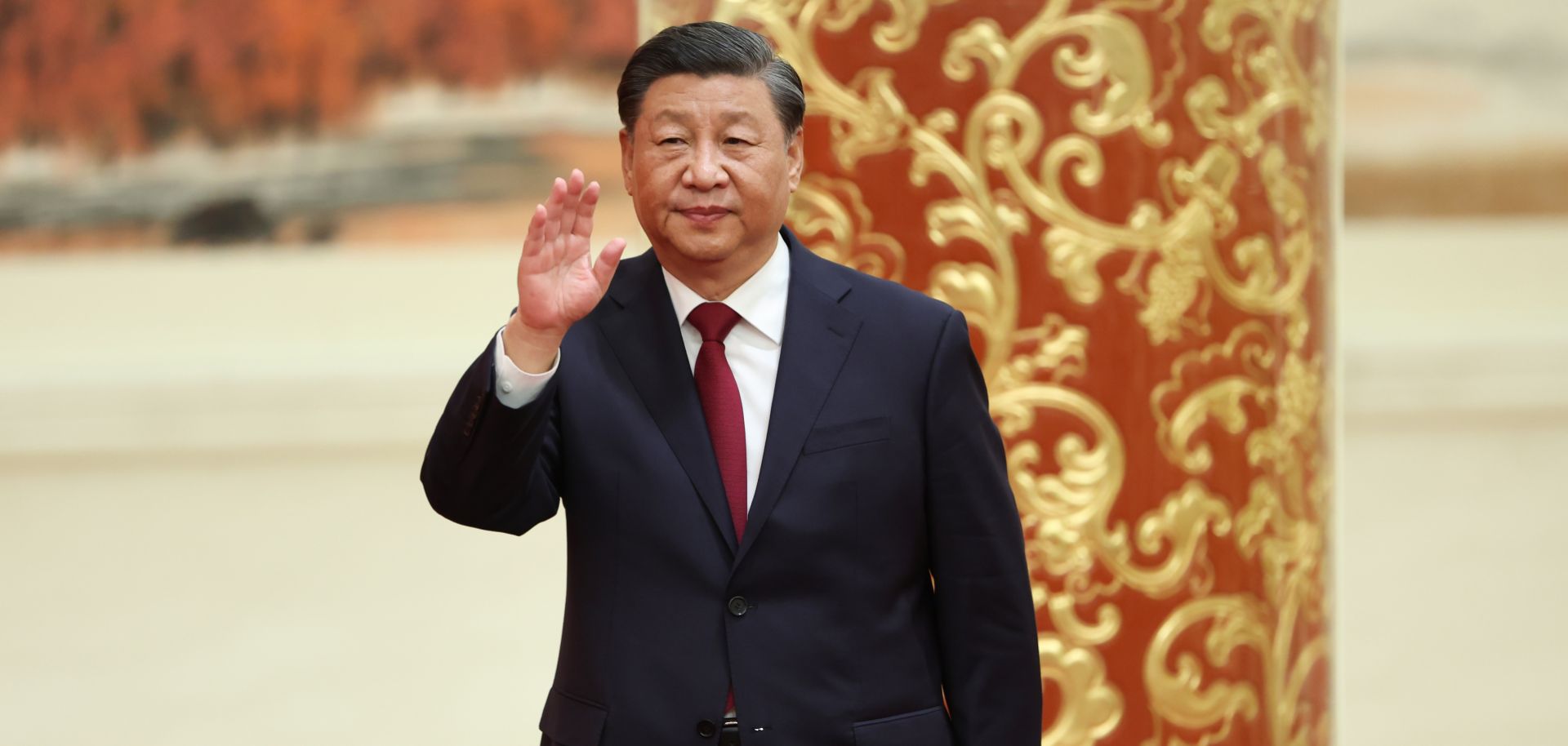
Chinese President Xi Jinping attends a meeting between members of China's Politburo Standing Committee and journalists at the Great Hall of the People on Oct. 23, 2022, in Beijing, China.
Chinese leader Xi Jinping secured a new term and a thoroughly loyal cabinet, which will enable him to carry out his nationalist and confrontational policy agenda over the next five-to-ten years. The Chinese Communist Party (CCP) appointed its new leadership at the 1st Plenum of its 20th Central Committee on Oct. 23, which comes after the CCP amended the Party constitution to consolidate Xi's position during the closing of China's 20th Party Congress on Oct. 22. Xi will remain the leader of the CCP for the next five years after gaining another term as General Secretary. The entire seven-person Politburo Standing Committee (PBSC), effectively Xi's cabinet, is now composed of loyalists who either owe their careers to Xi's patronage or whose views align with his policy agenda. Moreover, Xi still has no designated successor, as the youngest member of the new PBSC (from which the next CCP leader will likely be chosen) is Ding Xuexiang, who will be 65 years old at the next Party Congress in 2027 — an uncharacteristically old age for a new General Secretary. At 69 years old, Xi is also advanced in age. But he is increasingly the exception to Party leadership rules, as shown by his ability to secure an unprecedented third term at the CCP's helm. Thus, with no obvious prospects for a successor in the PBSC — whose members, unlike Xi, are not yet above the Party's unwritten leadership rules — Xi appears more likely to take a fourth term in 2027. From the events of Oct. 22-23, the Party changes that will most affect China's governance, both in formal institutions as well as in a widely televised breach of leadership etiquette:
- Politburo Standing Committee: The new PBSC's seven members comprise two leaders associated with Xi's anti-corruption campaign; two heads of the National Security Commission; Xi's ideological czar; and an old associate of Xi's who dutifully carried out the sweeping Shanghai lockdowns in April-May as part of Beijing's ''zero-COVID'' strategy.
- Politburo: Aside from the Politburo's seven pro forma seats guaranteed to PBSC members, 13 of the new Politburo's 17 other seats were newly appointed, and most of them have close ties to or ideological alignment with Xi. The body also includes at least six technocrats who will help advance Xi's technological innovation plans for China.
- Premier: Wang Yang and Hu Chunhua, the most qualified candidates for Premier (who serves as the chief government administrator and oversees economic policies) were ousted from the Politburo, and the Shanghai Party Secretary Li Qiang, who has no experience with central government duties, appears to be Premier-designate.
- Party constitution: The amendments to the Party constitution include pledges to uphold the ''Two Establishments'' and ''Two Safeguards,'' Party jargon that declares Xi as the core leader of the Chinese Communist Party and deems ''Xi Jinping Thought'' as the foundation of governing China in this ''new era.''
- Disrespecting elders: Former Chinese President Hu Jintao was forcibly removed from the televised Oct. 22 conclusion of the Party Congress, despite his physical protestations, leaving his seat next to Xi's empty for the rest of the meeting. The exact reason for his ejection is unclear, but these congresses are extremely choreographed quinquennial events, so it may have been a message to cadres nationwide that those whose loyalties don't lie with Xi are not welcome in the CCP.
In the next five years, Xi's preferred policies will grow in prominence. After the Oct. 22-23 constitutional and institutional changes, Beijing will forge ahead with Xi's hard-nosed approach to deleveraging the economy (including the real estate sector), even if it brings short-term pain, in order to make China's growth more sustainable. Politically, Xi will use his anti-corruption campaign to deter policy dissent and expand regulations in key sectors like tech to align market activities with state innovation and economic development goals. More controversial policies — like the Chinese government's strict ''zero-COVID'' approach to pandemic management and its ongoing crackdown on political dissent in Hong Kong — will also help Beijing maintain societal control by bolstering its narratives about effective governance.
- The ''Common Prosperity'' policy — feared in the West to be veiled wealth redistribution — was enshrined in the Party constitution, giving Beijing the long-term remit to crack down on ''excessive incomes'' and close China's income inequality via market regulations, not just government transfers.
- The anti-corruption campaign, which has tamped down on bribery and purged Xi's political rivals, was also placed in the constitution and will remain Xi's primary cudgel for aligning China's ministries and localities with central policy.
- The ''zero-COVID'' strategy will continue as long as Beijing deems it necessary for preventing deaths from the virus and preserving the Party's reputation for effective governance.
- Beijing's regulatory scrutiny in tech, entertainment and beyond will grow as Xi attempts to mold the economy to best achieve his views for China's ''national rejuvenation'' to global leadership.
- Xi's penchant to crush resistance to Beijing's rule (e.g. in Hong Kong and Xinjiang) will also persist, with sharp-tongued diplomats combatting naysayers. China will increasingly pester Taiwan as well, with military drills to deter the territory's independence.
China's strategic competition with the United States and Europe will accelerate, and Beijing will be vulnerable to policy blunders that ward off Western businesses and threaten to arrest China's development. The preponderance of technocrats in the Politburo, along with the national security bent of the PBSC, suggests that Xi will escalate China's geopolitical rivalry with the United States — and the West at large — through greater and more industrial policies aimed at spurring innovation, as well as legal (and extralegal) retaliation against Western sanctions. This will erode cross-border supply chains and further place Western businesses at a disadvantage to Chinese competitors.
- In domestic politics, Xi's overt power play against Hu will silence dissent, reinforcing the policy echo chamber around Xi. PBSC members will be reluctant to contradict Xi's policy machinations and lower-level cadres motivated to feed Beijing rosy but inaccurate data (e.g. on economic growth or military modernization efforts). Though Xi will be able to wield all levers of the state to achieve his policy goals, this echo chamber effect will make it harder for the Chinese government to detect economic failures.
- The deficit of economic administrative talent in the Politburo and China's likely novice Premier, Li Qiang, will make it tougher for Beijing to navigate the perilous waters of China's current economic downturn. The CCP's pro-Xi leadership will thus likely respond with more state intervention to remediate symptoms, but the economic fundamentals (especially the consumption depressing effects of Beijing's ''zero-COVID'' policy) will weigh on growth.
- Xi's China may slowly become less tenable as a market for foreign businesses (despite its 1.4 billion customers) as the unpredictability and costs of regulatory and compliance risks rises under a more interventionist Beijing that is increasingly distrustful of the West.
