
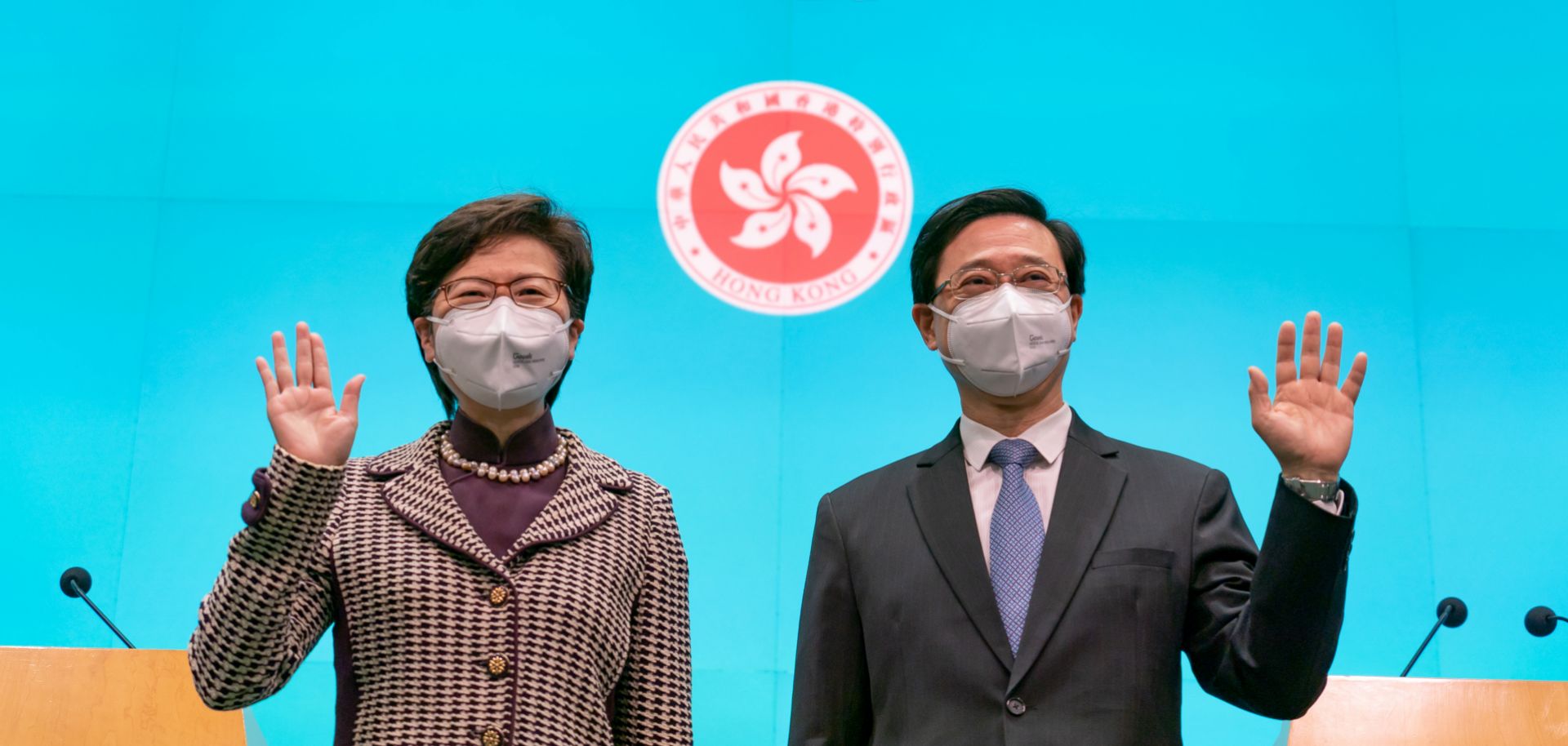
Hong Kong Chief Executive-elect John Lee (right) and current Chief Executive Carrie Lam attend a press conference at the Central Government Complex on May 9, 2022, in Hong Kong, China.
The election of John Lee will strengthen Hong Kong's security apparatus and policy ties to Beijing, weaken personal freedoms and erode the business environment for foreign companies over the next five years. These consequences will boost U.S.-China tensions, but the chances of renewed mass protests in Hong Kong remain low. On May 8, Hong Kong's pro-Beijing Election Committee selected former Secretary for Security John Lee to be the next chief executive of Hong Kong, with Lee garnering 1,412 votes in support, eight against, and four abstaining. Lee's five-year term will begin on July 1, the 25th anniversary of Hong Kong's handover from Britain to China. Local pro-Beijing parties hailed Lee's victory as a win for Hong Kong's stability, while local pro-democracy groups called it a sham election in the style of mainland China. Meanwhile, foreign groups like the European Union and the Group of Seven (G-7) condemned the elections as democratic backsliding from the promises of Hong Kong's Basic Law. Beijing's premier state news outlet, the People's Daily, heralded Lee's victory as advancing the model of ''patriots governing Hong Kong'' and the finale of Beijing's tripartite electoral reforms for Hong Kong. The other two comprised the Election Committee and Legislative Council, which were also filled with pro-Beijing members in elections in September and December 2021, respectively.
Lee's statements over the last month and his career trajectory suggest he will prioritize national security above all else in Hong Kong, continuing the erosion of the region's autonomy. In the press conference following his election, Lee stated that ''safeguarding our country's sovereignty, national security and development interests, and protecting Hong Kong from internal and external threats, and ensuring its stability will continue to be of paramount importance.'' Lee is also the first Hong Kong leader who does not come from a political or economic background.
- Lee led a lifelong career in law enforcement before serving as Hong Kong's Secretary of Security in 2017-2021, during which time he led the government's heavy-handed response to Hong Kong's pro-democracy protests of 2019-2020. He was a strong proponent of the 2019 extradition bill that triggered those protests as well.
- Lee also helped develop and implement Hong Kong's National Security Law (NSL), which was enacted in June 2020. The controversial law criminalizes threats to government authority, including alleged acts of secession, subversion, terrorism or collusion with foreign forces.
- In August 2020, one month after the NSL was passed, Lee was one of 11 Hong Kong officials that the United States sanctioned for restricting freedoms of expression and assembly in the region and for undermining Hong Kong's autonomy. These sanctions led YouTube and Facebook to block Lee's campaign pages in April 2022.
As chief executive, Lee will focus on improving national security, public stability and economic ties with China at the expense of the freedoms of the press, assembly and free speech in Hong Kong. In his election manifesto published on April 29, Lee pledged to enact legislation fulfilling Article 23 of the Basic Law, which could involve adding the crimes of treason, sedition, theft of state secrets, and collaborating with foreign political groups in conducting activities in Hong Kong to the NSL. Lee also pledged to boost loyalty among the youth and civil servants and ''prepare contingency plans with bottom-line thinking to prevent and mitigate risks,'' meaning he will defend the pro-Beijing government in Hong Kong from political challenges. In addition, Lee promised to strengthen industrial cooperation with China through the Greater Bay Area (which encompasses Hong Kong, Macao, and China's Guangdong province) by fostering data flows between the three regions, as well as judicial and legal exchanges. Lee also made multiple references to aligning Hong Kong with Chinese policy goals, including fulfilling the 14th National Five-Year Plan for economic development, promoting yuan-denominated products; the local application of China's digital currency; smart-city development (which enables government surveillance); and encouraging civil society to share ''Hong Kong's good stories'' with the world (which suggests a strengthening of the region's propaganda apparatus). Given Lee's background and support from Beijing, these pledges forebode ongoing repression of Hong Kong's freedoms of press, assembly, and speech, prioritization of Chinese economic ties over foreign ones, and strengthening Beijing's direct influence on policy in Hong Kong.
Given Lee's paramount focus on national security and backing from Beijing to deepen the democratic erosion of the last few years, Hong Kong's primary policy challenge over his five-year term will be maintaining its status as an international hub for business and finance. Under Lee, Hong Kong's relations with the West will deteriorate and its relations with China will further improve, while the region's business environment will continue to erode alongside constitutional freedoms. This will reduce Hong Kong's attractiveness for foreign businesses and investment and increase the chances of a revival of civil unrest founded on economic dissatisfaction. A repeat of the mass protests seen in 2019, however, remains unlikely.
- U.S. relations with Hong Kong have suffered greatly since 2019, with multiple rounds of U.S. sanctions and Beijing's rhetorical diatribes against foreign interference eroding Hong Kong's former status as a safe haven for businesses from U.S.-China tensions. Lee's focus on national security and economic ties with Beijing will only accelerate this sullying of U.S. relations. The same dynamic is playing out for European relations with Hong Kong.
- Hong Kong is suffering from a massive outflow of people and businesses, which will likely continue if Lee keeps his promises to further strengthen Hong Kong's national security laws. The territory's population dropped by 1.2% (or around 89,000 people) in both 2020 and 2021, leaving it at 7.39 million at the beginning of 2022. In February 2022 alone, another 100,000 people left amid worries about COVID-19 lockdowns. And between 2019 and 2021, 84 regional business headquarters left Hong Kong, amounting to a loss of 9% of the territory's total regional headquarters. Meanwhile, Hong Kong's GDP contracted 4% in the first quarter of 2022 due to government COVID-19 measures, which will remain in some form through at least late 2022, when Chinese President Xi Jinping begins his third term.
- Hong Kong's strengthening connections to mainland China could serve as a source of growth, but Hong Kong's competitive advantage has always been its status as a go-between for foreign and Chinese economies. If foreign business connections are weakening, this will be of little solace for Hong Kong's economy, unless Beijing replaces this foreign dependence with a much deeper integration of Hong Kong's economy with the surrounding Greater Bay Area. This, however, would involve heavy policy interference from Beijing and greater prioritization of local Chinese companies over foreign ones.
- Any economic headwinds and bolstering of the national security state could prompt Hong Kongers to once again hit the streets in protest, which could paralyze transportation in the city and drive Lee to implement even stronger surveillance and national security measures. Nonetheless, the Hong Kong police's heavy-handed arrests and the courts' handing down of harsh national security sentences over the last two years have proven quite effective at silencing dissent. As evidence, the pro-democracy group League of Social Democrats protested Lee's election as a sham on May 8, but the demonstration only gathered three attendees.
