
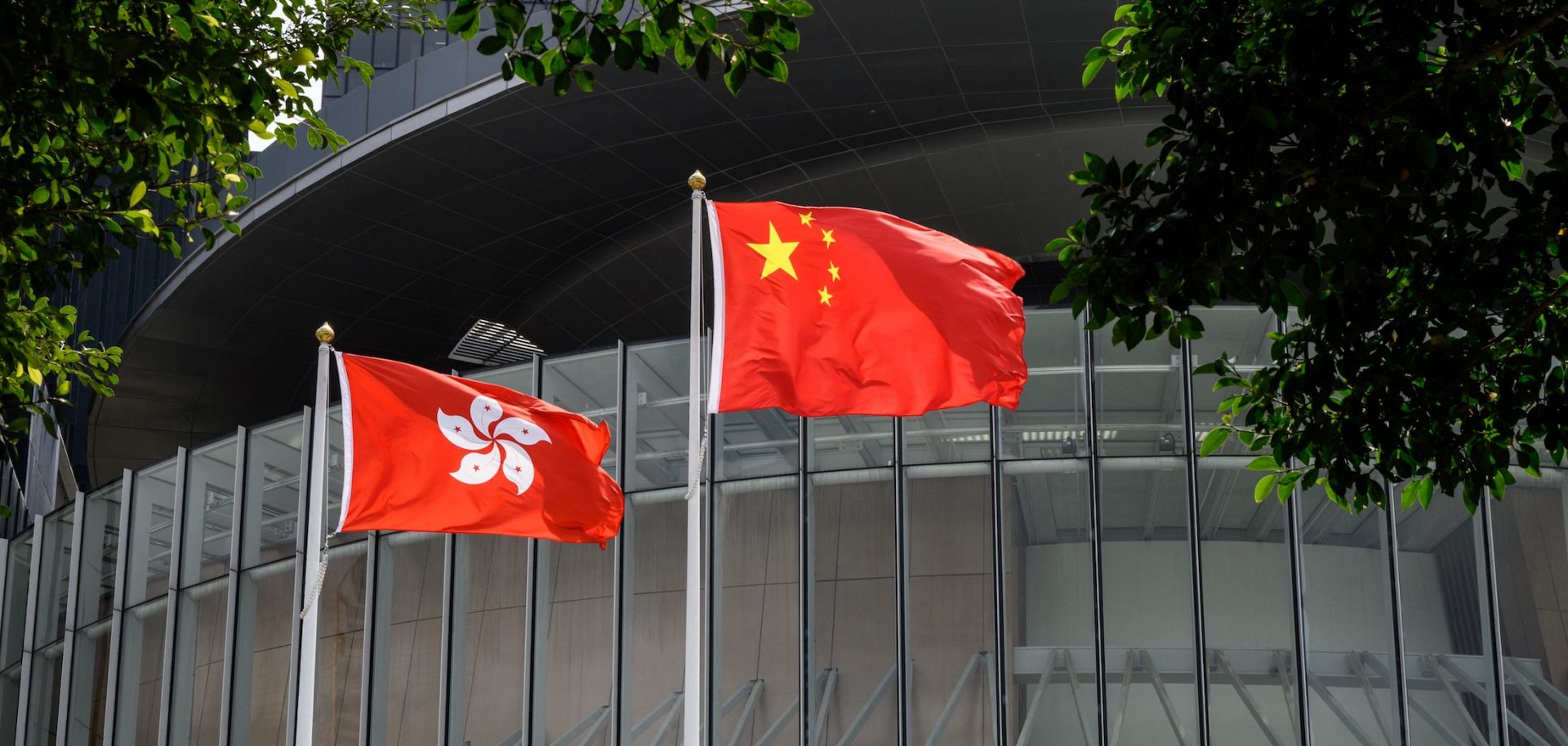
Flags of China (C) and Hong Kong (L) on March 30, 2021, outside the Legislative Council complex in Hong Kong.
The mainland's imposition of Hong Kong electoral reforms will ensure Beijing faces no meaningful opposition to its power in Hong Kong, further fracturing the opposition movement. On March 30, China's National People's Congress Standing Committee issued final approval of sweeping Hong Kong electoral reforms, which Chinese President Xi Jinping promulgated, allowing them to take effect March 31. In doing so, lawmakers laid out the complete details of measures meant to limit opposition disruption, including extensive screening of candidates to guarantee no anti-establishment figures enter office:
- Candidates must undergo four rounds of successive vetting before being allowed to run for office. First, they must collect sufficient nominations from all five sectors of the increasingly pro-Beijing Chief Executive Election Committee. Then, they will face scrutiny by the Hong Kong police force's national security unit, the Hong Kong national security committee and finally a newly established vetting committee. None of these decisions will face judicial review.
- The Legislative Council will see members elected by the broader public dwindle to only 20 of a newly expanded 90 lawmakers, with 40 directly appointed by the Chief Executive Election Committee and 30 chosen by professional groups. These professional groups, known as functional constituencies, will be reformed to add in more pro-Beijing constituents; the information technology sector will be removed and replaced by representatives of the Hong Kong Chinese Enterprises Association.
- The Chief Executive Election Committee will be more tightly controlled and pro-Beijing. It will be overseen by a new "chief convener," who must already hold state leadership, with Chief Executive Carrie Lam saying they would be one of the vice chairmen of the Chinese People's Political Consultative Conference (CPPCC).
- All 117 District Council representatives have been removed from the Election Committee, while 300 new members would be added on top of replacing these: Patriotic groups, CPPCC members, and municipal bodies dominated by pro-Beijing officials (area, district fight crime and district fire safety committees) and representatives of mainland-based Hong Kongers.
The scheduling of legislative elections using these new rules will leave the pro-democracy opposition marginalized and divided between those willing to collaborate with Beijing and those intent on further confrontation. On March 30, Hong Kong Legislative Council President Andrew Leung announced that long-delayed Legislative Council elections will go ahead in December, not September as originally planned.
- The waning of Hong Kong's COVID-19 outbreak and the rollout of vaccines will raise the prospect, once again, of protest backlash in the city. The national security crackdown, however, will deter widespread turnout given fears of arrest and the arrest of many key protest movement figures.
- Any protests that do emerge are likely to be dominated by students and youth, who are more willing to defy authorities and may bring chaotic clashes with police that will easily justify a national security crackdown.
