
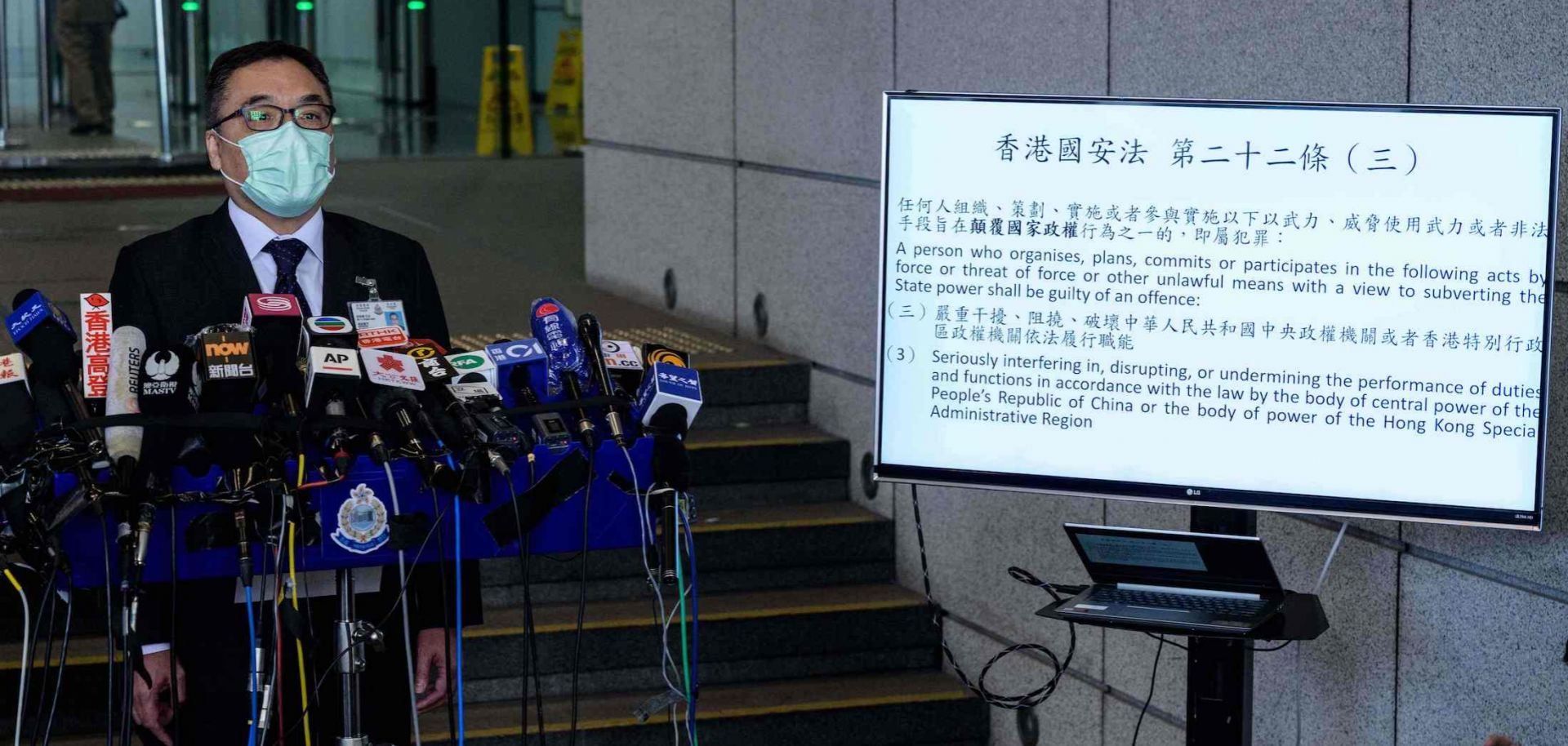
Hong Kong Police Force Senior Superintendent Steve Li Kwai-Wah holds a press briefing following the arrest of dozens of opposition figures under the city’s national security law on Jan. 6, 2021.
A mass arrest of moderate pro-democracy figures in Hong Kong signals an escalation in the application of the city’s national security law to a broader segment of the political opposition, which will increasingly limit the policymaking power of any pro-democracy forces. The first-time detention of a U.S. citizen, meanwhile, will also test whether U.S. President-elect Joe Biden's incoming administration will be able to navigate Hong Kong tensions without jeopardizing its broader relations with Beijing. On Jan. 6, Hong Kong police carried out a citywide operation in which nearly 1,000 officers netted 53 pro-democracy activists and former lawmakers linked to the July 2020 opposition primary for legislative council elections, leveling accusations of subversion under the city’s draconian national security law.
- Hong Kong Secretary for Security John Lee said that the arrested activists had planned "mass destruction,” “overthrow” and paralysis of the Hong Kong government during the unofficial primary. Lee was referring to the "35-plus" strategy advocated by many opposition members, which entailed using the primary to consolidate votes to win a majority that could then be used to paralyze the government by blocking the 2021 budget in hopes of triggering more mass protests, international sanctions and the resignation of Chief Executive Carrie Lam.
- Those arrested included former lawmakers Alvin Yeung, James To, Andrew Wan, Claudia Mo and Lam Cheuk-ting in addition to professor Benny Tai, who initially outlined the 35-plus plan. Notably, police also arrested the first U.S. citizen under Hong Kong’s national security law, lawyer John Clancey. Clancey is a long-time human rights activist and Hong Kong resident who served as treasurer for the political group Power for Democracy, which was involved in the primary. Subversion under Article 22-23 of the national security law carries up to a life sentence in prison, with varying offenses penalized with three-to-ten year prison sentences.
- Police also delivered information requests to at least three media outlets for data linked to the primary: Apple Daily, InMedia and StandNews. Following raids on the Hong Kong Public Opinion Research Institute (PORI), which conducted the primary, PORI said it had destroyed all voter information.
- In July, mainland authorities condemned the primary as a challenge to the constitution and the national security law, with pro-Beijing Hong Kong lawmakers calling for an investigation. Hong Kong then derailed any opposition plans by postponing the related legislative council elections, citing COVID-19 risks. After the extended legislature convened, however, authorities moved to expel four sitting pro-democracy lawmakers in early November, prompting the mass resignation of the entire pro-democracy camp, including moderate members.
Hong Kong and mainland authorities appear to be cleaning house, exercising policies that further entrench pro-Beijing power in the city in the hopes of scaring off support for the opposition, while also curbing its capacity and viability as a political alternative. On the tactical level, this includes suppressing protests via the chilling effect of the national security law and mass arrests of dissidents. The long delay in making these arrests suggests that authorities feel as if they can make these moves without spurring major domestic backlash in the form of protests, which have so far been muted. But such measures risk inflaming more radical elements in the Hong Kong protest movement to carry out more violent actions against the government. On a broader level, however, authorities may also pursue reforms to the Hong Kong legislative council that would fundamentally transform the body to curtail the power of elected lawmakers. Motivated by frustration with Hong Kong’s independent judiciary, this may also include judicial reform to limit their ability to check policymakers and to better screen appointees.
